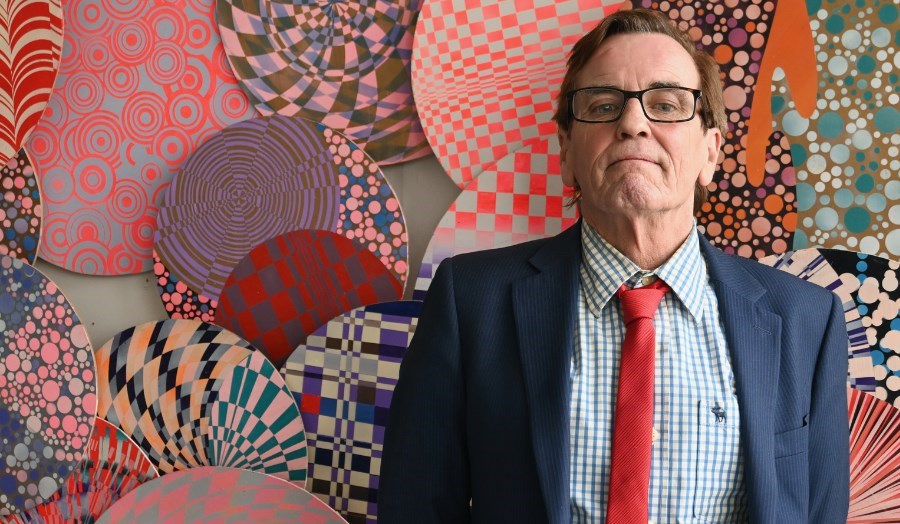
Tom Burns, 1959-2024: A Pioneer in Learning Development
Tom Burns, whose combination of play — and plays – with teaching in higher education added a light, collaborative and engaging model for learning and learning development, died on October 23 after a short illness.
Burns’ biography on his institutional webpage at London Metropolitan University (LMU) noted he had “always been interested in theatre and the arts and their role in building identity and community – and the power they can have in teaching and learning. When at school and first working in the building trade, he formed and led the Hainault Action Group setting up adventure playgrounds and devising community events and festivals for his local east London community.” Three decades ago he built his own career on teaching how to teach better at the university level.
A university teaching fellow and associate teaching professor at LMU’s Centre for Teaching Enhancement, he was known widely for efforts alongside his professional and personal partner Sandra Sinfield to improve teaching and learning in higher education. This ranged from online efforts such as two “living dialog” blogs – the Study Hub focusing on students and the Take5 focusing on instructors; co-founding the Association for Learning Development in Higher Education; and writing – again with Sinfield – popular textbooks such as Teaching, Learning and Study Skills: a guide for tutors; Essential Study Skills: the complete guide to success at university ; and most recently the open-access collaboration with Sandra Abegglen and Sinfield, Supporting Student Writing – And Other Modes of Learning and Assessment – A Staff Guide.
“Tom delighted in all aspects of teaching and learning and leaves an enduring legacy,” reads one line in an appreciation from the Association for Learning Development in Higher Education. “Tom was a very likeable person with a wonderful sense of humour and had a spirit of adventure. He was an inspirational figure and pioneer in the evolution of Learning Development. He had a tremendous ability to draw on personal experience to tell stories that engaged and inspired his colleagues, peers and students in all walks of life.”
The academic collaborative writings he made on the subject tell that same tale in a more formal – yet freeing – manner. As he, Sinfield and Abegglen wrote:
“Arguably, for our students, the transactional nature of pre-university education, the constant measurement, the League Tables, the SATs and the stats, obscures the fact that education is not autochthonous (sprung ready made from the earth itself) but is a set of social practices constructed by a community of which they are now members. Hence, we seek to destabilize the notion of education itself: to disrupt the ‘taken for granted’ perception that it is memorisation, and that study involves rote learning fixed forms of knowledge that already exist. Rather, we emphasise that education can involve the search for emergent knowledge and as yet unknown answers. Moreover, if education does involve transformation of the self, we need play for ‘It is in playing and only in playing that the individual child or adult is able to be creative and to use the whole personality, and it is only in being creative that the individual discovers the self (Winnicott 1971)’.”
Before entering higher education as a career, Burns built and ran those community adventure playgrounds and developed community theatre and festival projects in East London. As he told the Child in the City website in 2019, he came from a background that while poor, was “active and creative”:
His account continued with the genesis of his first ‘adventure playground,’ and which while grounded in that time and place set a template of sorts for his teaching career:
Once he started studying for a bachelor’s in English and European poetry, prose & drama at the University of Essex, he launched the first ever International Dario Fo Festival, which included symposia and workshops on the Italian actor and playwright as well as performances for students and community members. He would next earn a master’s in Learning and Teaching in Higher Education at LMU before joining its staff. He noted in a 2023 podcast for TalkingHE (see link below) that he was surprised to see how his focus on learning development had morphed into staff development.
Once in higher ed, Burns did not abandon the performing arts, although the distinction been plays and pedagogy probably mattered little to him. He and Sinfield took a production of John Godber’s 1977 play “Bouncers” on a tour of Crete and produced a feature film, “Eight Days from Yesterday.” All the while he was busy beavering on creating “multi-modal, participative, egalitarian and immersive” educational resources, “demonstrate[ing],” as he would write, “the importance of producing knowledge and cultural artefacts from within cultures, starting the education journey where people are, whilst enabling them to go where they want to go.” A video, “Take Control,” he and Sinfield made won the IVCA gold award for education in 1998.
Burns started his HE career at LMU in 1994, even then designing sociology and media modules to University of North London-affiliated Access students. As he explained later, “My practice is rooted in social justice and has always been emancipatory, designed to introduce diverse students to the genres, tropes and practices of HE whilst developing their own abilities, self-confidence and academic voice.”































































































Thank you for posting such a beautiful tribute to my friend, colleague, partner, co-author and husband, Tom Burns! You have absolutely captured his joyous and playful spirit. He achieved such a lot without losing his humanity and his love for people – and this is present in your tribute.