 News
News The Voice of Results Night: Anthony King, 1934-2017
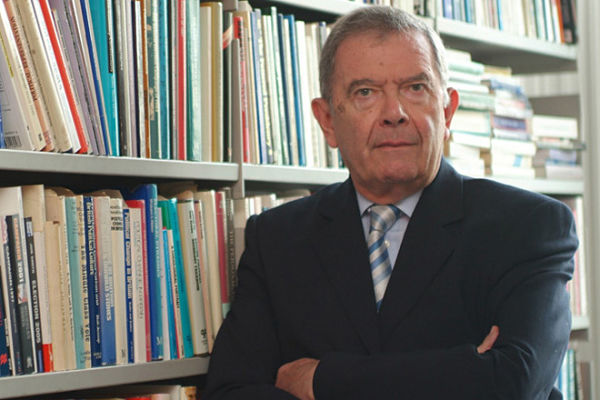
Anthony King started at the University of Essex in 1966, two years after the school’s initial year. (Photo: University of Essex)
King died on January 12. He was 82.
He was, said Anthony Forster, vice-chancellor at the University of Essex, “an inspirational teacher, a great political thinker and a brilliant writer, Professor King analyzed politics in books and on television with incredible intelligence, insight and wit.”
Anthony Stephen King was born in Canada in 1934 and earned a bachelor’s in history and economics at Queen’s College in Kingston, Ontario. He won a Rhodes scholarship and came to the United Kingdom to pursue studies at Oxford, which granted him a Ph.D. in politics. It also provided him his first teaching position, at Magdalen College, where he spent five years before what he termed “a case of push-and-pull” brought him to Essex.
“The push was I’d got bored with the self-importance of Oxford,” he told the Daily Gazette in Colchester. “It had become complacent and self-satisfied. I felt it didn’t have that much to shout about. The pull factor was the founder of Essex’s government department, Jean Blondel, who had a vision of what a good politics department should look like.” (That would include recruiting a young Ivor Crewe, who would serve as a future vice chancellor at Essex and a friend with whom King would co-write some of his most memorable books, including 1995’s SDP: The Birth, Life and Death of the Social Democratic Party and the best-selling The Blunders of our Governments in 2013.)
King taught at Essex University almost from its founding – he started in the Department of Government there in 1966 and essentially never left. “Tony was the intellectual heart of the Department of Government at Essex,” David Sanders, Regius Professor of Political Science, was quoted in the East Anglian Daily Times. “He was the clearest and most compelling lecturer I have ever observed and the very best writer working in contemporary political science.
“His personal kindness was immense,” Sanders added, while others recalled his sense of humor and wit. “Tony King combined the manner of a mid-Atlantic teddy bear with an encyclopaedic grasp of his subject,” eulogized The Daily Telegraph, which employed him as an analyst.
That willingness to descend from the ivory tower to engage with the public marked him as voice of authority to the general public. He was a fixture on the BBC the night of every general election from 1983 to 2005, offering his insights. “Tony King was passionate about the way government worked, he was extraordinary,” the BBC’s David Dimbleby told the BBC website. “He also played a public role. He was on the [Nolan] committee for standards in public life, on [the Wakeham] committee on reform of the House of Lords, so he was sort of embedded, in the way we do our politics.”
Still, his many writings and incisive scholarship remain uppermost in the minds of his peers. For example, Philip Cowley at Queen Mary University of London told Times Higher Education that while King received “a lot of coverage because of his media work – and rightly – he could also cut it with the more pukka academic stuff, and across a wide range.”
Among King’s many books were Britain Says Yes: The 1975 Referendum on the Common Market and Running Scared: Why America’s Politicians Campaign Too Much and Govern Too Little, and served as editor of The New American Political System. He saw several books published for SAGE, the parent of Social Science Space, including Britain at the Polls 2005 with John Bartle.
He was elected a fellow of the British Academy in 2010 and was a member of the Academia European, a foreign honorary member of the American Academy of Arts and Sciences and an honorary life fellow of the Royal Society of Arts.
King is survived by his wife Jan Reece.