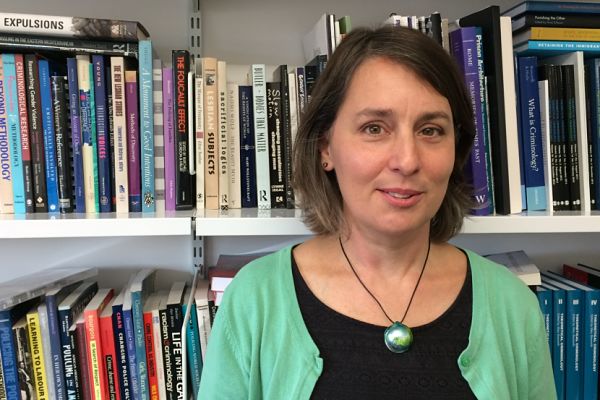
Mary Bosworth on Border Criminology
LISTEN TO MARY BOSWORTH NOW!
“Borders,” says Mary Bosworth, “are the key issue of our time.” And so, says the criminologist, “in response to the mass migration that’s happening, the criminal justice system is shifting. This shouldn’t surprise us – all other aspects of our society are changing.”
One of those changes is the creation of a new subfield of criminology, one explicitly evolved to understand immigration control and criminal justice. In this Social Science Bites podcast interview with Dave Edmonds, Bosworth talks about a field which she calls ‘border criminology.’
She starts the conversation by explaining that even the name of the field is a bit unsettled. Bosworth notes a couple of other terms making the rounds, including ‘crimmigration’ – coined by Juliet Stumpf — and ‘criminology of mobility.’ The latter, she adds, doesn’t capture way that it’s the movement of people that’s being criminalized, and so “that doesn’t work quite so well in English.
“Border criminology as a term, I think, captures more clearly the way in which this is a field of study which is trying to understand both things that are happening at the border but also things that are happening n our criminal justice system.”
Border criminologists as a class do lots of field work in places like courts and prisons, and in Bosworth’s case much of her recent work has been in Immigration detention centers, which in the United Kingdom hold about 3,500 foreign nationals on an average day.
One of the main takeaways from her research has been that these detention centers are “very painful places for all the people concerned” – whether detainees and the officers. The officers themselves often “don’t fully understand what they’re doing” and “don’t have a clear narrative” of the population they are detaining, which runs from criminals to visa overstayers to people who just don’t have any papers.
As an academic who once did research in prisons, Bosworth finds “the detention estate is much more recent and politicized — and doesn’t have tradition of letting researchers in.”
As someone who has been allowed in, Bosworth says she’s found policymakers are interested in hearing her results, but less so on acting on them. A “counternarraitive” on the threat posed by immigrants has created headwinds, she finds, that make reforming policy difficult despite the documented fiscal and human costs of the present system.
Methods in Action: Pioneering Work Inside Immigration Detection Centers. Click here to read
In this interview, she also describes the emotional toll on this sort of filed work, and some of the brighter spots of her efforts, such as creating an archive of artwork made by detainees.
Bosworth is a professor and fellow of St. Cross College at the University of Oxford and concurrently a professor at Australia’s Monash University. She’s the director of the interdisciplinary research group Border Criminologies and assistant director of the Center for Criminology at Oxford. She’s currently heads both a five-year project on “Subjectivity, Identity and Penal Power: Incarceration in a Global Age” funded by the European Research Council as well as a Leverhulme International Network on external border control.
To download an MP3 of this podcast, right-click HERE and save.
***
For a complete listing of past Social Science Bites podcasts, click HERE. You can follow Bites on Twitter @socialscibites and David Edmonds @DavidEdmonds100.