Richard Layard on Happiness Economics
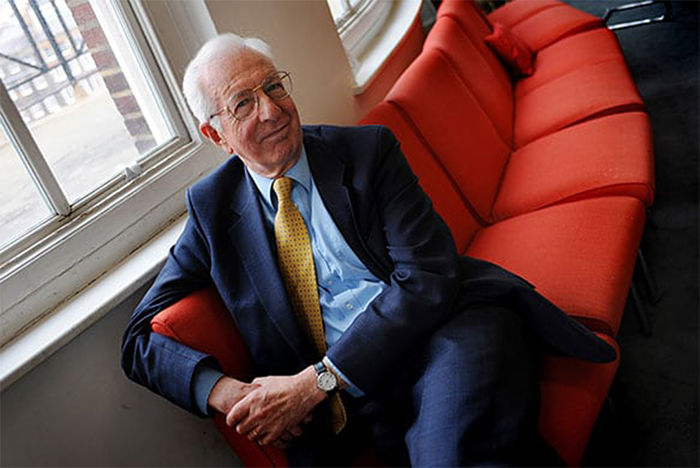
Richard Layard remembers being a history student sitting in Oxford’s Bodleian Library on a misty morning, reading philosopher Jeremy Bentham (he of the famed “It is the greatest happiness of the greatest number that is the measure of right and wrong”). As he recounts to interviewer David Edmonds in this Social Science Bites podcast, he thought, “Oh yes, this is what it’s all about.”
And while much has changed for the current Baron Layard FBA in the years since that epiphany, his laser-like focus on seeing happiness as the key product of any successful society has remained. Much of his effort as a labor (and Labour) economist has gone into popularizing the idea of happiness as the real measure of national success; he’s written extensively about the concept, ranging from his 2005 book, Happiness: Lessons from a New Science, to his latest, just released this year, Can We Be Happier? (written with George Ward). Layard is also co-editor, with John F. Helliwell and Jeffrey Sachs, of the World Happiness Report.
The fundamental impulse of a government, he insists, should be the creation of well-being, and not just wealth.
Three basic principles underlie happiness economics, Layard explains:
- “The way we judge the situation or the state of a nation is by the happiness of the people, especially the happiness of the least-happy people.”
- “We should try and produce the best state in the world that we can in the way that we live our lives and the people we touch or could touch. So we should be trying to produce the largest amount of happiness in the world that we can, especially taking into account the people who are least happy.”
- “Governments should also be trying to produce the greatest happiness in people, especially preventing misery. That was the view of Thomas Jefferson; I think it was the right view.”
While not spoken about in government circles nearly as much as say gross domestic product, these ideas aren’t revolutionary – both Bentham and Jefferson were active at the close of the 18th century, after all.
“It always had some traction,” Layard says, “but I think it’s gaining more traction now, particularly because the new science of happiness is making it practical to aim at the happiness of people. And secondly, because people have become somewhat disillusioned with economic growth — even before the financial crash.” New Zealand, Scotland and Iceland – all with female prime ministers, he notes – all have budgets aimed at wellbeing.
In the podcast, Layard explains how a qualitative instrument – asking people how happy they are or are not – turns out be an excellent predictor of future lifespan, work productivity, and whether an incumbent government is re-elected. These happiness-generated predictions prove to be more accurate than predictions based on the economy. “Bill Clinton said, ‘It’s the economy, stupid.’ I’m afraid he was the stupid one. … It is pretty clear in our mental fabric that how you feel is of ultimate importance, and these other things [such as wealth or health] are a means to that end.”
In 1990, Layard founded the Centre for Economic Performance at the London School of Economics, and was director of the center until 2003. His elevation to the House of Lords in 2000 was followed by some signal policy-oriented projects on happiness, mental health and even climate change. In addition to being a fellow of the British Academy, Layard was elected a Fellow of the Academy of Social Sciences in 2016.
To download an MP3 of this podcast, right-click HERE and save.
For a complete listing of past Social Science Bites podcasts, click HERE. You can follow Bites on Twitter @socialscibites and David Edmonds @DavidEdmonds100.