Celebrating Asian American and Native Hawaiian/Pacific Islander Heritage Month
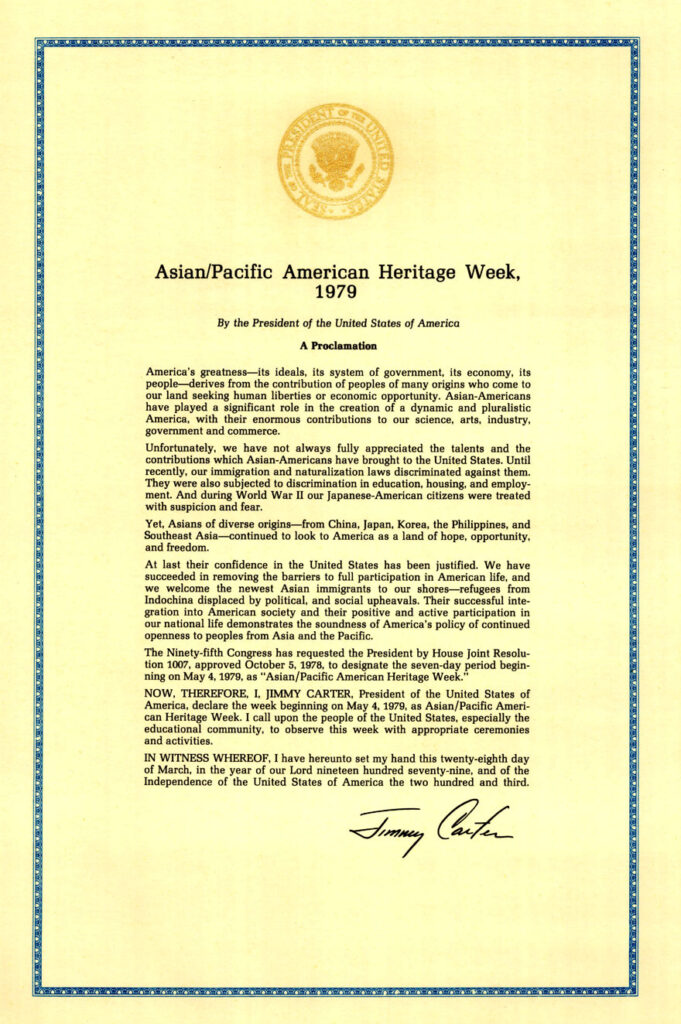
Every year in May, Asian American and Native Hawaiian/Pacific Islander Heritage Month celebrates the histories and cultures of AANHPIs in the United States. The celebration originated in 1979 when President Jimmy Carter signed Proclamation 4650 to establish the week of May 4th as Asian/Pacific American Heritage Week. The proclamation resulted from a nationwide campaign spearheaded by Jeanie Jew, a Capitol Hill staffer and Chinese American whose great-grandfather worked on the transcontinental railroad and died of racial violence. In 1992, President George H.W. Bush passed a law to expand the commemorative week into an entire month, and AANHPI Heritage Month was born.
The month of May commemorates two key dates in Asian American history. The first is May 7, 1843, which marks the arrival of America’s first Japanese immigrant—a 14-year-old fisherman named Manjiro, whose ship was caught in a storm and carried him from Japan to the United States. The second date, May 10, 1869—also known as Golden Spike Day—recognizes the completion of the transcontinental railroad. Approximately 15,000 Chinese workers labored on the transcontinental railroad, where they faced discrimination and brutal conditions.
AANHPIs are among the fastest-growing ethnic groups in the United States. In 2020, the United States Census Bureau reported that over 20.6 million people in the US identified as Asian, Native Hawaiian, or Pacific Islander alone. An additional 4.1 million identified as Asian in combination with another race, and nearly 690,000 identified as Native Hawaiian or Pacific Islander in combination with another race. AANHPIs in the United States represent more than 50 distinct ethnicities and over 100 unique languages and dialects.
With such a broad range of ethnicities and cultures under the AANHPI umbrella, one may wonder how the AANHPI Heritage Month got its acronym. The term “Asian American” itself is a fairly recent creation; the term is believed to have emerged in the 1960s when graduate students from the University of California, Berkley established the Asian American Political Alliance (AAPA). Inspired by the Black Power movement, the AAPA united Americans of Chinese, Japanese, Filipino, and Korean descent in protest of the Vietnam War. Asian Americans, Native Hawaiians, and Pacific Islanders were then lumped together until 1997, when the Office of Management and Budget, which determines racial categories in the US census, split the “Asian and Pacific Islander” category into “Asian” and “Native Hawaiian or Other Pacific Islander.” In 2021, the White House released A Proclamation on Asian American and Native Hawaiian / Pacific Islander Heritage Month, which marked a shift from the AAPI acronym used in previous proclamations. The proclamation reiterates that AANHPIs are not a monolith: “There is no single story of the AANHPI experience, but rather a diversity of contributions that enrich America’s culture and society and strengthen the United States’ role as a global leader.”
The COVID-19 pandemic resulted in a rise of anti-Asian rhetoric and violence. In response, the White House released the Memorandum Condemning and Combating Racism, Xenophobia, and Intolerance Against Asian Americans and Pacific Islanders in the United States in January 2021. Most recently, the White House Initiative on Asian Americans, Native Hawaiians, and Pacific Islanders released the National Strategy to Advance Equity, Justice, and Opportunity for Asian American, Native Hawaiian, and Pacific Islander Communities. Significantly, Vice President Kamala Harris is the first person of South Asian descent to hold the Office of Vice President.
The 2023 AANHPI Heritage Month theme, Advancing Leadership through Opportunities, was selected by the Federal Asian Pacific American Council.
Explore Further Resources
- Check out the AANHPI Resource Center, provided by the Federal Asian Pacific American Council.
- Visit Sage’s Asian American & Pacific Islander Heritage Month microsite and access featured research and special issues.
- Read the Library of Congress Asian American and Pacific Islander Materials: A Resource Guide.
- Learn about the White House Initiative on Asian Americans, Native Hawaiians, and Pacific Islanders (WHIAANHPI).
- Watch Asian Americans, a five-hour film series from PBS.
- Celebrate AAPI culture with San Francisco’s Asian American & Pacific Islander Heritage Month Celebration Guide