



Could Distributed Peer Review Better Decide Grant Funding?
The landscape of academic grant funding is notoriously competitive and plagued by lengthy, bureaucratic processes, exacerbated by difficulties in finding willing reviewers. Distributed […]

Princeton economist Alan Krueger, who The New York Times described as “help[ing] lead economics toward a more scientific approach to research and policymaking” in his repeated stints in the public sector, has died at age 58.

In his second article in a series on impact, Louis Coiffait looks at how REF and KEF treat impact in the UK.
David Canter considers the emotional and physical challenges of field research and the limits of conventional ethical approval.
The U.S. military’s innovation incubator, the Defense Advanced Research Projects Agency, has signed the Center for Open Science to create a research claims database as DARPA’s first step to assign a ‘credibility score’ to social and behavioral science research.

The active use of metrics in everyday research activities suggests academics have accepted them as standards of evaluation. Yet when asked, many academics profess concern about the limitations of evaluative metrics and the extent of their use. Why is there such a discrepancy between principle and practices?

A vital part of any research assessment program is the ability to clearly demonstrate the impacts, whatever they may, of the research undertaken. In this post, Katy McEwan presents the impact chain approach for writing impact case studies. A method, which provides a framework for producing impact narratives
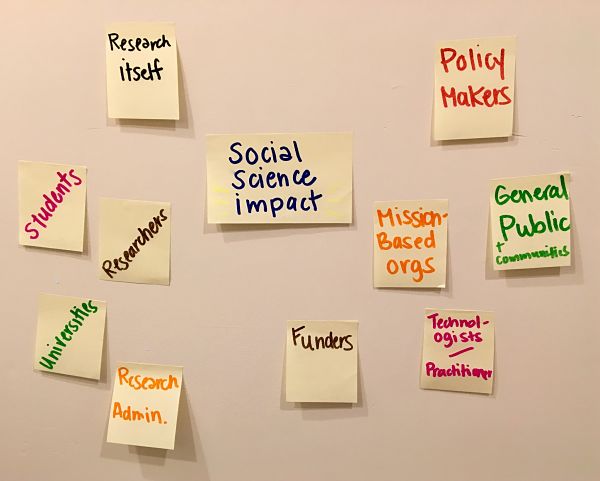
As part of a larger effort to support social scientists achieve and demonstrate impact, SAGE Publishing brought together 14 individuals who are both passionate about social science’s impact and intimately involved in improving its measurement for a one-day workshop.

In this first in a series of articles about impact, Louis Coiffait will provide an overview of the current situation for researchers (including social scientists) in the United Kingdom, in particular looking at the impact and knowledge exchange frameworks.
Jürgen Habermas, a globally known social theorist whose explorations of democracy, validity and communication have gained new prominence in the current moment, […] People often see science as a world apart: cool, rational and untouched by persuasion or performance. In this view, scientists simply discover […] “Research impact” means different things to different people. Some refer broadly to how science changes behaviors, beliefs, or practices outside academic institutions. […] David Canter considers informal places where people socialize, suggesting they’re an arena ChatGPT and other LLMs can’no’t replicate. As someone who lives […] It’s become cliche since Clive Humbly coined it in 2006, but data is indeed the new oil. It’s a mantra repeated by […] In September 2025, The Guardian reported about a lawyer in Australia having faced sanctions due to false citations. These citations were not […]
EXPLORE
Impact

Jürgen Habermas, 1929-2026: Exponent of the Public Sphere
READ MORE

Scientists Should Keep in Mind It’s Called the ‘Marketplace of Ideas’ for a Reason
READ MORE

Survey Finds Social Scientists Feel Unsupported in Seeking Societal Impact
READ MORE
Innovation

Reaching Parts to Which AI Has No Access
READ MORE

Andrea Medina-Smith on Making Research Data More FAIR
READ MORE

A Status Check on Hallucinated Case Law Incidents
READ MORE