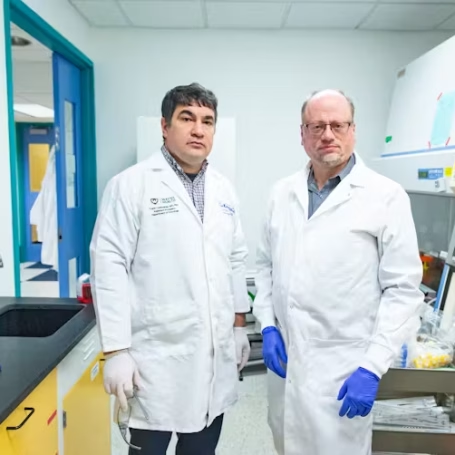




Could Distributed Peer Review Better Decide Grant Funding?
The landscape of academic grant funding is notoriously competitive and plagued by lengthy, bureaucratic processes, exacerbated by difficulties in finding willing reviewers. Distributed […]

The large language models, or LLMs, that underlie generative AI tools such as OpenAI’s ChatGPT, have an ethical challenge in how they parasitize freely available data.

Title of course: Space/Power/Species What prompted the idea for the course? A few years ago, I came across the architect Joyce Hwang’s […]
Paul Allin sets out why the UK’s Royal Statistical Society is launching a new campaign for public statistics.

The origin of the phrase “publish or perish” has been intriguing since this question was first raised by Eugene Garfield in 1996. Vladimir Moskovkinl talks about the evolution of the meaning of this phrase and shows the earliest use known at this point.

Philosophy has been instrumental to AI since its inception, and should still be an important contributor as artificial intelligence evolves..

It is estimated that all journals, irrespective of discipline, experience a steeply rising number of fake paper submissions. Currently, the rate is about 2 percent. That may sound small. But, given the large and growing amount of scholarly publications it means that a lot of fake papers are published. Each of these can seriously damage patients, society or nature when applied in practice.

The new AI Disclosures Project seeks to create structures that both recognize the commercial enticements of AI while ensuring that issues of safety and equity are front and center in the decisions private actors make about AI deployment.

The retraction of academic papers often functions as an indictment against a researcher’s reputation. Tim Kersjes argues that for retractions to function as an effective corrective to the scholarly record, they need shed this punitive reputation.

Jürgen Habermas, a globally known social theorist whose explorations of democracy, validity and communication have gained new prominence in the current moment, […] People often see science as a world apart: cool, rational and untouched by persuasion or performance. In this view, scientists simply discover […] “Research impact” means different things to different people. Some refer broadly to how science changes behaviors, beliefs, or practices outside academic institutions. […] David Canter considers informal places where people socialize, suggesting they’re an arena ChatGPT and other LLMs can’no’t replicate. As someone who lives […] It’s become cliche since Clive Humbly coined it in 2006, but data is indeed the new oil. It’s a mantra repeated by […] In September 2025, The Guardian reported about a lawyer in Australia having faced sanctions due to false citations. These citations were not […]
EXPLORE
Impact

Jürgen Habermas, 1929-2026: Exponent of the Public Sphere
READ MORE

Scientists Should Keep in Mind It’s Called the ‘Marketplace of Ideas’ for a Reason
READ MORE

Survey Finds Social Scientists Feel Unsupported in Seeking Societal Impact
READ MORE
Innovation

Reaching Parts to Which AI Has No Access
READ MORE

Andrea Medina-Smith on Making Research Data More FAIR
READ MORE

A Status Check on Hallucinated Case Law Incidents
READ MORE