


Could Distributed Peer Review Better Decide Grant Funding?
The landscape of academic grant funding is notoriously competitive and plagued by lengthy, bureaucratic processes, exacerbated by difficulties in finding willing reviewers. Distributed […]
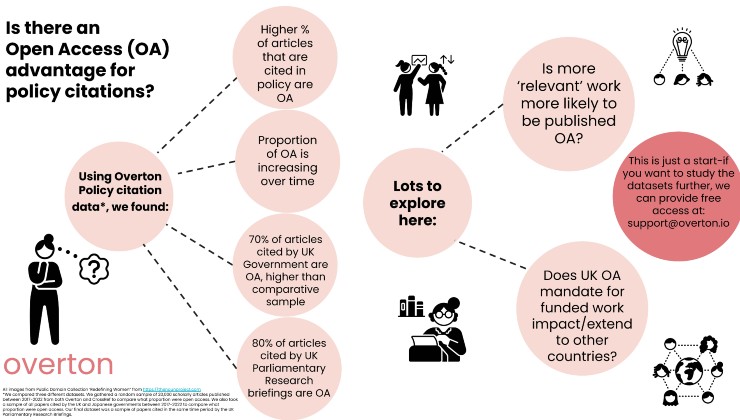
Will you research be cited more often if it was originally published open access? The people at Overton, a platform which tracks citation in policy, decided to investigate.

Therapeutic culture plays a central role in societies around the world. From self-help books to mental well-being workshops to conversations about the […]
Britain’s Economic and Social Research Council (ESRC) announced winners in six categories of its Celebrating Impact Prize 2022 on Nov. 3. Now in its tenth year, the prize celebrates the success of ESRC-funded researchers in achieving and enabling outstanding economic or societal impact from excellent research. The ESRC is the UK’s largest f

The next Data Science for Public Good (DSPG) forum event will be hosted on Nov. 20, 2022 from 4-6 p.m. Attendees may either attend virtually or in-person at the University of Virginia’s Student Health and Wellness building at 550 Brandon Ave, Charlottesville, VA 22903.
The next in SAGE Publishing’s How to Get Published webinar series focuses on promoting your writing after publication. The free webinar is set for November 16 at 4 p.m. BT/11 a.m. ET/8 a.m. PT.

Ways of thinking about knowledge have proliferated academic discussions for centuries, providing insights into how to maximize potential impacts. Ontologies, or the […]
Information Age Publishing has put out a call for papers focused on Native American and Indigenous Persons’ Work Issues to be published in a special issue volume of Research in Human Resource Management, a peer reviewed research series.

Political economist and journalist Will Hutton, author of the influential 1995 book The State We’re In, offers a state-of-the-field report on the social sciences in this Social Science Bites podcast.
Jürgen Habermas, a globally known social theorist whose explorations of democracy, validity and communication have gained new prominence in the current moment, […] People often see science as a world apart: cool, rational and untouched by persuasion or performance. In this view, scientists simply discover […] “Research impact” means different things to different people. Some refer broadly to how science changes behaviors, beliefs, or practices outside academic institutions. […] David Canter considers informal places where people socialize, suggesting they’re an arena ChatGPT and other LLMs can’no’t replicate. As someone who lives […] It’s become cliche since Clive Humbly coined it in 2006, but data is indeed the new oil. It’s a mantra repeated by […] In September 2025, The Guardian reported about a lawyer in Australia having faced sanctions due to false citations. These citations were not […]
EXPLORE
Impact

Jürgen Habermas, 1929-2026: Exponent of the Public Sphere
READ MORE

Scientists Should Keep in Mind It’s Called the ‘Marketplace of Ideas’ for a Reason
READ MORE

Survey Finds Social Scientists Feel Unsupported in Seeking Societal Impact
READ MORE
Innovation

Reaching Parts to Which AI Has No Access
READ MORE

Andrea Medina-Smith on Making Research Data More FAIR
READ MORE

A Status Check on Hallucinated Case Law Incidents
READ MORE