



Could Distributed Peer Review Better Decide Grant Funding?
The landscape of academic grant funding is notoriously competitive and plagued by lengthy, bureaucratic processes, exacerbated by difficulties in finding willing reviewers. Distributed […]
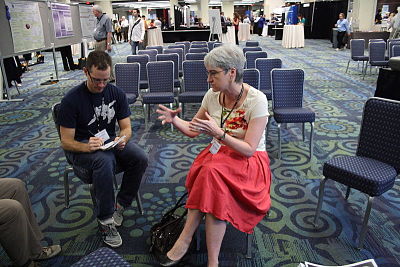
Tweeting and talking to reporters sure must be a good thing for boosting buzz about researchers’ work and then ultimately their careers, right? A new study says absolutely, but it also questions the benefits of some other career-boosting activities.

The rapid growth and impact of big data has led some to ponder whether big data might lead to the demise of small data, noted Rob Kitchin in an excerpt from his new book, The Data Revolution. But that ignores the benefits and beauties that small data deliver.

The political science journal Comparative Political Studies is experimenting for one special issue in which articles will be judged based on reviewers’ evaluations of what authors intend to do rather than what they report as their findings.
The Wellcome Trust, a large funder of biomedical research, is keen to ensure that the findings of that research are widely and openly shared. Here, Jonathon Kram and Adam Dinsmore from the trust’s evaluation team discuss why any apparent bias against writing up and publishing certain types of results would impede scientific progress.

An experiment on economists looked at offering small stipends for reviewers, as well as tighter deadlines and dollop of public shaming. Which worked, and could this have implications beyond this field and this journal? Max Nathan discusses.

in our debut cross-posting with Viva Voce Podcasts, Simon Chin-Yee describes his research studying how the political network in Kenya interacts with the changes wrought by climate change.

The authors of an award-winning textbook on qualitative research discuss their love of the method — and their respect for choosing the right method for the task at hand.

Amiera Sawas writes here on her experiences with risks in the field and beyond, finding that institutional protocols are undoubtedly robust on a wide range of physical threats, but more subtle threats, like sexual harassment, which cross psychological and physical lines, are not always explicitly dealt with.

The Royal Swedish Academy of Sciences has awarded this year’s Nobel Prize in Economic Sciences to the American economists Robert E. Hall […] Four Americans working in the social and behavioral sciences are among the 20 people named MacArthur Fellows this year. Recipients may be […] Euan Adie, the founder of Altmetric and later of Overton, discusses the reasons the led to Overton’s focus on showing researchers how […] The following is an adapted extract from The Cultural Industries, fifth edition, by David Hesmondhalgh. The increasing presence of information technology (IT) […] Developers of AI data centers have a public trust problem. According to multiple surveys, a majority of Americans say they would oppose […] I was adding some final flourishes on the topic of ‘iatrocracy’ to my forthcoming book with Natewindé Sawadogo – Sickness and Social […]
EXPLORE
Impact

Economic Peaks, Troughs and This Year’s Nobelists in Economics
READ MORE

Four From Social Science World Receive 2026 MacArthur Fellowships
READ MORE

Quick Insight: Euan Adie on Getting Academics Credit for Their Impact
READ MORE
Innovation
IT Giants and Their Operations: Should We Be Concerned?
READ MORE

What We Miss When We Study Public Trust with Surveys Alone
READ MORE

AI and ‘Iatrocracy’ – A Cautionary Tale
READ MORE












































































