Tirole Win Continues NSF/SBE Win Streak
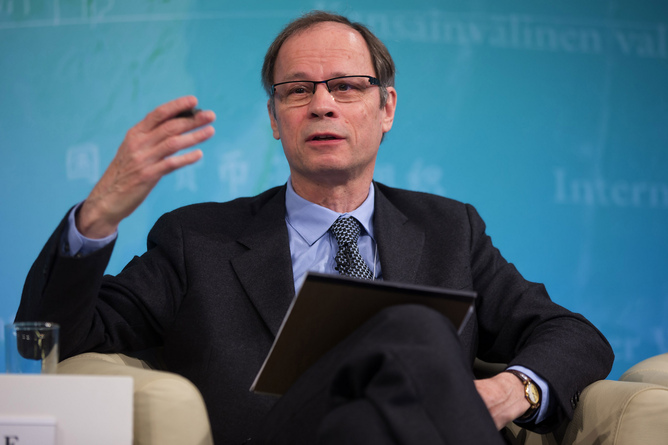
Jean Tirole
Jean Tirole became the first French economist since 1988 to win the economics Nobel and the 51st NSF-funded economist to win the prize. His research uses game theory to understand the behavior and regulation of the large firms that often dominate industries, such as telecommunications, banking, electricity and others.
As described by the NSF in a release, a small number of large firms, or a single monopoly, often controls market forces within an industry. Left unregulated, such markets may produce abnormally high prices, or allow unproductive firms to block the entry of new, more prolific ones.
While Tirole is from the Toulouse School of Economics in the University of Toulouse in France, his early work took place in the United States. The base for Tirole’s groundbreaking research was supported by NSF’s Economics Program while Tirole was at the Massachusetts Institute of Technology from 1984 until 1992.
NSF’s Social and Economic Sciences Division in its Directorate for Social, Behavioral and Economic Sciences (SBE) awarded three grants for projects on which Tirole had substantial input. A fourth project received an award from SBE’s Science of Science and Innovation Policy Program.
While it’s no surprise that the NSF supports work that routinely wins the Nobel and other important research prizes – the winner in chemistry this year, Stanford’s William Esco Moerner, has been funded by NSF’s Directorates for Mathematical and Physical Sciences; Biological Sciences; and Education and Human Resources, for example – the victories in economics highlight the role that the embattled Directorate of Social, Behavioral and Economic Sciences plays in funding research that has important, genuine and practical applications. (Click HERE for a NSF-prepared report on the agencies impressive batting average.)
There have been several efforts in the U.S. Congress to reduce funding specifically for the SBE directorate, even while increasing overall funding for the NSF as a whole. While no legislator has called for scrapping SBE as a whole, a proposal that does have a historical precedent, there is a meme that SBE produces more than its share of “questionable grants” and that at a minimum the 3 percent of the NSF budget that goes to SBE could either be halved or perhaps have politicians and not researchers create the parameters for what gets funded.
Such moves concern the NSF, its overseers the National Science Board, and the broader research community (including Social Science Space parent SAGE). Their counter-arguments fall along two lines: scientists are the best judges of scientific merit, and you can’t judge future impact from the odd-sounding specifics in current papers.
Tirole’s investigation, for example, has resulted in a unified theory that helps answer important policy questions regarding how governments might best deal with mergers or cartels, or how they could regulate monopolies. His model-based theories also have been important to legal cases promoting or maintaining market competition. Economists in the U.S. Department of Justice and the Federal Trade Commission have used his techniques to analyze several potential antitrust cases, and Tirole’s work has contributed to significant changes in U.S. law.
“Their selection for this important prize underscores the importance of their research,” NSF Director France Córdova was quoted in a release. “Those whom NSF nurtured along their career paths reflect the diligence and commitment the NSF community takes in evaluating the research proposals of young scientists.”
***
This article draws heavily from a press release from the NSF.