 Higher Education Reform
 A Marketplace of Ideas? Yes. A Market? No
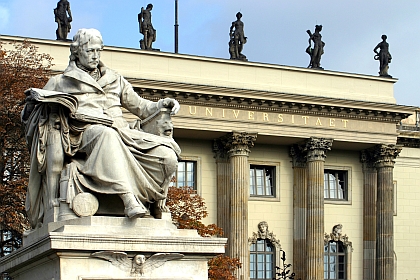
The purpose and practice of the university education has changed since the days of Wilhelm von Humboldt. But are things worse or just different? (Photo: Humboldt-Universität zu Berlin)
But universities feel threatened and increasingly incapable of fulfilling their primary functions. The question at the center of most current debates on university reform is to what extent universities themselves should determine the goals, values and norms of pedagogical and scientific practice. For politicians and the general public, academic freedom – even as a noble principle honored mainly in the breach – is becoming meaningless.
Debates on the freedom of higher education are as old as the university. But today’s ideologically imposed constraints are very different from the financial dependence of public universities on the state after 1945. The current international trend towards semi-private, semi-public universities poses new challenges to academic freedom. This is exemplified by the dominance of market-based vocabulary and principles for scientific conduct.

This article by Simon Jackson, Ann Thomson and Stefan Nygard originally appeared at The Conversation, a Social Science Space partner site, under the title “In the race to turn higher education into a market, we’re ignoring lessons from history”
From Humboldt on…
These debates are at the heart of a collection of articles on The Conversation. The pieces shed much needed historical light on the current restructuring of higher education and research – in Europe and beyond. They emerge from a recent major conference on higher learning and politics.
The cross-national historical comparisons presented here illustrate the peculiarities of the current reform culture. They also demonstrate the historical complexity of the relationship between university and society, and warn against national parochialism. When told there is no alternative, we should look abroad for ready proof to the contrary.
Higher education, society, politics, and the market have had very different interconnections in different countries. As a result, despite the wide influence of marketization ideology, there are real differences around the world reflected in public discussions on the future of the universities. We give a flavor of that variety here.
The public universities of contemporary Europe date from 1945, yet they are based on the early 19th century Humboldtian ideal of academic freedom, and on the value of faculty members who both teach and conduct research. Spreading round the world, this model gave rise to numerous local variations, including in the Anglo-American sphere, which in the 20th century overtook the German-French universities.
Local variations to similar problems
Today, the dominance of English-language universities is evident in many different regions of the world. Yet as the article on Japan in this series will illustrate, the mix of internationally circulating university models and national traditions of higher education has produced very different results. Despite pressure to homogenize, the introduction of marketizing principles of university management has provoked very different reactions around the world.
As Italian historian Andrea Mariuzzo shows, idealization of elite American universities is nothing new in global higher education. But nor is misrepresentation of the US system in order to justify various national projects. Mariuzzo examines Harvard reformers’ efforts in 1945 to define the balance between general liberal education designed to produce citizens, and specialized instruction supposedly aimed at economic success.
Meanwhile, Japanese historian Shigeru Okayama describes how European models of higher education influenced the Japanese approach from its inception. But he also exposes the failures of the private university system there, and the growing divide between English and Japanese language teaching.
A collective of doctoral researchers at the European University Institute have also provided a view “from below”, explaining how the marketized university is experienced by those who represent its future.
Learning from our history
It is undeniable that some of the current challenges to higher education are specific to our times. But others have a long history, despite being widely seen as new. We often hear that the university is globalizing. In fact the nation state remains a key player, and global academia remains primarily a space for international competition.
Within this space, all kinds of international honors contribute to national prestige, and individual scholars mobilize international recognition for national purposes. Distinguishing between which reforms are truly new and which are merely presented as such, and grasping the interplay between global trends and national situations will help us think about how to react in the face of today’s challenges.