In Post-Brexit Britain, is Migration a Crime?
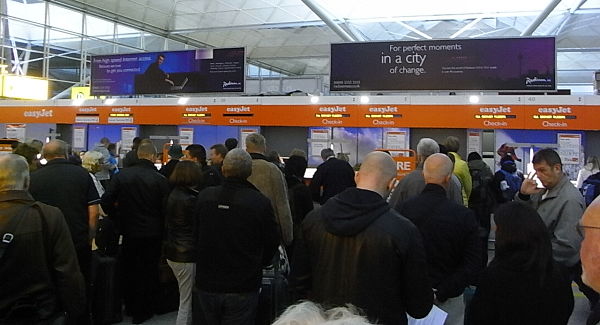
Can you spot the criminals in this queue? (Photo: Isriya Paireepairit/Flickr/CC BY-NC 2.0)
 After my arrival in Beijing, I began to set up interviews with people living in transnational marriages and couple relationships. I did not look specifically for Chinese-British couples, but I did come to meet quite a few. Strikingly, not one of these couples had been able to obtain a British visa. This meant that I only got to interview one half of a couple that had been involuntarily separated by the denial of a visa, or that I encountered couples who had made a home in China because Britain had closed its doors on them. I should add that my study looks specifically at highly-skilled couples. The people I interviewed held MAs and PhDs, worked as academics, investment bankers, researchers in NGOs, civil servants, head teachers, and so on. Settling in Britain, all of them could have been reasonably expected to prosper and make a meaningful contribution to society.
Returning to Britain in September, I was struck by the febrile political climate and the overt hostility that senior politicians and large parts of the media had begun to direct at the country’s immigrant population. I heard senior members of government propose that British companies should make public the number of foreigners they employed, that EU citizens living in Britain might be used as a bargaining chip in the forthcoming Brexit negotiations, and that the reduction of immigration into the country will be the primary goal in these negotiations. I read how journalists in major newspapers descended into fits of rage at the admission into Britain of a tiny number of child refugees from the notorious Calais jungle camp. The press has even sought to delegitimise the presence of these refugees by claiming that they are adults who have lied and cheated their way across the border. The most notable response on the part of Britain’s political class so far has come from an MP who has called for dental checks on refugees to determine their age.
Public debates before Britain’s EU referendum were dominated by concerns about immigration, driven, in part, by the openly xenophobic leave campaign. Pro-Brexit voters may have had heterogeneous motivations, but immigration has been the paramount topic of public debate, rivaled in the aftermath of the referendum only by concerns about the country’s prospective economic decline. In this sense, there is a close association between Britain’s withdrawal from the EU and the wave of anti-foreign resentment that is sweeping the country.
This wave has long been in the making. Influential newspapers have long been fiercely xenophobic. In my field of research, for instance, it is striking that papers such as the Daily Mail consistently equate transnational marriages with so-called ‘sham marriages.’ Britain’s political class has likewise done much to contribute to the anti-foreign sentiments that have now risen to the surface. Rhetorically, there is only a small step between Theresa May’s notorious poster requesting illegal immigrants to go home and Nigel Farage’s equally notorious poster warning that immigration had led British society to a breaking point. In public discourse today, the term ‘migrant’ is used by way of blanked generalization to describe all sorts of undesirables who have entered the country. It is hard to escape the conclusion that in Britain in late 2016, migration is synonymous with crime and deviance.
Under these conditions, what place is there still for foreign academics – and particularly for EU academics – in this country? Many of us have been in Britain for a long time, have developed careers and have formed close friendships with British people. In fact, the distinction between “Briton” and “foreigner” is unlikely to have been part of our thinking until recently. In everyday life, many of us are still likely to experience the friendliness, the friendships and the collegiality that used to make Britain an attractive place to work. And yet, the prevalent tone of public life has changed to such a degree that remaining here seems like an increasingly daunting prospect.