Economics Nobel Recognizes Nature and Knowledge
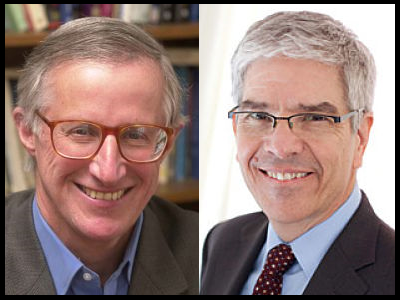
William Nordhaus, left, and Paul Romer
Two academics who have integrated what might have once seemed like non-economic externalities into economic models have been awarded the 2018 Sveriges Riksbank Prize in Economic Sciences in Memory of Alfred Nobel, popularly known as the Nobel Prize in economics. The winners are William D. Nordhaus of Yale University, cited for integrating climate change into macroeconomic analysis, and Paul M. Romer of New York University’s Stern School of Business, cited doing the same with technological innovations.
The laureates will split a prize of 9 million Swedish krona, roughly a million U.S. dollars.
“The contributions of Paul Romer and William Nordhaus are methodological,” the Nobel Committee detailed in a release, “providing us with fundamental insights into the causes and consequences of technological innovation and climate change. This year’s Laureates do not deliver conclusive answers, but their findings have brought us considerably closer to answering the question of how we can achieve sustained and sustainable global economic growth.”
Nordhaus, who was born in Albuquerque, New Mexico in 1941, started studying the interaction between the natural and the social world in the 1970s, and by the 1990s had created an “integrated assessment model” that quantitatively describes how environmental forces and economic forces influence each other.
The models have three separate but interacting modules: carbon circulation and emission, the greenhouse gas feedback loop, and economic growth (including energy inputs), with each modules’ outputs as roughly carbon concentration, global temperature and a time path combining GDP, welfare and global CO2 emissions.
“His tools,” wrote the committee, “allow us to simulate how the economy and climate would co-evolve in the future under alternative assumptions about the workings of nature and the market economy, including relevant policies. His models address questions about the desirability of different global scenarios and specific policy interventions.”
Romer, born in Denver in 1955, is a Romer is former chief economist of the World Bank. He started his path to the Nobel by noticing that while existing economic theories explained models many economic facts on the ground, but not recurring differences in the rate of growth. Exploring this terra incognita, Romer posited that increases in ideas lay behind these persistent and measurable differences.
“Romer’s breakthrough article showed how the rivalry and excludability of ideas determine economic growth,” the committee noted. “Romer believed that a market model for idea creation must allow for the fact that the production of new goods, which are based on ideas, usually has rapidly declining costs: the first blueprint has a large fixed cost, but replication/reproduction has small marginal costs. … Romer also showed that growth driven by the accumulation of ideas, unlike growth driven by the accumulation of physical capital, does not have to experience decreasing returns. In other words, ideas-driven growth can be sustained over time.”
Furthermore, he argues that while markets will produce technological changes (ideas made manifest), but unregulated markets will skimp on the necessary research to sustain the flow, and so government assist like robust patent laws and research grants are vital.