Teaching

Get Creative! MethodSpace Live Webinar Recording

July 26, 2019 2697

Communicating in visual or multimodal ways allows us to reach people who might not read the words we write. A MethodSpace focus for May was on ways to visualize research ideas as well as findings. In June and July, we are building on these ideas with a focus on Creative and Arts-Based Methods. Find all posts in this unfolding series.

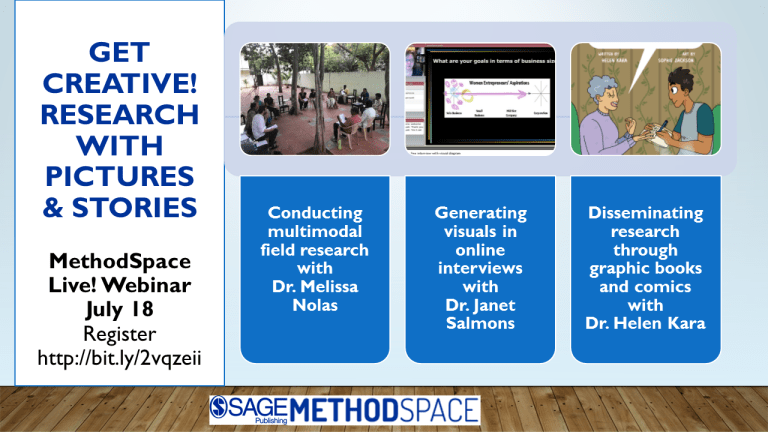
In order to engage in real-time and have a conversation about thought-provoking approaches, MethodSpace is having a live series of webinars. The first one was Get Creative! Research with Pictures & Stories, which appears below.

Methodspace addresses some of the questions we didn’t have time to answer during the webinar in separate posts; the first answer appears HERE.

Watch the first webinar below:

The panel-style format featured three expert contributors: Dr. Helen KaraDr. Melissa Nolas, and yours truly, Dr. Janet Salmons.

Helen Kara is a UK-based independent researcher, writer, Fellow of the Academy of Social Sciencesand Visiting Fellow at the UK’s National Centre for Research Methods. She is the author several SAGE Publishing books, including four of our Quick Little Fix titles and most relevantly today, Creative research methods in the social sciences: A practical guide.

Melissa Nolas is a senior lecturer in sociology at Goldsmiths, University of London. Her research areas include: human agency and lived experience; childhood, youth and family lives; civic and political practices across the life course; multimodal ethnography; publics creating methodologies. She is the Principal Investigator of the European Research Council funded Connectors Study and the co-editor of entanglements: experiments in multimodal ethnography.

Webinar host Janet Salmons, the methods guru here at MethodSpace, is an independent researcher, writer and consultant through her company,Vision2Lead, Inc. Janet too has written a number of books for SAGE, including Doing Qualitative Research Online, Qualitative Online interviews, and Online Interviews in Real Time. She previously served on the graduate faculty of the Capella University School of Business, and was honored with the Harold Abel Distinguished Faculty Award for 2011-2012 and the Steven Shank Recognition for Teaching for four consecutive years.



Sage, the parent of Social Science Space, is a global academic publisher of books, journals, and library resources with a growing range of technologies to enable discovery, access, and engagement. Believing that research and education are critical in shaping society, 24-year-old Sara Miller McCune founded Sage in 1965. Today, we are controlled by a group of trustees charged with maintaining our independence and mission indefinitely. 

View all posts by Sage

Related Articles

The Critical Student: How GenAI Reshapes Critical Skills and Higher Education’s Role Preparing Students For It
Critical Thinking
June 29, 2026

The Critical Student: How GenAI Reshapes Critical Skills and Higher Education’s Role Preparing Students For It

Read Now
AI Doesn’t Drive Student Cheating. It Just Hitches a Ride
Teaching
June 24, 2026

AI Doesn’t Drive Student Cheating. It Just Hitches a Ride

Read Now
The Visual Authority Trap
Critical Thinking
April 30, 2026

The Visual Authority Trap

Read Now
From ‘Which Database?’ to ‘Under What Conditions?’: Teaching Critical Thinking Through Search Tool Selection in an AI Age
Critical Thinking
April 28, 2026

From ‘Which Database?’ to ‘Under What Conditions?’: Teaching Critical Thinking Through Search Tool Selection in an AI Age

Read Now
The 3E Cycle: Establish-Examine-Evolve as a Structured Model to Foster Critical Thinking

The 3E Cycle: Establish-Examine-Evolve as a Structured Model to Foster Critical Thinking

In university classroom, I once asked my undergraduate students if a particular policy decision had strengthened or weakened the national economy. Few […]

Read Now
Beyond Fact-Checking: Making Critical Thinking an Everyday Multimodal Habit

Beyond Fact-Checking: Making Critical Thinking an Everyday Multimodal Habit

Students now encounter arguments mainly through digital feeds. These arguments are layered with music, editing, facial expressions, captions, filters, AI-generated imagery, and […]

Read Now
From Hot Takes to Habitual Inquiry: A Puzzle-Based Routine for Everyday Critical Thinking in Higher Education 

From Hot Takes to Habitual Inquiry: A Puzzle-Based Routine for Everyday Critical Thinking in Higher Education 

In today’s information ecosystem, reactions often unfold in seconds: a headline provokes emotion, an AI-generated paragraph sounds authoritative, a post feels right, […]

Read Now
0 0 votes
Article Rating
Subscribe
Notify of
guest

This site uses Akismet to reduce spam. Learn how your comment data is processed.

0 Comments
Newest
Oldest Most Voted