Index Finds Little Global Progress on Gender-Based Development Goals
An effort to measure how well equality across genders is progressing around the world, using a tool developed around United Nations-developed goals, has detected “little progress” in the last half decade.
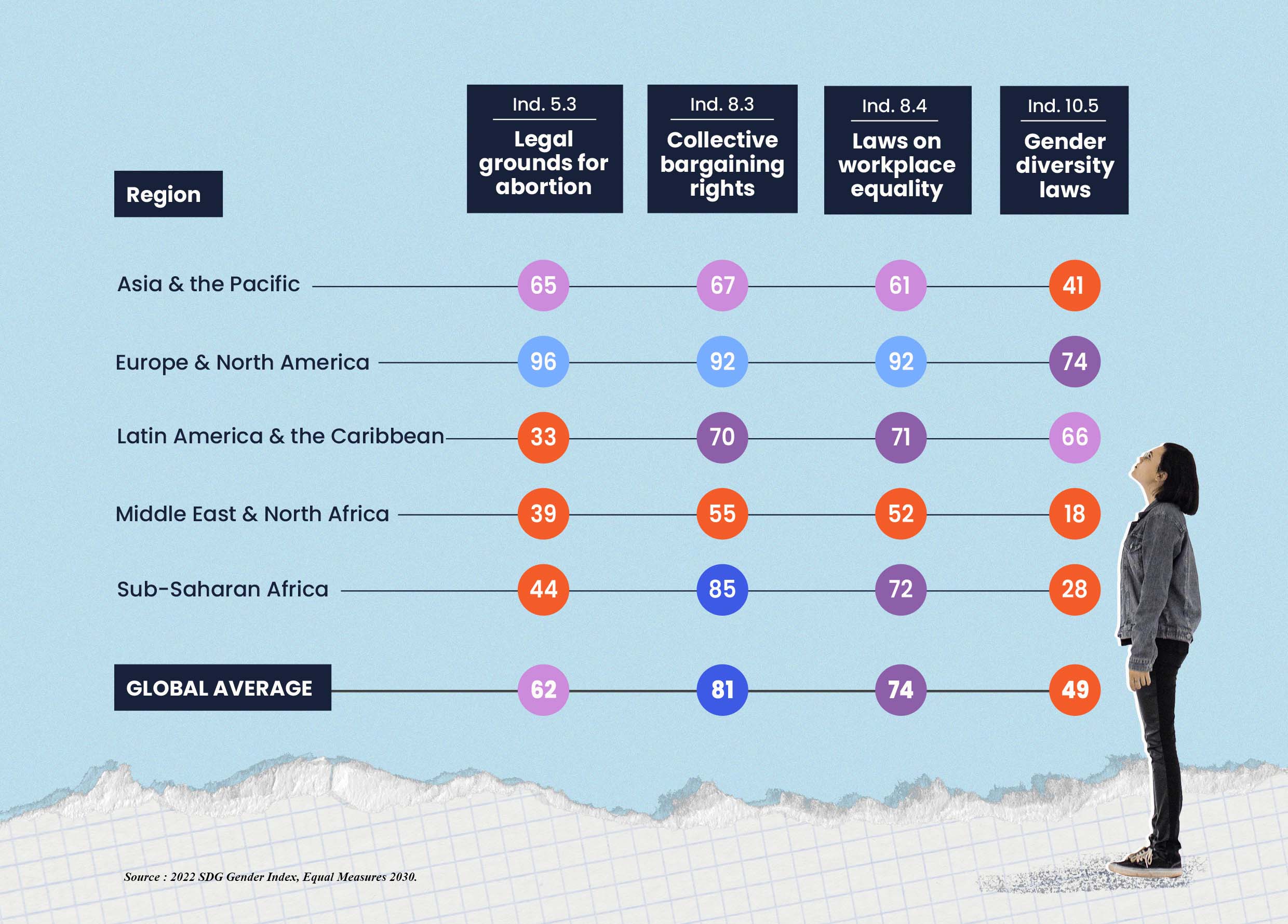
The 2022 Sustainable Development and Growth Gender Index finds “little progress on gender equality at the global level between 2015 and 2020.” If current trends continue, the global index’s score will not reach the United Nation’s goals by a 2030 deadline.
A report on the findings, Back to Normal Is Not Enough, written by Angela Hawke, acknowledges that while the lack of progress is not exactly news, reporting it out does matter. “If we are to reach the vision laid out in the Sustainable Development Goals (SDGs) for people and our planet, we must track progress – or the lack of it – with a gender lens across the whole of the 2030 Agenda. 2 And we must use the resulting data to drive accountability for gender equality commitments. The SDG Gender Index is the most comprehensive tool available to do precisely that.”
The 2022 Gender Index rates a country based on a range of SDGs established by the UN. In the realm of gender equality, these goals include ending discrimination, violence, discrimination, and practices such as child, early and forced marriage and female genital mutilation, while ensuring full access to public services and infrastructure, political and public life, and the full spectrum of gender-specific health care and reproductive rights. The goals also include equal rights to economic resources, enabling technology to promote the empowerment of women, and enforceable legislation for the promotion of gender equality and the empowerment of all women and girls at all levels.
The rating uses a scale of 0 to 100 points: A very good rating is 90-100, good rating is 80-89, fair rating is 70-79, poor rating is 60-69, and very poor rating is 0-59. Countries were evaluated on use of digital banking, women in parliament, government openness, CO2 emissions, climate vulnerability, and anemia. The top three countries, Denmark, Sweden, and Norway, all scored above 90. Five Anglophone countries scored in the ‘good’ category, with Ireland 10th, New Zealand 11th, Australia 14th, the United Kingdom 18th, and Canada 16th. The United States ranked 38th in the world, with a score of 76.6.
The index is a project of Equal Measures 2030 — an independent and nonprofit sector-led partnership. Organizations involved include the Asia-Pacific Resource and Research Centre for Women, Bill & Melinda Gates Foundation, Data2X, the African Women’s Development and Communication Network, ONE Campaign, Plan International, and Women Deliver. The report did not look at events during COVID, but recognizes how the pandemic and its collateral damage hurts girls and women.
The data the index combed through for the gender index includes government statistics in the UN SDG Database and from household surveys carried out by international agencies. They work closely with the World Health Organization, UN Women, UNICEF, and other to avoid duplication of data analysis. Of the 144 counties surveyed, more than half of the countries made some progress between 2015 and 2020. Sixty-three countries made saw their scores improve one to two points and 28 countries made improvements of three points or more. Benin and Saudi Arabia each saw scores rise by nine points (although still in the ‘very poor’ category), while Armenia rose eight points and is 45th globally.
Though less than a quarter of countries are increased their score by three points towards gender equality, only a third of countries either did not see their score change or are seeing their score decline. No region improved more than three points in their index score since 2015.
The report offers six policy recommendations to meet the 2030 SDG deadline:
- Reform and apply laws: This leads to better health, educational, employment, and more representation of women in legislative bodies and government roles.
- Invest in public services and social (including care) infrastructure: This includes progressive taxation and strong investment in public services and infrastructure.
- Promote the leadership, participation and voice of girls and women: This leads greater visibility of women in public life creating a virtuous circle of participation.
- Close the gender data gaps: This means formalizing the idea of a gender data ecosystem to making good use of “big data.”
- Invest in, create space for, and listen to feminist organizations and movements: Provide proper resourcing and safe, secure spaces for these groups to operate and advocate.
- Work with and empower girls and young women: They need to have a seat at the table to give their perspectives on the policies and laws for them.