Biden Administration Releases ‘Blueprint’ For Using Social and Behavioral Science in Policy
On Wednesday, U.S. President Joseph Biden’s administration laid down a marker buttressing the use of social and behavioral science in crafting policies for the federal government by releasing a 102-page Blueprint for the Use of Social and Behavioral Science to Advance Evidence-Based Policymaking.
“This blueprint,” explained Steve M. Newell and Kei Koizumi, two executives of the federal Office for Science and Technology Policy, “recommends actions for agencies across the federal government to effectively leverage social and behavioral science in improving policymaking to deliver better outcomes and opportunities for people all across America. These recommendations include specific actions for agencies, such as considering social and behavioral insights early in policy or program development. The blueprint also lays out broader opportunities for agencies, such as ensuring agencies have a sufficient number of staff with social and behavioral science expertise.”
The broad outlines of what is required are summarized in the blueprint’s finer print. “The U.S. government can better incentivize evidence use in its spending by adopting a set of strategies, including: 1) incorporating existing evidence into federal programs, 2) supporting and engaging recipients to identify and implement evidence-based interventions, and 3) building evidence where needed to further build knowledge about what works.”
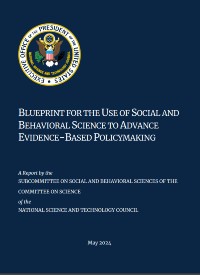
The report was created by the Social and Behavioral Sciences Subcommittee of the National Science And Technology Council’s Committee On Science. The council is a cabinet-level office that advises the president and coordinates science policy across the government. The document lists 22 “primary contributors” from various federal agencies, although an appendix includes three pages of government experts consulted for the report. Federal officials have been talking about such a report for more than a year, and had informally promised its release last year.
Regardless of the timing of its release, those working at the nexus of science and policy, such as Juliane Baron, executive director of the Federation of Associations in Behavioral & Brain Sciences, welcomed its arrival. “This blueprint is an exciting opportunity for FABBS members and has tremendous potential to benefit humanity,” she said. “It is very gratifying to see OSTP lay out specific recommendations for building and strengthening the behavioral and social science ecosystem and incentivize the demand side. For decades, FABBS and our members have been offering up a supply of behavioral insights.”
Newell and Koizumi framed the blueprint as the latest effort by the Biden administration to focus on evidence-based policy, citing, for example, a memo the president issued his first week in office “to champion evidence-based policy decisions guided by the best available science and data.”
While that might seem like an unnecessary step in policy formation – who wouldn’t want to base their decisions on the best and latest data? – there are, in practice, genuine obstacles to doing so.
The blueprint details one such impediment:
Other obstacles range from the meta – such as a rejection of social and behavioral science’s very utility – to the mechanical. “Barriers to the use of social and behavioral science in decision-making and practice,” the blueprint reads, “can range from structural challenges (such as data interoperability or restrictive funding parameters) to beliefs and attitudes (such as a lack of awareness of the value of social and behavioral science from senior federal leadership).”
The blueprint offers a six-part framework for integrating social and behavioral science into government operations: Identifying opportunity areas; consider social and behavioral insights; synthesize evidence and highlight best practices; identify actionable steps and policy mechanisms; implement and disseminate; and reflect and revise.
On the surface, these aren’t new insights. The report notes, for example, the 2018 Foundations for Evidence-Based Policymaking Act (aka the Evidence Act), legislation from the Trump Administration that built on even earlier Executive Branch calls to ensure scientific evidence-informed government policy.
But the blueprint goes beyond a restatement of these basic (if sometimes ignored) principles to both offer very specific recommendations on implementing the framework and a “technical companion” chock full with almost a hundred actual examples of social and behavioral research evidence already being used within the federal government – and which are grouped to which specific piece of the framework they demonstrate in action.
The recommendations include strengthening evidence ecosystems, promoting meaningful engagement, reducing barriers, increasing capacity, and lastly, mandating social and behavioral science-informed strategies.
Calls to strengthen the ecosystem include efforts both within and outside the federal bureaucracy. One focus cited is ensuring that existing research findings, publications, and data are easily available, including a reminder that policy since the so-called “Nelson memo” is to ensure that research paid for by federal dollars is free to access. “Strengthening the evidence ecosystem is also reliant on data availability, utility, and quality, goals highlighted in the Vision for Equitable Data: Recommendations from the Equitable Data Working Group report as well as efforts led by the Office of Management and Budget, the Federal Statistical Agencies, and evaluation and data offices across the federal government.”
Looking beyond federal researchers, the reports reads, “These strategies can include hosting regular panels of leading researchers on topics of importance to government decision-makers, formally contracting with research organizations to provide evidence on key societal issues on a regular and rapid basis, or establishing pathways for external social and behavioral scientists to co-develop research approaches to provide insights on pressing research questions and policy evaluations, such as those captured in agency Learning Agendas and Annual Evaluation Plans.”
The blueprint concludes with five detailed use cases for social and behavioral evidence applied to specific societal concerns, including recidivism and inmate re-entry into society, pathways to good jobs, communicating hazard information, and delivering broadband access universally. Each of these use cases includes a statement of the current problem, a synthesis of current barriers to solutions, what solutions might look like, what levers exist to allow action, what’s been adopted to date, and what we still need to do.