 International Debate
 Viewing ‘Homo economicus’ Through Prism of Behavioral Economics
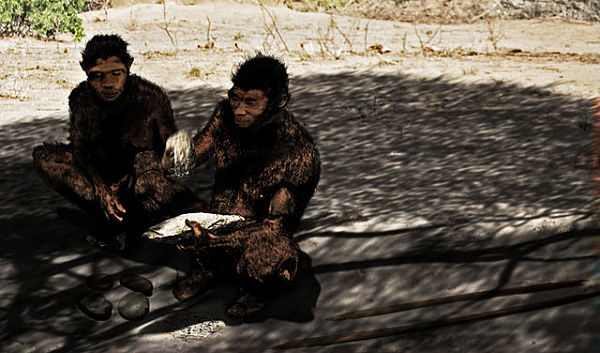
“I’m thinking that with a nudge here and a nudge there we can out-compete those neanderthals.” (Image: Henry Gilbert and Kathy Schick/CC BY-SA 3.0)
Once, behavioral economics was a fledgling challenge to traditional theories. Not any longer; it has matured into a growing field that tries to understand how psychology affects economic decisions.
The tension between traditional and behavioral economics is centered on a fundamental issue of human behavior. Economists have long built their discipline around a view of humans as rational actors who know how to maximize their own happiness – the “homo economicus,” or economic man. Supporters of behavioral economics say that, to the contrary, humans are anything but rational. They argue that a keener understanding of human motivations and incentives can sharpen economic models, improve policy decisions in government and business, and have a positive influence on enterprises as discrete as lunch choices, retirement savings or how companies engage with their customers.

This article by Ken Fireman originally appeared on the LSE Business Review blog as “Behavioural economics challenges traditional view of ‘homo economicus'” and is reposted under the Creative Commons license (CC BY-NC-ND 2.0).
Critics of behavioral economics retort that it has sharply delineated limitations – and that its efforts to influence behavior, sometimes known as nudges, aren’t as powerful as the field’s cheerleaders hope. Some question the propriety of this approach, whether it is government or business that’s doing the nudging. They also doubt proponents’ contentions that behavioral economics can make managers and companies more effective and that it will eventually subsume traditional economics.
Victoria Finkle, a freelance journalist who covers business, banking and public policy, writes in her report “Will a better understanding of behavior improve economic models?” for SAGE Business Researcher that companies and governments have applied the principles of behavioral economics to influence consumers and citizens to modify their behavior. One of the best-known applications is the nudge, an idea popularized by behavioral researchers Richard Thaler and Cass Sunstein, which has had numerous public-policy and private-sector applications.
“A nudge . . . is any aspect of the choice architecture that alters people’s behavior in a predictable way without forbidding any options or significantly changing their economic incentives,” Thaler and Sunstein wrote. “To count as a mere nudge, the intervention must be easy and cheap to avoid. Nudges are not mandates. Putting the fruit at eye level counts as a nudge. Banning junk food does not.”
This so-called choice architecture is present in every decision people make, whether they’re aware of it or not. “The cafeteria will be organized one way or another – fruit and candy will both be served – so why not do it in a way that will encourage people to make healthy decisions?” Finkle writes.
The field also seeks to draw on insights and techniques from scientific disciplines, such as neuroscience. Johannes Haushofer, a professor of psychology and public affairs at Princeton University, wanted to study how poverty, stress and economic decision-making interacted. In particular, he was interested in the impact of interventions such as unconditional cash transfers to poor people. Instead of asking recipients how they felt about it, he measured their cortisol levels.
“If you ask people how happy they are, they might just tell you they’re pretty happy because they’re grateful for this cash transfer,” he says. “The advantage of measuring stress hormones is you don’t have to worry about that, it’s an objective measure.”
But when does a nudge become a shove? There’s no clear line, Finkle writes. And skeptics of the behavioral approach have pointed out some stark real-world limitations, especially when grappling with society’s most intractable problems. One study found that applying various strategies to encourage poor people to save more didn’t work, for one simple reason: “liquidity constraints,” otherwise known as not having enough money.
Also worrisome is the possibility that behavioural approaches can be applied to enterprises that are more concerned with private gain than public weal. “You can think of it as having a light side and a dark side,” says John Beshears, an assistant professor of business administration at Harvard Business School.
Yet amid the ongoing debate, there is a sense of convergence.
Thaler, for example, wrote in his 2015 book, Misbehaving, that the field of behavioral economics will disappear entirely if all economists “are willing to incorporate important variables in their work, even if the rational model says those variables are supposedly irrelevant.” In such an apotheosis, he wrote, “all economics will be as behavioural as it needs to be.”
David Levine, a professor of economics at Washington University in St. Louis, who has been critical of some behavioral economic insights, reaches a similar conclusion, albeit from the opposite starting point. While he says behavioral economics is “doomed” as a separate field of study, he adds: “The parts that are good will become part of mainstream economics and people won’t view them as some sort of different discipline or separate subject.”
***
SAGE Publishing is the parent of Social Science Space.