Communication

Video: Evidence-Based Policy in the Trump Era

July 19, 2018 2718

Two U.S. senators, one a Republican and one a Democrat, assessed how the decades-old movement toward using evidence in public policy is faring in the Trump administration in a session hosted by the Brookings Institution and based on the July 2018 volume of The ANNALS of the American Academy of Political and Social Science.
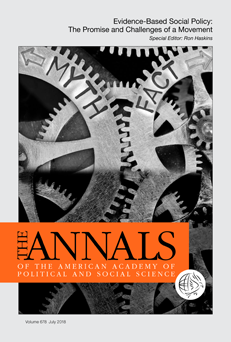
Evidence-based policy issue of ANNALS

View the digital version of the July edition of the ANNALS here.

The volume, which offers an expansive overview of the movement toward evidence-based policy approaches, contains 17 papers by leading experts or policymakers, including Sen. Todd Young, R-Indiana, and Sen. Tom Carper, D-Delaware. The July 17 event began with comments by Young and Carper on how they use evidence in meeting their responsibilities as policymakers, and then featured a panel discussing their comments and the larger issues involved.

As issue guest editor and panel moderator Ron Haskins explained in the introduction to the volume:

For the past decade or two, both federal and state governments – and even several big cities – have been experiencing what might be called an evidence-based uprising that is helping them select or develop effective social and educational programs and then improve them. This volume of the Annals is designed to provide a survey of the field of evidence-based practices and policymaking in papers written by some of its most notable practitioners. All the authors and the editor are fans of evidence-based policy, but most of us are well aware that we have miles to go before we can argue that the field has been proven to consistently improve the nation’s policies and show clear progress in reducing the nation’s social problems, most of which are complex and resistant to amelioration.

The papers explore the history and significance of the evidence-based policy movement, its foundation in empirical research, and the vital role of program evaluation in that research. The papers also address the major elements of the movement, the contributions of government and non-governmental institutions to evidence-based policy, and the views of policymakers.



The American Academy of Political and Social Science, one of the nation’s oldest learned societies, is dedicated to the use of social science to address important social problems. For over a century, our flagship journal, The Annals of the American Academy of Political and Social Science, has brought together public officials and scholars from across the disciplines to tackle issues ranging from racial inequality and intractable poverty to the threat of nuclear terrorism. Today, through conferences and symposia, podcast interviews with leading social scientists, and the annual induction of Academy Fellows and presentation of the Daniel Patrick Moynihan Prize, the Academy is dedicated to bridging the gap between academic research and the formation of public policy.


View all posts by American Academy of Political and Social Science

Related Articles

Quick Insight: David Edmunds on Podcasting for Academe
Communication
July 28, 2026

Quick Insight: David Edmunds on Podcasting for Academe

Read Now
Social Science Expertise Need Credible Engagement to Reach the Public
Communication
July 17, 2026

Social Science Expertise Need Credible Engagement to Reach the Public

Read Now
Watch the Panel: Academic Freedom and the Role of the Academic Librarian
Industry
July 15, 2026

Watch the Panel: Academic Freedom and the Role of the Academic Librarian

Read Now
Quick Insight: Adam Seth Levine on Research4Impact
Impact
June 30, 2026

Quick Insight: Adam Seth Levine on Research4Impact

Read Now
New Series Offers Quick Insights on Today’s Issues

New Series Offers Quick Insights on Today’s Issues

Quick Insight is a series of short videos in which experts from academe and the larger community surrounding the academy address a […]

Read Now
Quick Insight: Mahzarin Banaji on the Bias in the Machine

Quick Insight: Mahzarin Banaji on the Bias in the Machine

Mazarin Banaji, the experimental psychologist at Harvard University widely known for the implicit association test she and her colleagues developed, has spent […]

Read Now
Hazel Markus: We Don’t Have to be Afraid of Difference

Hazel Markus: We Don’t Have to be Afraid of Difference

Stanford psychologist Hazel Rose Markus has been a leading scholar in understanding how culture and psychology interact, a research portfolio that saw […]

Read Now
0 0 votes
Article Rating
Subscribe
Notify of
guest

This site uses Akismet to reduce spam. Learn how your comment data is processed.

0 Comments
Newest
Oldest Most Voted