
The Public’s Statistics Should Serve, Well, the Public
Official statistics such as CPI (the Consumer Prices Index), and GDP (Gross Domestic Product) are widely quoted and analysed, including apparently by the now previous government on matters as important as the timing of the general election.
It is generally the case that official statistics are produced for use in government decision-making. But it is also the ethos among producers of statistics for the government that those statistics should also be freely available to businesses, the media, and the public. Official statistics in the United Kingdom are published on pre-announced release dates and, at least those statistics produced by the Office for National Statistics (ONS), only given to government ministers at the same time as they are published. The notion of statistics for the public good embraces both their use in policy making and by ensuring that the statistics are widely available. However, the Royal Statistical Society (RSS) believes that there is more to be done to truly deliver statistics for the public good, so it is now campaigning for the focus to be on public statistics.
Let’s start by applauding the United Nations’ fundamental principles for official statistics. These locate official statistics as “an indispensable element in the information system of a democratic society, serving the government, businesses, and the public with data about the economic, demographic, social and environmental situation.” The principles apply to the work of all national statistical offices and they clearly underpin the UK official statistical system. They are embodied in the legislation establishing the UK Statistics Authority (UKSA) in 2007 with the statutory objective of “promoting and safeguarding the production and publication of official statistics that serve the public good” (Statistics and Registration Service Act 2007, §7). The phrase quoted was used purposefully in the legislation, with the intention of preventing any future interpretation that official statistics are primarily for government: the public good is properly understood as both informing the public about social, economic, and environmental matters and assisting in the development, delivery, and evaluation of public policy by governments.
The Royal Statistical Society (RSS) has been exploring what statistics for the public good means in practice, including in conversations inside the statistical system and with non-government users. Based on these insights, it is soon apparent that, across national statistical organizations, there is an innate tendency for producers of official statistics to prioritize government users over other users.
In providing information to support government users, statisticians can be confident that they are working towards the public good by assisting the development of public policy and in its implementation, monitoring, and evaluation. However, this may not be enough to fully serve the public good. For example, there are public interest questions on the performance of government and on the consequences of policy decision (both of which may be framed in different ways by government and by others), and on issues that are not current government priorities.
There is a flavor of leaning towards government needs in the UK government’s recent response to the Lievesley review of the UKSA. One recommendation was for a Triennial Statistical Assembly, to determine the UK’s needs for statistics through a wide consultative process, with UKSA then producing a proposal for the statistical priorities for the next three years. In its response, the Cabinet Office agreed to this recommendation, but “with conditions,” adding that “external user engagement will always be balanced against the statistical needs of the Government – particularly economic – which take precedence.”
This does not mean that non-government users are ignored. There are many examples, such as the population censuses, where a wide user base is consulted. Government data can be obtained, analyzed, and published by external organizations, for example, the Centre for Public Data’s Missing Numbers investigations. While this meets more user demands and can unearth unpublished data, it invariably results in a one-off release. There are worse examples. The Observer recently reported that “the government has taken years to reveal the capital costs of some free schools and has failed to publish any data on capital costs for more than four years.”
We fed our emerging thoughts on the case for more public statistics into the Lievesley review and we welcomed her findings. Lievesley is in no doubt about the broader role of official statistics – “to empower, enabling citizens to call governments to account and providing a window on society.”
The RSS recently launched its campaign for public statistics to explore and develop how we can capitalize on the increasing amounts of data available and look beyond official statistics to help answer society’s most important questions. Public statistics is characterized by taking a question-based approach – identifying the areas where statistics are needed to help answer society’s big questions. Too often, the planning and inevitable prioritization of official statistics programs and budgets start from the statistics that are currently produced.
Having framed questions that need statistics, where do we find answers? We live in an increasingly data-rich world. There is a huge quantity of data available beyond official statistics that could be used – and indeed already is being used – to promote the public good. UKSA makes efforts to incorporate some of this into official statistics, but the process is not widespread.
A change of direction in how official statistics systems operate is needed. We might envisage that UKSA’s role, as well as one of the providers of official statistics, will be to gather the questions and identify sources of suitable quality to provide the statistics required. The UKSA’s code of practice for statistics is already being adopted, on a voluntary basis, by non-government producers of statistics and data, alongside the processes to ensure compliance with the code within government.
There is much to unpack around the supply of public statistics and the demand for them. We see this as a long-term vision. Our goal is that production and delivery of public statistics enables a public sphere in which citizens engage with topics and issues. As we in the RSS take forward our overall strategy, including supporting public understanding and engagement, we are firmly committed to working with all who share our passion for better data, better evidence, better decisions, and a better society. We want to do this by building a stronger, shared vision of the form, function, and intended outcomes of a UK public statistics system.
We believe greater public value can be unlocked by a more balanced, user-focused, and more diverse
portfolio of public statistics. Our aim in this report is to generate and sustain a debate about how best to
deliver public statistics. The UK official statistics system – both its producer and its regulatory roles – is vital for this, but we also raise the question of whether that is sufficient for public statistics as we envision
them.”
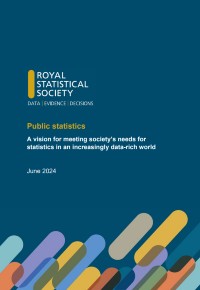
“We believe greater public value can be unlocked by a more balanced, user-focused, and more diverse
portfolio of public statistics. Our aim in this report is to generate and sustain a debate about how best to
deliver public statistics. The UK official statistics system – both its producer and its regulatory roles – is vital for this, but we also raise the question of whether that is sufficient for public statistics as we envision them.”