 Insights
 Watch Now: ‘All Change! 2024 – A Year of Elections’
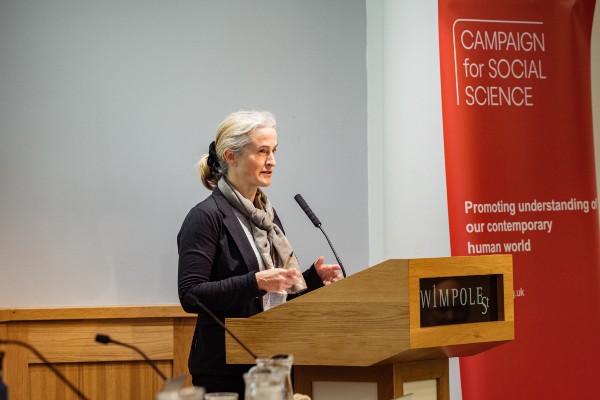
In November, Sage and the Academy of Social Sciences hosted the 2024 Campaign for Social Science Annual Sage Lecture. This year’s talk, “All Change! 2024 – A Year of Elections,” was delivered by Dr. Hannah White OBE.
White is director and CEO of Institute for Government, a UK think tank aiming to make government more effective. She works directly with government ministers to help them understand the value of academic research and how to use it in their roles.
Speaking to a packed lecture theatre in central London, White explored “the relationship between governments delivering for their people and the trust of those people in democracy.”
She began with an overview of recent election results, highlighting Narendra Modi’s losses in India, the Conservatives’ capitulation in the UK, and Donald Trump’s dramatic return to power in the United States. These changes in power typify post-pandemic voting trends: Since 2020, White noted, incumbents have been ousted in 40 of the 54 elections held in Western democracies.
For White, understanding the factors driving this wave of anti-incumbent voting not only helps to contextualize the current political landscape; it offers a glimpse into the future of democracy.
If voters’ electoral choices are driven by evidence of governments delivering for the public, then, as White argued, “there’s an electoral incentive for governments to focus on delivery and hence to work to improve the effectiveness of the state.”
“But if that relationship is loosening,” White continued. “If voters are rewarding factors other than delivery, […] then that’s likely to increase political instability, giving politicians less incentive to focus on delivery, and that could ultimately, I think, undermine democracy.”
Political Change in the United Kingdom
The UK general election, held in July, brought the question of government effectiveness into sharp focus.
A Labour government was elected for the first time in 14 years, claiming 412 of 650 seats and a strong parliamentary majority, as voters spurned an incumbent Conservative Party beleaguered by scandals and party in-fighting.
Keir Starmer, the UK’s new prime minister, “campaigned on a promise to restore trust in government,” observed White, “through a two-pronged approach: of delivering on Labour’s promises and strengthening the ethical standards of his government.”
The UK public chose a party focused on delivering, ousting a government that had failed to do so in the process. But can the new Labour government make good on its promises, deliver change, and inspire trust in government effectiveness?
Watch the full recording of this year’s Campaign for Social Science Annual Sage Lecture to learn more.