From Hot Takes to Habitual Inquiry: A Puzzle-Based Routine for Everyday Critical Thinking in Higher Education
In today’s information ecosystem, reactions often unfold in seconds: a headline provokes emotion, an AI-generated paragraph sounds authoritative, a post feels right, and we respond before reflecting. This pattern is not merely anecdotal. Research shows that rapid engagement with AI-mediated content can weaken reflective judgment when learning environments lack structured opportunities for deeper analysis (Ninghardjanti et al., 2025). Speed, when pedagogically unchecked, reshapes cognition.
Universities urge students to think critically, yet the concept is frequently treated as a discrete skill assessed in exams rather than embedded in everyday learning. Studies of digitally saturated classrooms suggest that presenting evaluation criteria alone does not ensure sustained analytical practice, particularly when students encounter rhetorically persuasive or AI-generated content (Yang et al., 2025).
The real challenge is not defining critical thinking, but making it habitual. Students need repeatable routines—small, structured practices integrated into ordinary class time—that cultivate disciplined inquiry. Evidence indicates that structured questioning and active inquiry significantly strengthen independent evaluation and reflective reasoning under conditions of information overload (Jaramillo Gómez et al., 2025). The question, then, is how to design such routines into the rhythm of higher education.
The Proposal: The Puzzle–Evidence–Language–Genre (PELG) Routine
In my work developing a competency-based professional development model for pre-service teachers, I found a simple but powerful shift: begin not with answers, but with puzzles.
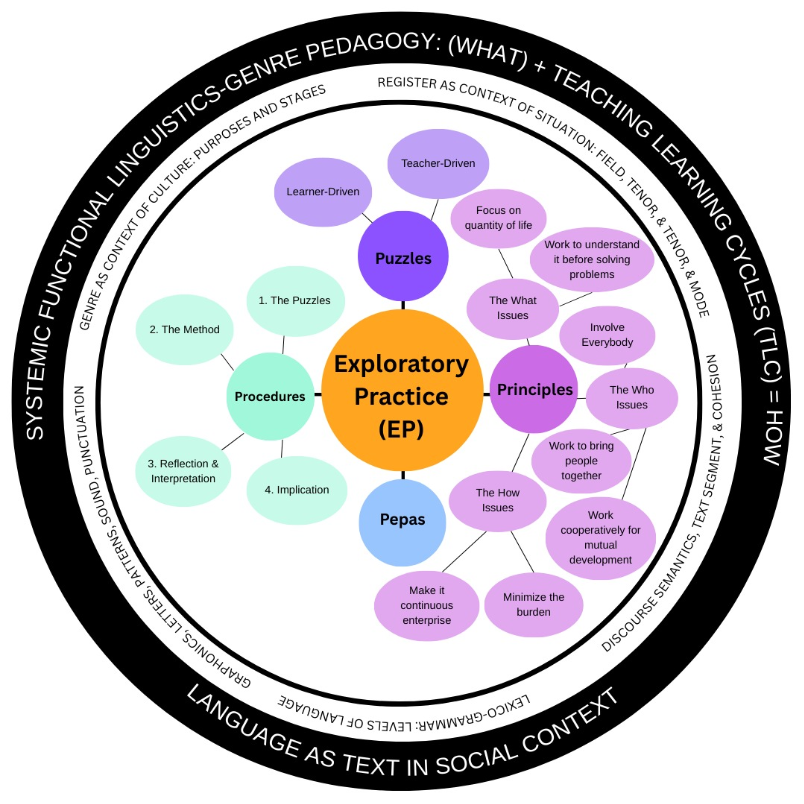
Drawing on Exploratory Practice (Allwright, 2003; 2005), I propose a weekly 15–25-minute micro-routine (see the figure below) that can operate in any course, across disciplines. Its purpose is not to add workload, but to transform ordinary classroom moments into sites of inquiry.
1. Puzzle (2 minutes) – Start with “Why?”
Students write one genuine puzzle framed as a question of understanding.
For example:
Why do I trust this post even though it has no sources?
This move is deceptively simple. Framing inquiry as puzzlement interrupts the reflex to react. It builds the habit of intellectual patience, the ability to stay with uncertainty rather than rushing to judgment.
2. Evidence (5 minutes) – Capture, Don’t Assume
Students gather small but concrete evidence: two quotations, an annotated screenshot, a brief source trail, or a tally of rhetorical patterns.
The rule is intentional minimalism: keep 1–3 artifacts and record immediate observations.
This keeps inquiry sustainable. It avoids the trap of “research fatigue” while shifting students from intuition (“I feel this is persuasive”) to documentation (“Here is how it persuades”).
3. Language (8 minutes) – How Credibility Is Made
Critical thinking is not only about what is said, but how it is said.
Using a simplified Systemic Functional Linguistics lens (Halliday & Matthiessen, 2004), students ask:
- What is happening (Field)?
- Who is positioning themselves, and how (Tenor)?
- How is meaning organized (Mode)?
They notice hedging, certainty markers, thematic emphasis, and cohesion patterns.
This stage reveals a crucial truth: misinformation often succeeds not because it is factual, but because it is rhetorically elegant.
4. Genre (10 minutes) – Make Thinking Visible
Students transform insight into a short, purposeful genre:
- a 150-word evidence note
- a claim–evidence–reasoning paragraph
- a verification checklist
- a source-annotated caption
Genre Pedagogy and the Teaching Learning Cycle (Callaghan & Rothery, 1988; Rose & Martin, 2012) provide scaffolding so that critical thinking is not assumed but structured. Students move from analyzing models to independently producing accountable texts.
Over time, this Puzzle–Evidence–Language–Genre cycle becomes habit. Inquiry stops being exceptional. It becomes normal classroom behavior.
Practice Impact
Information now often appears credible before it is verified. AI fluency mimics expertise, and algorithms reward speed. Critical thinking therefore competes not only with ignorance but with immediacy. The PELG routine counters this culture through structured pause, documented evidence, linguistic awareness, and accountable communication.
The Library as a Habits-of-Evidence Hub
Libraries can scale this habit by curating datasets, teaching source tracing, providing genre tools, and supporting faculty integration—positioning themselves as campus hubs for ethical, evidence-based inquiry across disciplines and communities globally.
Reflection
Critical thinking should not be an occasional performance but a sustained weekly rhythm embedded in the life of the classroom. Rather than cultivating suspicion, we should nurture disciplined curiosity; rather than rewarding speed, we should prioritize structured inquiry; rather than amplifying hot takes, we should normalize habitual investigation. If students are to navigate the complexity of today’s information landscape, they must learn not only what to think about, but how to slow down, pose better questions, gather and examine evidence, and make their reasoning visible. Habits develop through repetition, and repetition requires intentional design. The Puzzle–Evidence–Language–Genre routine offers one deliberate way to weave critical thinking into the everyday practice of higher education.
References
Allwright, D. (2003). Exploratory Practice: Rethinking practitioner research in language teaching. Language Teaching Research, 7(2), 113–141. https://doi.org/10.1191/1362168803lr118oa
Allwright, D. (2005). Developing Principles for Practitioner Research: The Case of Exploratory Practice. The Modern Language Journal, 89(3), 353–366. https://doi.org/10.1111/j.1540-4781.2005.00310.x
Callaghan, M., & Rothery, J. (1988). Teaching factual writing: A genre-based approach. Metropolitan East Disadvantaged Schools Program.
Halliday, M. A. K., & Matthiessen, C. M. I. M. (2004). An introduction to functional grammar (3rd ed.). Hodder Arnold.
Jaramillo Gómez, D. L., Álvarez Maestre, A. J., Parada Trujillo, A. E., Pérez Fuentes, C. A., Bedoya Ortiz, D. H., & Sanabria Alarcón, R. K. (2025). Determining factors for the development of critical thinking in higher education. Journal of Intelligence, 13(6), 59. https://doi.org/10.3390/jintelligence13060059
Ninghardjanti, P. P., Umam, M. C. M. C., Subarno, A., Widodo, J., & Risanti, N. N. (2025). Evaluating the impact of AI on critical thinking skills among higher education students by combining the TAM model and critical thinking theory. Frontiers in Education, 10. https://doi.org/10.3389/feduc.2025.1719625
Rose, D., & Martin, J. R. (2012). Learning to write, reading to learn: Genre, knowledge and pedagogy in the Sydney School. Equinox.
Yang, A., Sulaiman, N. A., & Yaccob, N. S. (2025). Enhancing critical thinking skills for higher education students through structured instructional modules. Cogent Education, 12(1). https://doi.org/10.1080/2331186X.2025.2587466
Yanto, E.S (2025). Developing A Competency Profile- Based Professional Development Model for Pre-Service English Teachers Through Exploratory Practice in Indonesia [Doctoral dissertation, Universitas Negeri Yogyakarta].