
The 3E Cycle: Establish-Examine-Evolve as a Structured Model to Foster Critical Thinking
In university classroom, I once asked my undergraduate students if a particular policy decision had strengthened or weakened the national economy. Few hands went up immediately. Opinions came quickly. The responses felt obvious to them, almost settled before analysis could begin.
What was missing was hesitation.
Students were ready to take positions, but less prepared to interrogate them.
This pattern is not unique. In higher education, critical thinking is often taught as debate, speech, critique, or essay writing. Students learn to defend arguments, sometimes to attack opposing ones. But rarely are they required to reconstruct ideas after sustained examination.
To address this gap, I developed a structured classroom model called “The 3E Cycle: Establish – Examine – Evolve”. Its goal is simple – it makes critical thinking procedural, collaborative, and embedded in classroom practice.
The Challenge
What is missing in the way critical thinking is taught is not content but structure. Many students equate critical thinking with having strong opinions. Moreover, in large public university settings, participation is uneven. Loud voices dominate. Others retreat. And when students self-select positions, they often defend beliefs they already hold.
Critical thinking, however, requires intellectual flexibility. It requires the ability to examine assumptions, including one’s own, and to refine conclusions in light of evidence.
The 3E Approach
The 3E Cycle institutionalizes this flexibility through structured role allocation and staggered intellectual responsibility.
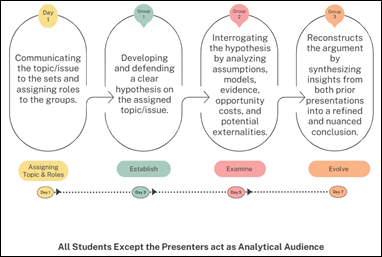
Design: The class is divided into multiple sets of three groups, with each group consisting of four to five students. Within each set, roles are assigned to the groups through randomized role allocation as:
- Establish (Group 1) – Develops and defends a clear hypothesis on the assigned topic/issue.
- Examine (Group 2) – Interrogates the hypothesis by analyzing assumptions, models, evidence, opportunity costs, and potential externalities.
- Evolve (Group 3) – Reconstructs the argument by synthesizing insights from both prior presentations into a refined and nuanced conclusion.
Each set participates once during the semester. The topic/issue is communicated to the selected set at the beginning of its cycle rather than in advance.
The cycle unfolds usually over seven instructional days:
- Day 1 – Issue announced; roles assigned.
- Day 3 – Establish group presents.
- Day 5 – Examine group presents.
- Day 7 – Evolve group presents.
Each group makes a 30-minute presentation on its assigned day. All other students of the class attend as analytical audience members. Verbal presentations are subsequently submitted in written form as graded assignments. Assessment rubrics are shared in advance and evaluate depth of analysis, quality of evidence, fairness of critique, and sophistication of synthesis rather than ideological position.
How It Works in Practice
Consider one issue recently assigned to a set:
“India’s recent foreign policy initiatives have generated greater economic costs than benefits.”
The Establish group presented a cost-benefit framework, citing trade balances, energy imports, strategic investments, and geopolitical risk exposure. Their task was not to provoke but to build a coherent, evidence-supported hypothesis.
Two days later, the Examine group responded. They did not attack. Instead, they questioned data sources, challenged the time horizon of analysis, examined indirect gains such as strategic alliances, and highlighted counterfactual scenarios.
By the final day, the Evolve group had to integrate both prior presentations and produce a more nuanced position. Their conclusion reframed the issue conditionally: the economic outcome depended on sectoral exposure, global commodity cycles, and policy coordination. What began as a binary claim became a layered economic assessment.
Other issues assigned were:
- “Subsidy-driven welfare schemes distort markets more than they alleviate poverty.”
- “Artificial intelligence will increase economic inequality in developing countries.”
In each case, it is the structure – not the topic – that drives the learning.
Practical Impact
The 3E Cycle has produced noticeable improvements.
First, students demonstrate greater intellectual patience. They listen more carefully, knowing their peers will build upon their reasoning.
Second, randomized role allocation disrupts ideological comfort zones. Students must learn to defend positions they do not personally hold, fostering analytical empathy and reducing polarization.
Third, the staged format encourages evidence use. The Examine group must engage with actual arguments, not anticipated ones. The Evolve group must synthesize rather than summarize.
The model requires no additional funding, no specialized technology, and no curriculum overhaul. It works within existing syllabi and accommodates undergraduate and postgraduate cohorts alike. Non-working days and holidays are factored into planning, and assessment criteria are transparent from the outset.
From Activity to Habit
The 3E Cycle approach transforms classroom disagreement into structured intellectual evolution. It teaches students that thinking critically is not merely about winning an argument. It is about improving it. When students pause to ask what assumptions underlie a claim or how a position might be reconstructed rather than rejected – critical thinking moves from performance to practice.