


Could Distributed Peer Review Better Decide Grant Funding?
The landscape of academic grant funding is notoriously competitive and plagued by lengthy, bureaucratic processes, exacerbated by difficulties in finding willing reviewers. Distributed […]

The first time you’re asked to write a peer review, it can seem like confirmation that you are no longer an academic poseur but a real member of the club. Then the realization that you’ve never written a peer review sets in. Here are some tips on taking that initial step.

Math can be immoral. too. Algorithms rarely come equipped with an explanation for why they behave the way they do, notes mathematician Jeremy Kun, and the easy (and dangerous) course of action is not to ask questions.

The AllTrials campaign, which asks clinical researchers to register their trials and then release all the data gained, has come to the United States.

An archived version of a webinar offering strategies and tools for text and data mining for scholars in the social sciences and […]

The US tortured prisoners in the ‘War on Terror.’ That that a major health care association colluded in this, argues J. Wesley Boyd, is unconscionable.

It’s a poor workman who blames his tools, argue two proponents of the ‘proper’ use of PowerPoint in the classroom. And here they offer tips on how to use the dread Microsoft product well.

It is evident then that building trust and creating relationships is what volunteers want as the mainstay of good research practice, not extra forms or excessive levels of data protection by researchers.
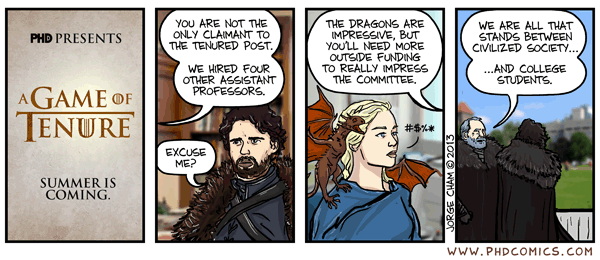
Cathy Sandeen, chancellor of University of Wisconsin Colleges and the University of Wisconsin-Extension, argues that universities need to be more honest on how academic freedom applies to different teaching roles in an environment where tenure is no longer a given.

The Royal Swedish Academy of Sciences has awarded this year’s Nobel Prize in Economic Sciences to the American economists Robert E. Hall […] Four Americans working in the social and behavioral sciences are among the 20 people named MacArthur Fellows this year. Recipients may be […] Euan Adie, the founder of Altmetric and later of Overton, discusses the reasons the led to Overton’s focus on showing researchers how […] The following is an adapted extract from The Cultural Industries, fifth edition, by David Hesmondhalgh. The increasing presence of information technology (IT) […] Developers of AI data centers have a public trust problem. According to multiple surveys, a majority of Americans say they would oppose […] I was adding some final flourishes on the topic of ‘iatrocracy’ to my forthcoming book with Natewindé Sawadogo – Sickness and Social […]
EXPLORE
Impact

Economic Peaks, Troughs and This Year’s Nobelists in Economics
READ MORE

Four From Social Science World Receive 2026 MacArthur Fellowships
READ MORE

Quick Insight: Euan Adie on Getting Academics Credit for Their Impact
READ MORE
Innovation
IT Giants and Their Operations: Should We Be Concerned?
READ MORE

What We Miss When We Study Public Trust with Surveys Alone
READ MORE

AI and ‘Iatrocracy’ – A Cautionary Tale
READ MORE