


Could Distributed Peer Review Better Decide Grant Funding?
The landscape of academic grant funding is notoriously competitive and plagued by lengthy, bureaucratic processes, exacerbated by difficulties in finding willing reviewers. Distributed […]

Current legislation calls for federally funded science to be in the ‘national interest.’ What does that even mean, and why do scientists fear this Republican-led effort?

Amitai Etzioni argues that the U.S. shouldn’t automatically resort to the big stick when engaging in its self-imposed job as the world’s enforcer of freedom of navigation.

With most works of art looking at the past, the real focus is the present. The new movie ‘Suffragette,’ writes Robert Dingwall, invites us to think about the consequences of political systems that are supposedly democratic but systematically exclude many voices.

Given the angry images cascading off TV screens, it’s pretty clear that migrants aren’t welcome in Europe. Or are they? Three papers in a themed edition of the ‘International Journal of Comparative Sociology’ suggest a more nuanced answer.

The Global Insights Initiative, with its intriguing acronym of GINI, will bring experimentation to the World Bank’s poverty-fighting efforts by incorporating behavioral and social science into its project design and evaluation.
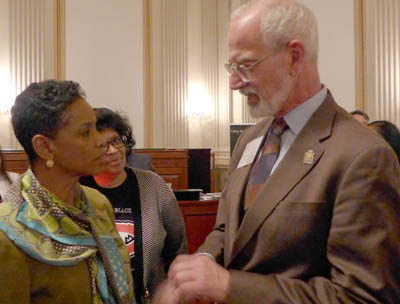
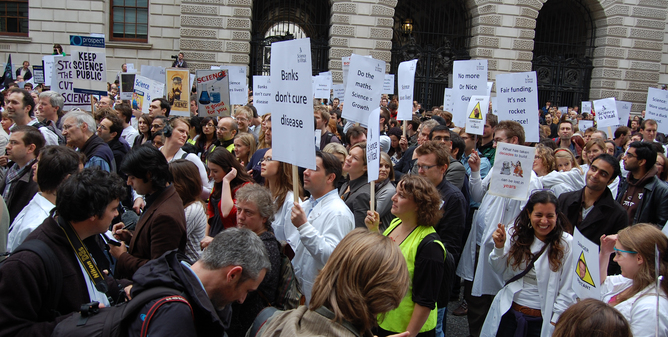
A bill that would require the National Science Foundation to justify, in writing, that every grant it makes is in the national interest and “worthy of federal funding” passed the science committee of the U.S. House of Representatives this morning.

From the margins of the political landscape to its center, Ruth Wodak examines the trajectories of populist right-wing parties in Europe in order to understand and explain how they are transforming from fringe voices to persuasive political actors who set the agenda and frame media debates.

Although a U.S. government shutdown has apparently been kicked down the road just a little bit longer, but a potential new shutdown — and its ruinous consequences for grant-funded science –always seems to be just around the corner.

Jürgen Habermas, a globally known social theorist whose explorations of democracy, validity and communication have gained new prominence in the current moment, […] People often see science as a world apart: cool, rational and untouched by persuasion or performance. In this view, scientists simply discover […] “Research impact” means different things to different people. Some refer broadly to how science changes behaviors, beliefs, or practices outside academic institutions. […] David Canter considers informal places where people socialize, suggesting they’re an arena ChatGPT and other LLMs can’no’t replicate. As someone who lives […] It’s become cliche since Clive Humbly coined it in 2006, but data is indeed the new oil. It’s a mantra repeated by […] In September 2025, The Guardian reported about a lawyer in Australia having faced sanctions due to false citations. These citations were not […]
EXPLORE
Impact

Jürgen Habermas, 1929-2026: Exponent of the Public Sphere
READ MORE

Scientists Should Keep in Mind It’s Called the ‘Marketplace of Ideas’ for a Reason
READ MORE

Survey Finds Social Scientists Feel Unsupported in Seeking Societal Impact
READ MORE
Innovation

Reaching Parts to Which AI Has No Access
READ MORE

Andrea Medina-Smith on Making Research Data More FAIR
READ MORE

A Status Check on Hallucinated Case Law Incidents
READ MORE