

Could Distributed Peer Review Better Decide Grant Funding?
The landscape of academic grant funding is notoriously competitive and plagued by lengthy, bureaucratic processes, exacerbated by difficulties in finding willing reviewers. Distributed […]

Socially responsible businesses in emerging fields such as energy efficiency and renewable energy have great potential, but can be fraught with uncertainty. […]
Corporate social responsibility (CSR) means going above and beyond business interests to take action for the greater good of society. If a […]
We’ve all experienced that occasional afternoon slump at the office. But when workplace emotional exhaustion accumulates on a daily basis, it can […]
“In matters of style, swim with the current; in matters of principle, stand like a rock.” —Thomas Jefferson We hope you’ve enjoyed […]

The British Academy recently published a guide for students encouraging those studying the humanities and social sciences to become statistically savvy.

Quantitative Skills (QS) can take you far in academia and the research world, giving you the keys to unpick complex phenomena and critically evaluate other studies. These Q&As with established professors, early career researchers and PhD students reveal the importance of QS within their diverse fields.

Quantitative Skills (QS) give ‘empirical grit’ to the work of charities and third sector organisations. Here, Sharon Witherspoon, Director of the Nuffield Foundation and 2011 Winner of the British Academy President’s Medal and Aleks Collingwood, Programme Manager at the Joseph Rowntree Foundation, explain how QS have been crucial to their careers.

Quantitative Skills (QS) are invaluable in the public sector and politics. They provide robustness to political debates and policy decisions. Find out more from a member of the House of Lords, the National Statistician and Director of Operations at the British Library.
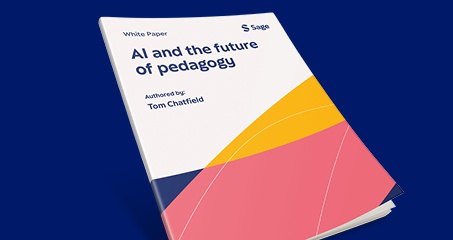
When people trust science, they can make better decisions, follow helpful rules and work together on big problems like health, climate change […] Do you know a social or behavioral science researcher whose work resonates across disciplines and which has made a significant impact in […] Please note: this contest has now closed. The winner will be contacted in due course. This November, Sage and Overton invite you to share the unexpected […] The latest generation of artificial intelligence models is sharper and smoother, producing polished text with fewer errors and hallucinations. As a philosophy […] In a new white paper by Tom Chatfield, the philosopher of tech and critical thinking outlines a practical roadmap for integrating artificial intelligence into […] Distance learning far precedes the digital age. Before online courses, people relied on print materials (and later radio and other technologies) to […]
EXPLORE
Impact

There Is a Cost to Being Honest About Science
READ MORE

Outstanding Social and Behavioral Scientists Sought for Sage-CASBS Award
READ MORE
Share Your Most Surprising Policy Citation for Chance to Win $500 [Closed]
READ MORE
Innovation

An AI Authorship Protocol Aims to Sharpen a Sometimes-Fuzzy Line
READ MORE

A Box Unlocked, Not A Box Ticked: Tom Chatfield on AI and Pedagogy
READ MORE

AI Gaming of Some Online Courses Threatens Their Credibility
READ MORE