Marking Islamophobia Awareness Month 2026
Don’t Let It Slide: Beyond Raising Awareness
November marks Islamophobia Awareness Month, an annual campaign that celebrates the contributions of Muslims, reflects on Muslim experiences, and draws attention to the widespread and growing prejudice and discrimination Muslims face.
This year’s theme, “Don’t Let It Slide,” is a simple but important phrase.
But what does “Don’t Let It Slide” actually mean when many Muslims increasingly fear for their safety in public spaces? Or when dehumanising narratives about Muslims and Islam have become commonplace across the media, politics and everyday conversation? And what does it ask of us when, as scholars including Peter Hopkins and Nathan Lean have argued, Islamophobia is not only normalised, but can also be politically and economically profitable?
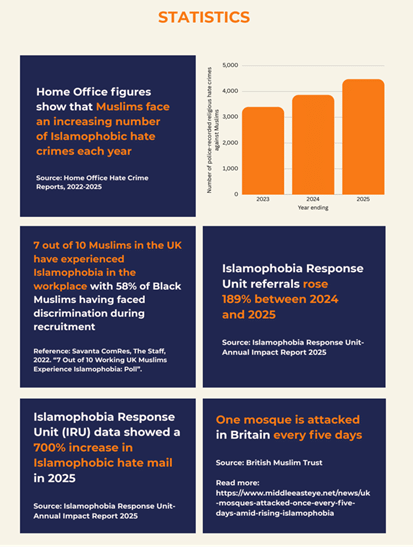
With anti-Muslim hatred at record levels and attacks on Muslim communities growing in number and severity, this year’s theme, a call to action, feels especially urgent.
For many, Islamophobia Awareness Month is an opportunity to learn more about Muslim experiences and the impact of anti-Muslim prejudice. Understanding Islam and the historical roots of Islamophobia, recognising the forms it takes today, and listening to those affected is essential.
But awareness on its own is not enough. “Don’t Let It Slide” asks us to think about what we do with that awareness. What happens when we hear a discriminatory comment, encounter a stereotype, or see misinformation being repeated? Do we challenge it, or do we let it pass?
It can be tempting to dismiss individual comments or incidents as too small to address. But prejudice does not become normal overnight. Islamophobia is sustained through the comments that go unchallenged, the stereotypes that are repeated as fact, the assumptions that shape how Muslims are spoken about, and the misinformation that gradually becomes part of everyday discourse.
Turning Awareness into Action
Challenging Islamophobia is something we can all play a part in. So how do we not let it slide?
- Keep learning: Seek out credible books, research, documentaries and first-hand perspectives that deepen your understanding of Islam, Islamophobia and the diversity of Muslim experiences.
- Don’t let prejudice go unchallenged: When you encounter Islamophobic remarks, stereotypes or misinformation, question or challenge them where you can. Not every intervention needs to be confrontational to make a difference.
- Listen and engage: Make space to hear directly from Muslim colleagues, friends, scholars and communities, rather than relying on assumptions about Muslim experiences.
- Reflect on your own assumptions: None of us are immune to the ideas and stereotypes circulating around us. Taking the time to question our own assumptions is part of recognising how prejudice can take root.
We cannot challenge what we do not understand, and critical scholarship has an important role to play in building that understanding. Explore this curated selection of resources from Sage, Social Science Space’s parent, alongside a number of external resources that we think are worth exploring.
Sage Resources
Sage Journals Articles (free to access all November)
The “Great Replacement” conspiracy: How the perceived ousting of Whites can evoke violent extremism and Islamophobia by Milan Obaidi, Jonas Kunst, Simon Ozer, and Sasha Y. Kimel | Group Processes & Intergroup Relations, 2021
Engaging With Vilifying Stereotypes: The Role of YouTube Algorithmic Use in Perpetuating Misinformation About Muslim Congresswomen by Saifuddin Ahmed and Teresa Gil-Lopez | Journalism & Mass Communication Quarterly, 2022
Xenophobic and Islamophobic Rhetoric among Evangelical Opinion Leaders in the Age of Trump by Joseph Roso | Socius: Sociological Research for a Dynamic World, 2025
A Hijab-Effect Too? Clients’ Reflections on Professionalism and Empathy Toward Hijab-Wearing Public Servants by Katharina Dinhof, Jurgen Willems, and Noortje de Boer | Review of Public Personnel Administration, 2024
The Women’s Mosque of America: Authority and Community in U.S. Islam by Helena Zeweri | Contemporary Sociology: A Journal of Reviews, 2023
Reducing Islamophobia through Conversation: A Randomized Control Trial by Kathryn Benier, Nicholas Faulkner, Isak Ladegaard, and Rebecca Wickes | Social Psychology Quarterly, 2024
Stereotypes about Muslims in the Netherlands: An Intersectional Approach by Samira A. Wiemers, Valentina Di Stasio, and Susanne Veit | Social Psychology Quarterly, 2024
Reducing Islamophobia: An assessment of psychological mechanisms that underlie anti-Islamophobia media interventions by Samantha L. Moore-Berg, Boaz Hameiri, Emily Falk, and Emile Bruneau | Group Processes & Intergroup Relations, 2022
Labour’s island of strangers: race, class and the politics of immigration in Starmer’s Britain by David Bates | Race & Class, 2026
Blurred boundaries between direct and indirect discrimination under EU law: The true nature of religious discrimination created by a corporate neutrality policy by Mustafa T. Karayigit | International Journal of Discrimination and the Law, 2026
Islamophobia: The discursive apparatus of Israel’s genocide in Gaza, Palestine by Samir Sweida-Metwally | Critical Sociology, 2025
The suspect citizen: Institutional Islamophobia, prevent, and the British Muslim experience by Judith Bruchhaus & Tahir Abbas | The British Journal of Politics and International Relations, 2025
“Muslims are Leaving Football, They Think ‘What is the Point?’”: A Qualitative Study on Islamophobia in Grassroots Football in England and Wales by Imran Awan and Irene Zempi | Journal of Sport and Social Issues, 2025
Managing the Self: The ‘invisible work’ of British Muslim women in maintaining safety in public spaces by Minahil Naqvi, Erica Pani, Alan Mace, and Nancy Holman | Environment and Planning C: Politics and Space, 2026
Identifying a space for young Black Muslim women in contemporary Britain by Sheymaa Ali Nurein and Humera Iqbal | Ethnicities, 2021
Say-Walahi Diaspora Youth, Islamophobia and Anti-Black Racism: Implications for Education by Ahmed Ali Ilmi | Urban Education, 2025
Special Issue: Islamophobia, racialisation and the ‘Muslim problem’ in France | French Cultural Studies, 2021
Sage Books
The Muslim, State and Mind Psychology in Times of Islamophobia by Tarek Younis | Sage Social Science for Social Justice
Understanding Islam A Guide for Teachers by Imran Mogra
The SAGE Handbook of Islamic Studies by Akbar S Ahmed and Tamara Sonn
Islamophobia: History, Context and Deconstruction by Zafar Iqbal
Sage Research Methods
Micro-Level Theoretical Frameworks: Developing MusCrit to Study the Muslim American Experience by Noor Ali | Sage Research Methods Video, 2026
Inclusive Researching of Islamophobia Moral Panic: A Reflexive Case Study on Ethics and Online Discourse by Paul TJ French | Sage Research Methods Case, 2026
Mixed-Methods Research, Anti-Muslim Racism and Muslim Communities in Ireland by James Carr | Sage Research Methods Case, 2018
Further Resources
Books and Chapters
Hopkins, P. (2025). ‘The Islamophobia industrial complex’. In Everyday Islamophobia (pp. 33–50). Bristol University Press. DOI. [https://do…1529232691]
Lean, N. (2017). The Islamophobia Industry: How the Right Manufactures Hatred of Muslims. Pluto Press.
Websites and Articles
Amaliah. 10 Books to Understand How Islamophobia Became a Global Industry. Read the article. [https://ww…-supremacy]
Everyday Muslim. Everyday Muslim. Visit Everyday Muslim. [https://ww…uslim.org/]
Islamophobia Awareness Month. Islamophobia Awareness Month. Visit the IAM website. [https://ww…eness.org/]
Manchester University Press. (2021). Islamophobia Awareness Month reading list. View the reading list. [https://ma…ding-list/]
Runnymede Trust. Islamophobia: The intensification of racism against Muslim communities in the UK. Read the publication.