The Publication Facts Label – Shared Information About the Ingredients of Integrity
With threats to research integrity continuing to increase, more and more attention is being paid to “trust markers.” There is currently no agreed industry definition of exactly what a trust marker is – although this will soon be addressed by a new National Information Standards Organization Working Group – but, in its broadest sense, it’s an indicator of the integrity of a piece of content. Importantly, it is not necessarily an indication of the quality of that content.

ORCID trust markers are a good example of what this means in practice. According to ORCID, they are “assertions in records that you trust, for your particular use case, [which] should be those added by the data sources you trust, as disclosed by the provenance data attached to each assertion.” They are easily identifiable in an ORCID record, both behind the scenes, in the metadata, and visually online, by a green check mark beside an item. ORCID trust markers indicate that the data has been added by a trusted third party – an organization that “owns” the information being shared – such as an institutional affiliation added directly to an individual’s ORCID record by their own university, or grant information added by the funder who made the award.
These markers don’t indicate the quality of the university or the grant, only that they are genuine entities (not fake) and that the individual has a verified connection with them.
The NISO Working Group will be looking at a number of existing and evolving trust markers, including one that is a little different from the others – the Publication Facts Label (PFL). Developed by the Public Knowledge Project for journals on its widely-used Open Journal Systems (OJS) platform, it’s modeled on the widely-used Nutrition Facts label that appears on packaged food. Nutrition labels, according to this 2025 U.S. Department of Agriculture study, are now regularly used by nearly 80% of adults over the age of 18 in the US – a pretty impressive takeup! Like the nutrition facts label, the goal for the PFLis to quickly and easily share facts about a research article with whoever is reading it, whether that’s another researcher, a journalist, a policy-maker, a member of the public, or anyone else.
The label appears as a dropdown on the article landing page, delivering “just-in-time” facts about the article’s adherence to well-established scholarly publishing standards such as the number of reviewers, the time to publication, whether there are any conflicts of interest or datasets connected with the article, and more (see figure). All the data in the label is pulled directly from the publishing system, which helps to guarantee its validity, and raises the bar on preventing hacking.
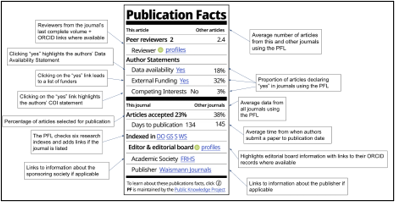
To help ensure that the PFL is accessible and helpful to all these groups, the PFL has been tested on over 100 researchers, science journalists, and high school students (tough but invaluable critics during the development process!). Public Knowledge Project also included a brief feedback poll in their initial pilot of the label with 130 OJS journals; members of the public (22% of those who opened the label) scored it 4.8/5 in terms of usefulness, and researchers scored it 4.4. High schoolers (admittedly a small sample) graded it 2/5, so perhaps more work is needed there!
The PFL is currently being rolled out to the 42,000 journals using recent versions of OJS, and has been adopted by nearly 1,500 of them already. However, to achieve its full value, the label needs to become an industry standard across all scholarly journals. Following in the footsteps of the Nutrition Facts label, which is a trusted source of information for consumers of food and drink, widespread adoption of the PFL would build trust in published research by increasing transparency about the publishing process in a way that can be easily understood by all readers.
Among the benefits of this increased trust is a greater integration and utilization of the global expansion of research activity, following the expansion of higher education in the Global South in the twenty-first century. This means scientists gaining a greater confidence in citing and building on relevant research from a broader range of sources. It means encouraging the public to see the special qualities that distinguish what research brings to the infosphere.
Discussions are underway with a mix of stakeholders – industry organizations, service providers, and publishers, including Sage, the parent of Social Science Space – about piloting the label, and we’re hoping to announce one or more pilots later this year or early 2027. And, for a quick and fun overview of the Publication Facts Label, we’re happy to share this video.