 Recognition
 A Sweet (Potato) Winner for Social Science
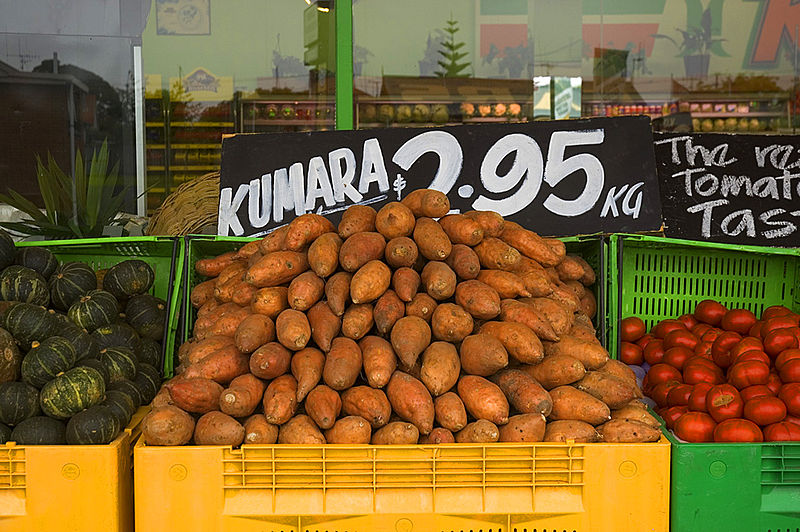
Linguistic evidence, like the Maori word for sweet potato being similar to the Quechua word, also suggests pre-Columbian contact.
A paper that shines light on the enigmatic spread of the sweet potato throughout the populated bits of the Pacific Ocean and what that tells us about pre-Columbian contact between Polynesia and the Americas has been named one of six winners of the Cozzarelli Prize for scientific excellence and originality.
Six Cozzarelli awards are given out each year for papers that appeared in the Proceedings of the National Academy of Sciences of the United States of America, or PNAS, a pioneer of open access. The awards cover the breadth of the fields PNAS covers –physical and mathematical science, biology, engineering and applied science, biomedical science, and applied biological, agricultural and environmental science. The sweet potato paper was honored in the area of behavioral and social science.
In that paper, “Historical collections reveal patterns of diffusion of sweet potato in Oceania obscured by modern plant movements and recombination,” Caroline Roullier of France’s Centre International de Recherches en Agronomie pour le Développement and three co-authors used markers found in current sweet potato populations to add evidence for contact between Pacific islanders and South Americans before Europeans arrived in the New World. That relatively straightforward task, which runs in parallel with archaeological and linguistic investigations by others, has been made more difficult by later reintroductions of sweet potatoes, which “have reshuffled the crop’s initial genetic base, obscuring primary patterns of diffusion.” Nonetheless, Roullier and her colleagues say their research gives “strong support for prehistoric transfer(s) of sweet potato from South America (Peru-Ecuador region) into Polynesia.”
The award was established in 2005 and named in 2007 to honor late PNAS Editor-in-Chief Nicholas R. Cozzarelli. This year’s honorees will be recognized during the PNAS Editorial Board Meeting and the NAS Annual Meeting Awards Ceremony on April 27 in Washington, D.C.
To see the other papers recognized, click here.