Two Social Scientists Headed to National Science Board
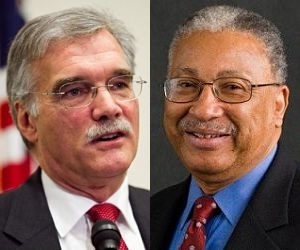
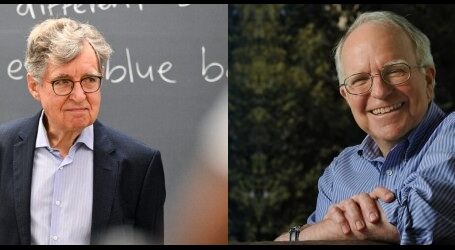
Robert Groves, left, and James Jackson
The board sets policy for the federal National Science Foundation and provides advice to the president and Congress on science and engineering policy; it has gained a little extra prominence this year in publicly opposing legislation that sets limits on NSF’s discretion to fund grants—specifically in the social sciences—based on merit.
According to the White House, appointments to fill the remaining two vacancies on the 24-member board (the NSF director is an ex officio 25th members) are anticipated in the next few months. The five people named Monday will be sworn in during the board’s meeting in August. Among the currently sitting board members, only two — Alan Leshner and Deborah L. Ball — have backgrounds in the social sciences.
Groves is currently the provost and Gerard Campbell SJ Professor in the Department of Mathematics and Statistics at Georgetown University, positions he has held since ending three years as head of the Census in 2012. He was a research professor at the University of Michigan from 2002 to 2012 and a research professor at the University of Maryland from 1995 to 2012. While at Michigan, Groves directed the school’s Survey Research Center Institute for Social Research from 2001 to 2009; he was the program director of the Survey Research Center from 1988 to 1995, a period that included serving as associate director of the Census from 1990 to 1992.
Jackson, meanwhile, is currently at Michigan, where he has been research professor and director of the Institute for Social Research since 2005. Since joining the faculty there in 1971, he has been the Daniel Katz Distinguished University Professor of Psychology, a faculty associate in the Center for Research on Ethnicity, Culture and Health, and professor of Afroamerican and African Studies. Jackson served on the Councils of the National Institute on Aging from 2005 to 2008 and the National Institute of Mental Health from 1989 to 1993. He was elected the W.E.B. Du Bois Fellow of the American Academy of Political and Social Science in 2012, and is in the second year of two-year term as president of COSSA, a Washington-based coalition that advocates for the social sciences.
Other incoming members of the board include:
John L. Anderson, a professor of chemical engineering and is currently serving as the eighth president of the Illinois Institute of Technology. A member of the National Academy of Engineering, Anderson formerly served as provost of Case Western Reserve University and dean of the College of Engineering at Carnegie Mellon University.
Roger N. Beachy, the founding executive director of the World Food Center at UC Davis. Previous positions include serving as the first director of the U.S. Department of Agriculture’s National Institute of Food and Agriculture and as president of the Donald Danforth Plant Science Center in St. Louis.
Vicki L. Chandler, a distinguished plant biologist and former director of the BIO5 Institute at the University of Arizona. She is currently the chief program officer for the Gordon and Betty Moore Foundation where she leads the science program. A member of the National Academy of Sciences, Chandler is president of the Genetics Society of America.
Sethuraman Panchanathan, the senior vice president for knowledge enterprise development at Arizona State University. He also directs the Center for Cognitive Ubiquitous Computing and founded the university’s School of Computing and Informatics and Department of Biomedical Informatics.
The National Science Foundation Act of 1950 created both the NSF and the National Science Board. The law states that nominees to the board will be “selected solely on the basis of established records of distinguished service” and “eminent in the fields of the basic, medical, or social sciences, engineering, agriculture, education, research management or public affairs.”