 News
News Finding Right With Wrong: Improving STEM Performance in US Schools
“Ideally, this idea could be applied across the education system so that even elementary school students are taught that errors can be a useful and critical part of the learning process, and that making an error does not mean they are not good at a particular skill.”
We all learn from our mistakes, but for some reason this learning principle is absent in most, if not all, STEM instruction and curricula in the United States, explains new research in the journal PIBBS—Policy Insights from the Behavioral and Brain Sciences.
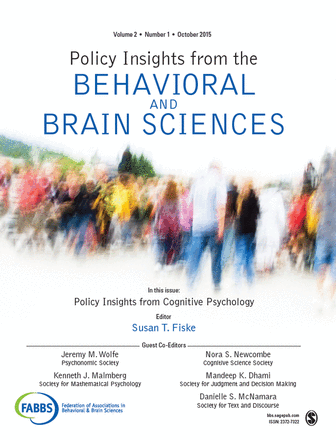
The Federation of Associations in Behavioral and Brain Sciences, or FABBS, with SAGE, the parent of Social Science Space, publishes the journal Policy Insights from the Behavioral and Brain Sciences. This journal features research findings in the sciences of mind, brain, and behavior that are applicable to nearly every area of public policy. The second issue features 22 articles focused on cognitive psychology focused on topics including education, health, evaluating and mitigating risk, law, and improving society.
In contrast, errors are frequently discussed in Japanese classrooms. Japan’s practice of learning by mistakes “may very well be one of the reasons for the greater performance on STEM content seen frequently in Japan and other countries compared with the United States,” the article states.
Learning from mistakes is one piece of a larger principle known as the ‘worked example.’ The research authors—Julie Booth, Kelly McGinn, Laura Young and Christina Barbieri—suggest that the constraints of standardized testing may help explain why STEM instructors in the United States rarely used worked examples.
Through worked example learning, students are asked to study a worked-out example of a problem solution, rather than solving those problems themselves. In addition to learning from mistakes by studying incorrect worked examples, other worked example types are:
- Faded Worked Examples– in which the first example is completely worked out, and subsequent examples have fewer and fewer steps worked out, and more and more steps for students to complete themselves.
- Worked Examples with Self-Explanation– in which students are asked to explain what was done in the example.
- Comparing Worked Examples–in which students are asked to compare two worked examples.
Citing 2015 research from the Journal of Education for Students Placed at Risk, the researchers explain that during the course of a school year, teaching with worked examples has yielded a 7 percent improvement in student performance.
Yet, despite three decades of research showing the benefits, worked examples are the exception rather than the norm in most U.S. textbooks, according to the researchers. A typical math curriculum textbook includes worked examples in less than 5 percent of practice problems when in actuality approximately half of the problems should contain worked examples.
Improving student performance in STEM requires changes not just to the textbooks, but also in the training of teachers in these approaches. What is needed is a shift in the culture of the U.S. classroom, the researchers explain, “such that atypical classroom activities—such as spending time focused on errors and other [worked example] techniques—are embraced as a valuable part of learning.”