Critical Thinking is Critical in Universities
In an age of homogeneous thinking, where peers, AI or a favorite social media personality or politician present perspectives as facts, it can be easy to accept what we are told. It has never been more important to critically think about the information available to us: can we see the purpose or bias behind what is being said? Academia is based on that principle: asking why to develop new ideas.
My colleagues from Leeds Beckett University and I wrote The Critical Thinking Toolkit: Your guide to success in learning, thinking and writing at university to promote students’ critical thinking at university. We are passionate about students doing well at university and have a strong range of teaching and support knowledge that we drew on to set out in the book the tools that support students to develop critical thinking skills for academia and ultimately life.
Critical thinking is seen to develop deep learning (Craik & Lockhart, 1972) as it enables the student to make sense of the topic by exploring troublesome ideas and concepts, whilst taking a recursive approach to consider materials form various perspectives and an excursive approach to consider new ideas and challenge bias (Meyer & Land, 2005). As such, critical thinking is a critical academic skill for students to develop.
At university, critical thinking enables students to recognize the complexities of the subjects and issues they are studying and facilitates more nuanced discussions. Students are likely to get a better grade on each assessment and overall degree classification: a joy for students but also often a required indicator of academic success for higher education providers to demonstrate both value for money and excellence.
As a social work student, I was told that if I did not cite the module leader’s book that I would not pass the module. On reading the book, however, I found it to be out of date. Had I complied and used the book as the primary source I would have passed the module — but not have developed contemporary knowledge. Instead, I used the book as a source alongside a greater breadth of reading which enabled me to understand both a historical perspective which was important for context and a wider understanding of relevant social work issues from a variety of perspectives. My thinking critically about the recommended reading empowered me to critically think about the topic, and my knowledge was enhanced.

Critical thinking in universities develops:
- Problem solving skills, which will support you personally and professionally.
- Enhanced and informed decision-making skills, as you are able to evaluate a range of information to determine pros and cons and establish a best course of action.
- Research skills, as you have developed the ability to identify and engage with a variety of sources.
- Emotional intelligence, as if you are able to understand different perspectives you are more likely to be aware of your own and other people’s feelings which enables you to respond more appropriately.
- Self-reflection skills, as if you are able to analyze situations you are more likely to be able to transfer these skills to yourself.
- Leadership skills, as you apply all of the skills above. (see page 15 of our book)
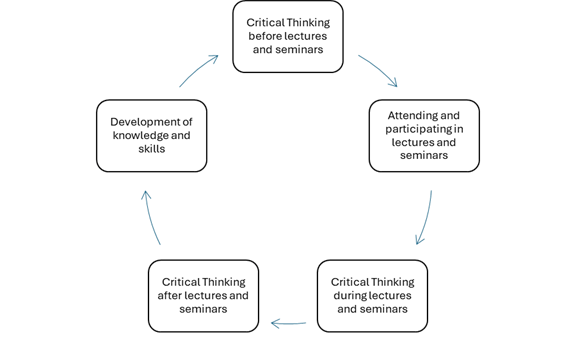
Donald Schön argued in The Reflective Practitioner (1983) that reflection can be undertaken in action and on action, and in 1991, he added reflection for action. If we replace reflection with critical thinking, we can see that critical thinking can be undertaken for action (preparation for lectures and seminars), in action (lectures and seminars) and on action (after lectures and seminars): an experiential learning loop, as illustrated below. This demonstrates the importance of continual critical thinking. It is not an isolated or silo-ed activity, but instead critical thinking should be undertaken by students before, during and after learning activities.
Engaging in and developing academic critical thinking is not easy. It requires investment – both time and practice, which can and does feel uncomfortable. It is important students are supported to develop critical thinking skills by academics, with knowledge sharing, practice advice and emotional reflection on skill development. It can be helpful for students and academics to be discuss the importance of being curious, an awareness of biases and the ability to draw conclusions. However, the more that students practise critical thinking, the more proficient that they will get.
Critical thinking sharpens the mind, indicating that it is beneficial holistically not just academically. It can assist students to analyze information on social media, in relationships and in jobs – a key skill in and out of university. Indeed, a benefit of critical thinking is developing the ability to transfer learning from one situation to another, a priceless skill. This can be applied to in-course work-based learning including volunteering, placements or a year out working, where taught theory can be applied to practice situations. In addition, many students will need, or choose, to work alongside their academic studies to gain money and experience, where again critical thinking skills can be applied in any work environment to enhance professionalism and productivity.
However, critical thinking is not just critical to students at university: employers value graduates who are able to think critically. Valdonė Indrašienė and her co-authors (2023) found that both employers and employees saw critical thinking as an invaluable skill in employment that is associated with creative thinking, innovation and competitive organizations. Graduate attributes are skills, strengths and characteristics that employers look for in graduate employees and can include self-awareness and lifelong learning, employability and professional development, global citizenship and engagement and academic and research literacy (Wong et al, 2021). Often, graduate attributes form part of the person specifications of the job description, so a final benefit of having developed critical thinking skills at university is the ability to apply critical thinking to a job application process and placing graduates with critical thinking skills in a more competitive position to be successful in getting the dream job.
Each of these graduate attributes requires critical thinking. Firstly, self-awareness and emotional intelligence require critical thinking on self, strengths, areas for development and impact on others, key to being an effective graduate employee that interacts effectively with colleagues, management and, where appropriate, customers to maximize organizational efficiency and profitability.
Similarly, professional development requires critical thinking to be able to able to hear, access and action feedback to be able to take action to address areas for development and enhance your productivity as an employee. Global citizenship and engagement come from an awareness and interrogation of the world around you and how it presents so that you can advocate not only for the organization you work within but also the needs of the wider community.
Finally, academic and research literacy comes from critical thinking when reading materials so that you understand bias and perspective but also have the ability to make informed decisions in a graduate role. The development of critical thinking skills in university facilitates the use of critical thinking in employment and are valued by employers. Again, employability is a key required indicator of academic success for higher education providers to demonstrate value for money and excellence, so is worth education providers investing in the development of critical thinking skill development in every course.
Therefore, I feel justified in claiming that critical thinking is for university and for life.