


Could Distributed Peer Review Better Decide Grant Funding?
The landscape of academic grant funding is notoriously competitive and plagued by lengthy, bureaucratic processes, exacerbated by difficulties in finding willing reviewers. Distributed […]

As take-out and delivery via apps quickly became the norm during the pandemic, the author noticed seeing many more prompts to tip and intensifying rhetoric around tipping in some media outlets. This uptick surfaced many important policy and research questions the author wanted to draw attention to.

Behavioral economist John List talks about his work on field experiments and how research done in the natural world can lead to insights that otherwise might be hard to tease out in a lab.

[Ed. – April 2, 2022 is World Autism Awareness Day.] Being autistic, but not diagnosed, can lead to a lifetime of struggles […]
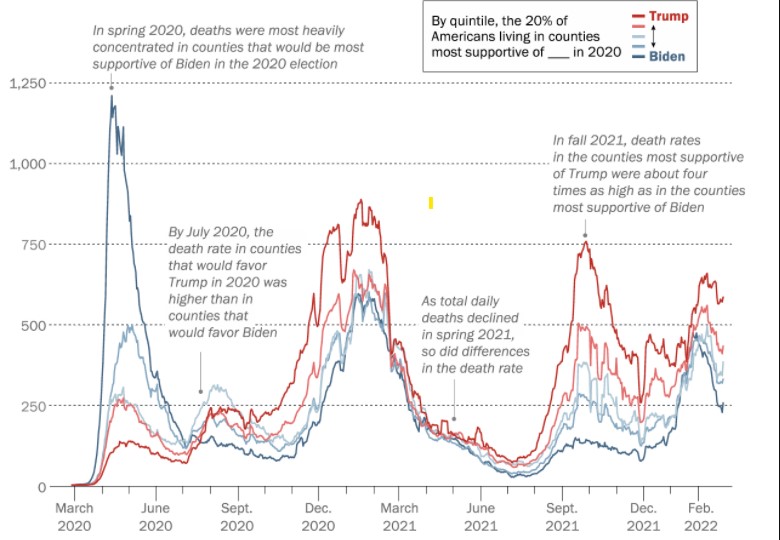
The Pew Research Center writes that “as the relationship between population density and coronavirus death rates has changed over the course of the pandemic, so too has the relationship between counties’ voting patterns and their death rates from COVID-19.”
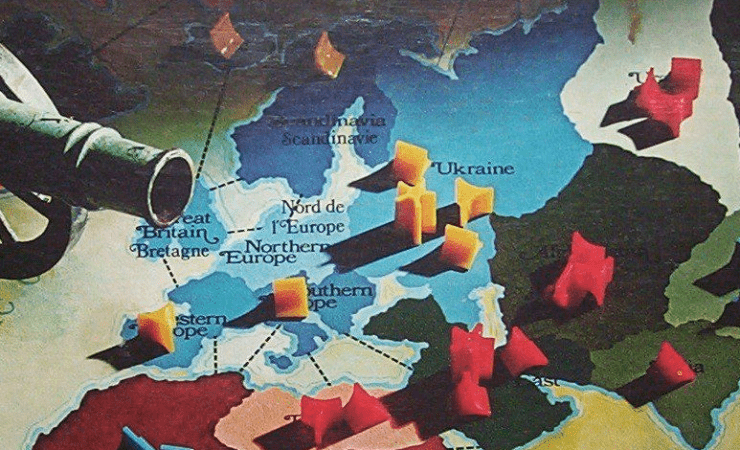
Game theory is the formal study of strategic choices between two sides. It’s useful to decision makers because it can illustrate the range of options open to combatants within a given crisis, and also map the likely “wins and losses” strategically decided upon by the parties involved. The challenge is applying a hypothetical spectrum to the range of passive and aggressive options, and their consequences in Ukraine today.
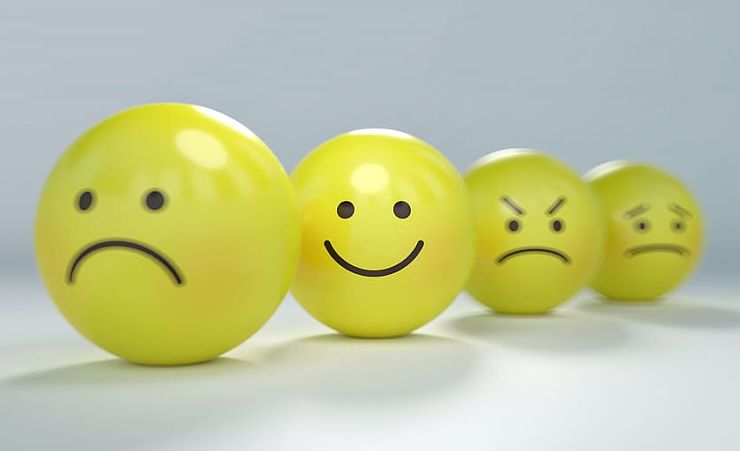
A team from the University of Michigan tracked emoji use as a marker of emotions, and tracked how the use of emoji in work communications can predict remote worker dropouts.
Resilience of young people, new treatment tools give Harvard psychologist Matt Nock hope amid mental health challenges posed by social media, school and campus disruptions
The World Health Organization declared COVID a pandemic on March 11 2020. In the two years since, countries have diverged on their containment strategies, introducing many different ways of mitigating the virus, to varying effect. Here, four health experts look at what has worked well, what mistakes scientists and policymakers made, and what needs to be done to protect human health from here on.
Jürgen Habermas, a globally known social theorist whose explorations of democracy, validity and communication have gained new prominence in the current moment, […] People often see science as a world apart: cool, rational and untouched by persuasion or performance. In this view, scientists simply discover […] “Research impact” means different things to different people. Some refer broadly to how science changes behaviors, beliefs, or practices outside academic institutions. […] David Canter considers informal places where people socialize, suggesting they’re an arena ChatGPT and other LLMs can’no’t replicate. As someone who lives […] It’s become cliche since Clive Humbly coined it in 2006, but data is indeed the new oil. It’s a mantra repeated by […] In September 2025, The Guardian reported about a lawyer in Australia having faced sanctions due to false citations. These citations were not […]
EXPLORE
Impact

Jürgen Habermas, 1929-2026: Exponent of the Public Sphere
READ MORE

Scientists Should Keep in Mind It’s Called the ‘Marketplace of Ideas’ for a Reason
READ MORE

Survey Finds Social Scientists Feel Unsupported in Seeking Societal Impact
READ MORE
Innovation

Reaching Parts to Which AI Has No Access
READ MORE

Andrea Medina-Smith on Making Research Data More FAIR
READ MORE

A Status Check on Hallucinated Case Law Incidents
READ MORE