



Could Distributed Peer Review Better Decide Grant Funding?
The landscape of academic grant funding is notoriously competitive and plagued by lengthy, bureaucratic processes, exacerbated by difficulties in finding willing reviewers. Distributed […]
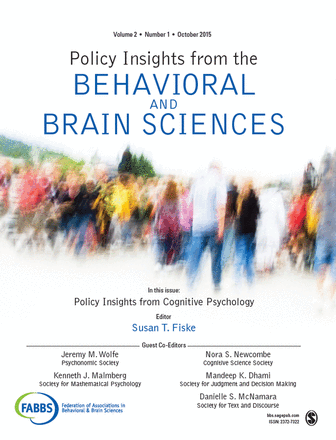
Psychologist Susan Fiske was the founding editor of the journal Policy Insights from the Behavioral and Brain Sciences. In trying to reach a lay audience with research findings that matter, she counsels stepping a bit outside your academic comfort zone.

‘Policy has clearly outpaced science’ in the United States on the issue of legalizing marijuana for either medical or recreational use, say two researchers from Harvard University and McLean Hospital

Teacher observations are both costly and time intensive, but perhaps it’s time to invest in better teacher evaluation to get better student results. So argues Robert Pianta, who has personally helped develop some measures that might achieve such high hopes, in a an article in the journal PIBBS..

When does a modern young person become an ‘adult’? Age 13? 16? 18? 21? Legal definitions aside, young people in the developed world are feeling they’ve become independent operators much later in life than ever before.

Remember when Barbie made the stereotypical ‘Math is hard!’ comment? That sentiment is real, and unchecked it can be contagious. Luckily, however, math anxiety can be cured.

Putting down your phone is merely the first step in banishing distractions while you drive, according to research in the journal ‘Policy Insights from the Behavioral and Brain Sciences.’ In fact, asking Siri to do something at a remove is pretty darned dangerous, too.

Gendered language shapes how we think about the appropriate roles for men and women, especially when we are children and just beginning to form our understanding of the world. That might not sound like a problem, but it can reinforce stereotypes we are trying to tear down.

Remember the admonition to ‘show your work’ in math class? Focusing on where you went wrong – instead of hurrying to what is right – may be a great way to actually learn something, so it’s a shame more teachers don’t do that.
Four Americans working in the social and behavioral sciences are among the 20 people named MacArthur Fellows this year. Recipients may be […] Euan Adie, the founder of Altmetric and later of Overton, discusses the reasons the led to Overton’s focus on showing researchers how […] Here’s a couple of quick questions for you. What is the smallest of the eight discipline-based directorates at the United States’ National […] I was adding some final flourishes on the topic of ‘iatrocracy’ to my forthcoming book with Natewindé Sawadogo – Sickness and Social […] How is AI changing the shape and space of higher education? Critical thinking continues to rank highly among key skills and attributes […] My colleagues and I recently spoke with a group of talented, interesting students who just completed their first year of college about […]
EXPLORE
Impact
Four From Social Science World Receive 2026 MacArthur Fellowships
READ MORE
Quick Insight: Euan Adie on Getting Academics Credit for Their Impact
READ MORE

NSF’s Embattled SBE Directorate Shown as Agency’s Policy Heavyweight
READ MORE
Innovation

AI and ‘Iatrocracy’ – A Cautionary Tale
READ MORE

The Critical Student: How GenAI Reshapes Critical Skills and Higher Education’s Role Preparing Students For It
READ MORE

AI Doesn’t Drive Student Cheating. It Just Hitches a Ride
READ MORE