

Could Distributed Peer Review Better Decide Grant Funding?
The landscape of academic grant funding is notoriously competitive and plagued by lengthy, bureaucratic processes, exacerbated by difficulties in finding willing reviewers. Distributed […]

The possible retraction of a high profile paper in the medical sciences offers a teachable moment about replication, peer review, cognitive bias and the beauty and beastliness that can be science.

Social science and humanities spending by government is seen as a luxury by many. While there’s politics involved, some of that view likely follows from the yardsticks used to measure research value.

Many social scientists find themselves members of a cult of quantification, argues Robert Dingwall, in love with numbers for their own sake even when those numbers produce no useful knowledge.
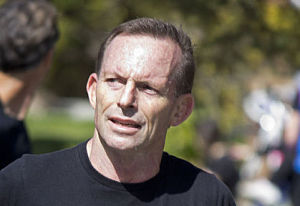
When Tony Abbott took office as Australia’s prime minister and didn’t name a science minister, he asked that his government be judged by action, not titles.

When he was inducted as a fellow into the American Academy of Political and Social Sciences on May 8, Carnegie Mellon criminologist Daniel Nagin delivered a concise and pointed precis of modern research into proactive policing as part of his remarks.
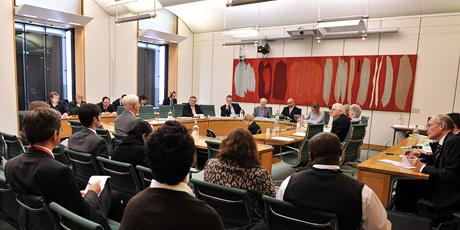
Last month a team of UK academics launched an initiative called the Evidence Information Service, which seeks to enable rapid dialogue between researchers and policy makers. Here, the system’s founders describe the response so far and the challenges that lie ahead.
While there are ample perspective benefits to behavioral nudges in the creation of public policy, make sure the nudges are designed for real people and not some rational superbeing.
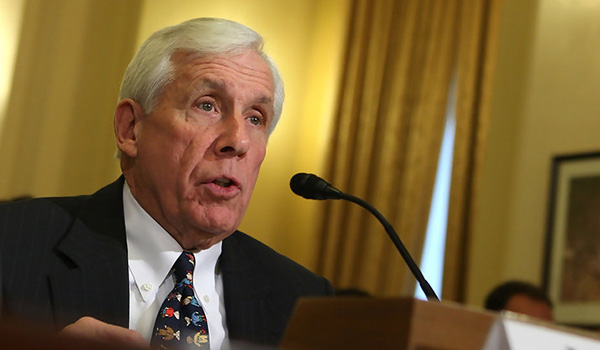
With no controversy and the only discussion about how best to honor the retiring chairman of the panel, the subcommittee of the House Appropriations Committee that oversees the unlikely bedfellows of justice, commerce and scientific agencies has approved a $7.4 billion budget for the National Science Foundation.
Jürgen Habermas, a globally known social theorist whose explorations of democracy, validity and communication have gained new prominence in the current moment, […] People often see science as a world apart: cool, rational and untouched by persuasion or performance. In this view, scientists simply discover […] “Research impact” means different things to different people. Some refer broadly to how science changes behaviors, beliefs, or practices outside academic institutions. […] David Canter considers informal places where people socialize, suggesting they’re an arena ChatGPT and other LLMs can’no’t replicate. As someone who lives […] It’s become cliche since Clive Humbly coined it in 2006, but data is indeed the new oil. It’s a mantra repeated by […] In September 2025, The Guardian reported about a lawyer in Australia having faced sanctions due to false citations. These citations were not […]
EXPLORE
Impact

Jürgen Habermas, 1929-2026: Exponent of the Public Sphere
READ MORE

Scientists Should Keep in Mind It’s Called the ‘Marketplace of Ideas’ for a Reason
READ MORE

Survey Finds Social Scientists Feel Unsupported in Seeking Societal Impact
READ MORE
Innovation

Reaching Parts to Which AI Has No Access
READ MORE

Andrea Medina-Smith on Making Research Data More FAIR
READ MORE

A Status Check on Hallucinated Case Law Incidents
READ MORE