


Could Distributed Peer Review Better Decide Grant Funding?
The landscape of academic grant funding is notoriously competitive and plagued by lengthy, bureaucratic processes, exacerbated by difficulties in finding willing reviewers. Distributed […]
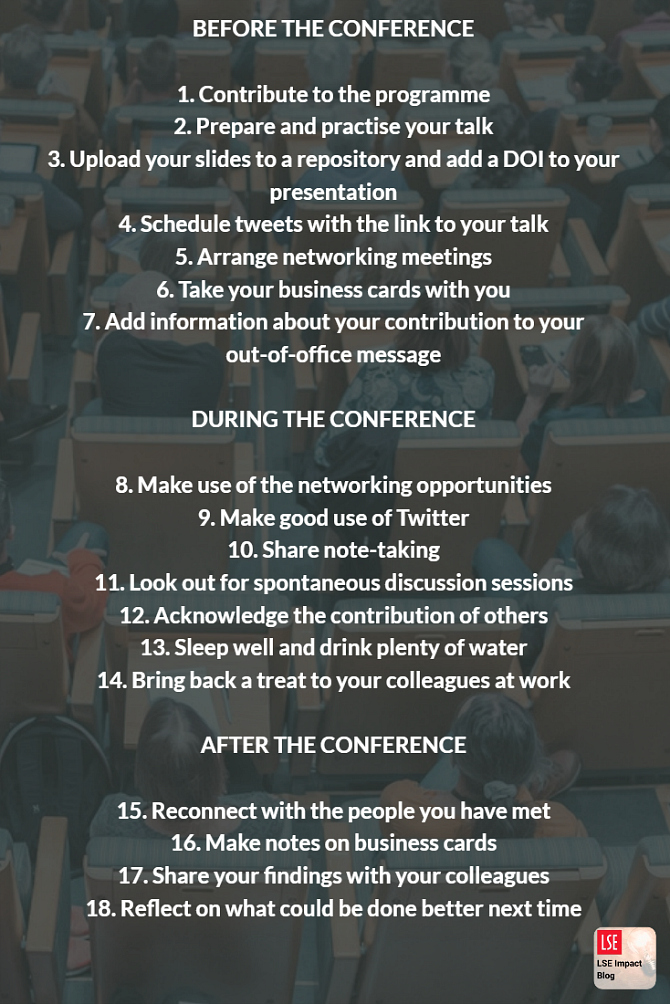
Going to an academic conference is an exciting opportunity to connect with like-minded individuals and exchange stimulating ideas. However, to make the most of a conference requires a lot of hard work before, during, and after the meeting itself. Marta Teperek provides a checklist of things to do at each of these stages.
Anna-Sigrid Keck and colleagues designed a structured doctoral program focused on transdisciplinary research and compared students’ publication patterns to students in traditional programmes. While rates of productivity were broadly similar, citation rates were found to be higher for transdisciplinary students, as were indicators of collaboration such as co-authorship.
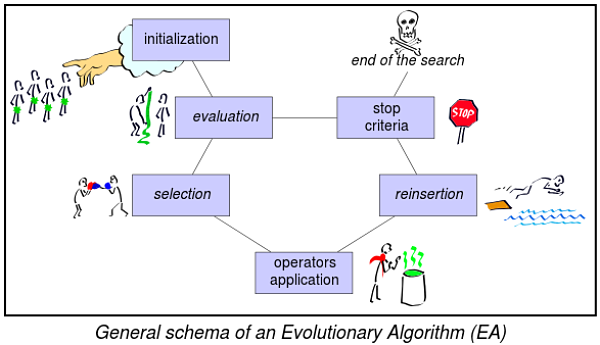
When discussing the nexus of computer science and social science, the transaction is usually in one direction – what can computer scientists do for social scientists. But a recent paper from Tufts University anthropologist Nick Seaver reverses that flow, using the tool of ethnography to interrogate the tools of engineering.
Tom Chatfield, author of the new SAGE Publishing book Critical Thinking, and Mark Kingwell, the University of Toronto, held a lively conversation on the import of technology on how we think and act ‘critically.’ Chatfield, described as a ‘tech philosopher,’ and Kingwell, a more traditional professor of philosophy, traded perspectives, insights into the digital, and purportedly post-truth, era in this one-hour webinar.
In a keynote address delivered to the London Info International conference, Ziyad Marar, president of global publishing for SAGE Publishing, outlines the intersection between big data and social science research. He notes that social and behavioral researchers have seen some opportunities as beyond their grasp, and that SAGE is working to bridge that gap.
America’s rural-urban divide, it seems, has never been greater, a point reinforced by large geographic disparities in support for Donald Trump in the 2016 presidential election. But it is also the case that big cities and rural communities are more tightly integrated than ever and are increasingly interdependent, both economically and socially. That was the starting point for a recent webinar which is archived here.
In this collection of videos , Tom Chatfield eschews the biblical but embraces the practical as he gives specific guidance for training your brain to think critically. In a digital era delivering rivers of information awash in ‘fake news,’ the significance and sheer volume of this information make the question of how we engage with it a vital one.

This study examinesdthe motivation for white professors in higher education to become culturally inclusive in their teaching practices and the transformational experiences that created this motivation and shaped their development.
Jürgen Habermas, a globally known social theorist whose explorations of democracy, validity and communication have gained new prominence in the current moment, […] People often see science as a world apart: cool, rational and untouched by persuasion or performance. In this view, scientists simply discover […] “Research impact” means different things to different people. Some refer broadly to how science changes behaviors, beliefs, or practices outside academic institutions. […] David Canter considers informal places where people socialize, suggesting they’re an arena ChatGPT and other LLMs can’no’t replicate. As someone who lives […] It’s become cliche since Clive Humbly coined it in 2006, but data is indeed the new oil. It’s a mantra repeated by […] In September 2025, The Guardian reported about a lawyer in Australia having faced sanctions due to false citations. These citations were not […]
EXPLORE
Impact
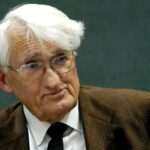
Jürgen Habermas, 1929-2026: Exponent of the Public Sphere
READ MORE

Scientists Should Keep in Mind It’s Called the ‘Marketplace of Ideas’ for a Reason
READ MORE

Survey Finds Social Scientists Feel Unsupported in Seeking Societal Impact
READ MORE
Innovation

Reaching Parts to Which AI Has No Access
READ MORE

Andrea Medina-Smith on Making Research Data More FAIR
READ MORE

A Status Check on Hallucinated Case Law Incidents
READ MORE