


Could Distributed Peer Review Better Decide Grant Funding?
The landscape of academic grant funding is notoriously competitive and plagued by lengthy, bureaucratic processes, exacerbated by difficulties in finding willing reviewers. Distributed […]

The knowledge economy. Intellectual property. Software. Maybe even bitcoin. All pretty much intangible, and yet all clearly real and genuinely valuable. This is the realm where economist Jonathan Haskel of Imperial College London mints his own non-physical scholarship.
Authors Marc Cowling, Paul Nightingale, Nick Wilson, and Marek Kacer find “everything researched and written about COVID-19 in whatever context – medical, […]

Behavioral economist John List talks about his work on field experiments and how research done in the natural world can lead to insights that otherwise might be hard to tease out in a lab.

The work of Christopher Boafo, Richard Afriyie Owusu and Karine Guiderdoni-Jourdain offers an understanding of the internationalization of informal smaller firms in two major enterprise clusters in a sub-Saharan African economy through a network perspective.
A report from the Brookings Institution finds, at least in the case of economists, the U.S. government is roughly at the same place as academe when it comes to diversity.

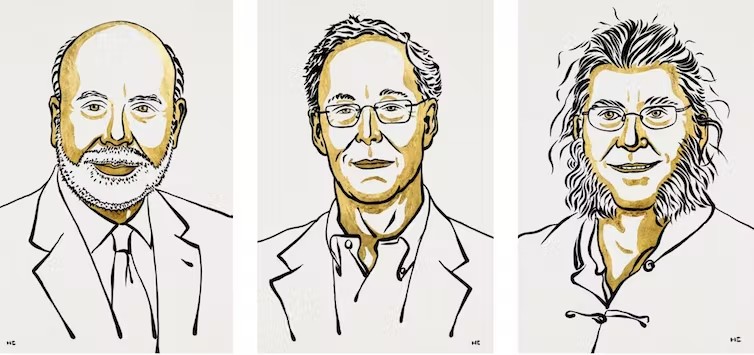
This year’s Nobel Prize in economics has been awarded to Canadian -born but US-based economist David Card for his work with Alan Krueger in reversing the perception that raising the minimum wage inevitably reduces the number of jobs.
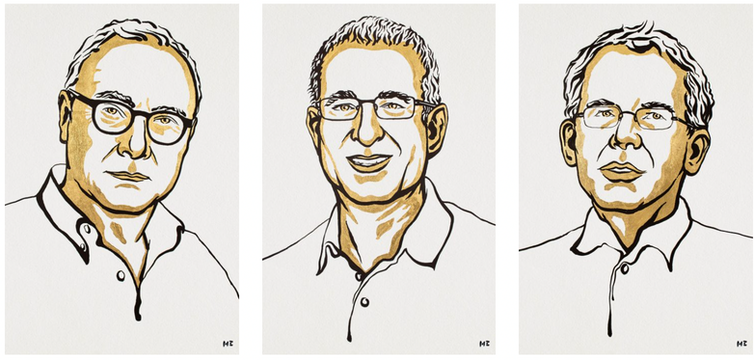
The Nobel committee’s decision to award its economics prize for 2021 to David Card, Josh Angrist and Guido Imbens marks the culmination […]
There is no shortage of disciplines and industries rife with sexism. The STEM fields – science, technology, engineering and mathematics – are particularly well known for their misogynistic […]


Jürgen Habermas, a globally known social theorist whose explorations of democracy, validity and communication have gained new prominence in the current moment, […] People often see science as a world apart: cool, rational and untouched by persuasion or performance. In this view, scientists simply discover […] “Research impact” means different things to different people. Some refer broadly to how science changes behaviors, beliefs, or practices outside academic institutions. […] David Canter considers informal places where people socialize, suggesting they’re an arena ChatGPT and other LLMs can’no’t replicate. As someone who lives […] It’s become cliche since Clive Humbly coined it in 2006, but data is indeed the new oil. It’s a mantra repeated by […] In September 2025, The Guardian reported about a lawyer in Australia having faced sanctions due to false citations. These citations were not […]
EXPLORE
Impact

Jürgen Habermas, 1929-2026: Exponent of the Public Sphere
READ MORE

Scientists Should Keep in Mind It’s Called the ‘Marketplace of Ideas’ for a Reason
READ MORE

Survey Finds Social Scientists Feel Unsupported in Seeking Societal Impact
READ MORE
Innovation

Reaching Parts to Which AI Has No Access
READ MORE

Andrea Medina-Smith on Making Research Data More FAIR
READ MORE

A Status Check on Hallucinated Case Law Incidents
READ MORE