
Could Distributed Peer Review Better Decide Grant Funding?
The landscape of academic grant funding is notoriously competitive and plagued by lengthy, bureaucratic processes, exacerbated by difficulties in finding willing reviewers. Distributed […]

The American Council of Learned Societies has named its 2019 ACLS Fellows and the inaugural recipients of the Mellon/ACLS Scholars & Society Fellowship.
Alessandro Massazza, a PhD student in the Department of Clinical, Educational and Health Psychology, at University College London has received money from the Economic and Social Research Council to research the psychiatric consequences of complex emergencies. In this shortlisted essay from the ESRC Better Lives Writing Competition, in which PhD students who have received money from the ESRC write short essays about how their research leads too better lives, he explores how the double-edged sword of memory affects us after a traumatic event.
The ability to work with digital research methods and data analysis is opening up a whole new world of research potential for social scientists. No one knows this better than Digital Sociologist Dr. James Allen-Robertson from the University of Essex. For him, these new techniques have enabled multiple interdisciplinary research collaborations and a whole new world of funding and professional opportunities.
Here, James tells us how computational social science has given him and his research output a new lease of life.
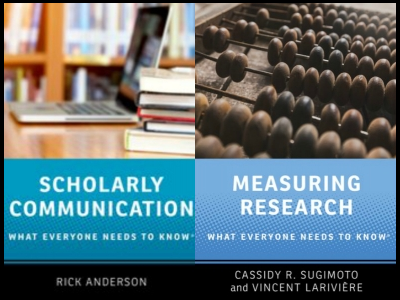
Academics are required to not only find effective ways to communicate their research, but also to increasingly measure and quantify its quality, impact and reach. In Scholarly Communication: What Everyone Needs to Know, Rick Anderson puts us in the picture. And in Measuring Research: What Everyone Needs to Know, Cassidy Sugimoto and Vincent Lariviere critically assess over 20 tools currently available for evaluating the quality of research.
Psychologist Abby Dunn is a doctoral researcher at the University of Sussex whose work has focused on parenting, and in particular parenting for those with complex needs. In this shortlisted essay from the ESRC Better Lives Writing Competition, in which PhD students who have received money from the ESRC write short essays about how their research leads too better lives, she examines how mental health practitioners interact with patients who are also parents.
The social science community has a large stake in the accuracy of the U.S. Census for the community’s contued research. Here, law professor Jonathan Entin discusses the legal controversy swirling around the impact a question on citizenship has on the census, something the U.S. Supreme Court is hearing about this week.
In their new video series entitled “Science in the District: Cognitive Psychology in the Real World,” the Federation of Associations in Behavioral & Brain Sciences explores different ways in which cognitive science is at play in the world, particularly to keep individuals safe and healthy.
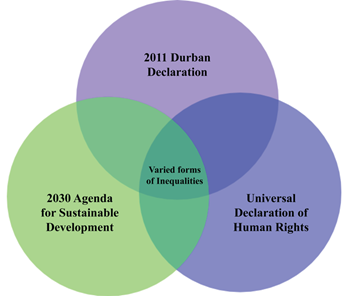
Evidence suggests that one effect of the growing phenomenon of online hate speech is that it fosters varied forms of inequalities (e.g. class, race, gender, and place of origin) and, consequently, also (in)directly undermines important United Nations declarations promoting human rights.

Euan Adie, the founder of Altmetric and later of Overton, discusses the reasons the led to Overton’s focus on showing researchers how […] Here’s a couple of quick questions for you. What is the smallest of the eight discipline-based directorates at the United States’ National […] Sage’s 10-Year Impact Awards recognize academic papers appearing in Sage-published journals that have achieved lasting impact. The winning papers are the most […] I was adding some final flourishes on the topic of ‘iatrocracy’ to my forthcoming book with Natewindé Sawadogo – Sickness and Social […] How is AI changing the shape and space of higher education? Critical thinking continues to rank highly among key skills and attributes […] My colleagues and I recently spoke with a group of talented, interesting students who just completed their first year of college about […]
EXPLORE
Impact

Quick Insight: Euan Adie on Getting Academics Credit for Their Impact
READ MORE

NSF’s Embattled SBE Directorate Shown as Agency’s Policy Heavyweight
READ MORE

Sage’s 10-Year Impact Awards Capture Longer-Term Significance
READ MORE
Innovation

AI and ‘Iatrocracy’ – A Cautionary Tale
READ MORE

The Critical Student: How GenAI Reshapes Critical Skills and Higher Education’s Role Preparing Students For It
READ MORE

AI Doesn’t Drive Student Cheating. It Just Hitches a Ride
READ MORE