
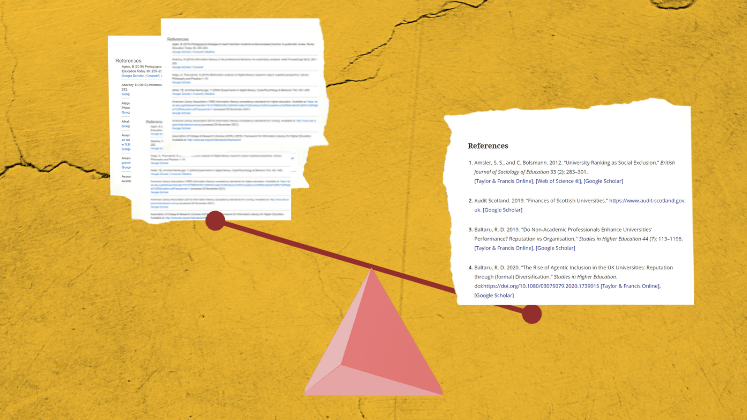


Could Distributed Peer Review Better Decide Grant Funding?
The landscape of academic grant funding is notoriously competitive and plagued by lengthy, bureaucratic processes, exacerbated by difficulties in finding willing reviewers. Distributed […]

The knowledge economy. Intellectual property. Software. Maybe even bitcoin. All pretty much intangible, and yet all clearly real and genuinely valuable. This is the realm where economist Jonathan Haskel of Imperial College London mints his own non-physical scholarship.

How virtual reality platforms respond, and how they protect users and their data, that will ensure the metaverse is a force for good, not the opening of a door to a malevolent underworld.

Technology is here to stay, and the authors argue that now is a crucial time for understanding what is really going on “under the hood” of technology.

For all sorts of reasons, our article “A Design Thinking Approach to Teaching Sustainability” should not have been written. This blog entry […]

Political scientists Monika McDermott and David Jones help readers understand why further restrictions never pass, despite a majority of Americans supporting tighter gun control laws.
The current convention that envisions the manuscript as a self-contained universe produces a range of negative consequences extending beyond papers’ obscene length: many scholars seem to cite papers based on their abstracts or even title alone; reviewing literature takes lots of time; noncore research communities are badly served; new requirements on research transparency and openness are difficult to meet; and, finally, our papers are not particularly enjoyable to read.

The United States has formally established the Advanced Research Project Agency for Health, or ARPA-H, as an independent entity within the National Institutes of Health. Anthropologist Adam H. Russell will head the new agency as acting deputy director

In this second response to Ziyad Marar’s thought piece “On Measuring Social Science Impact” from Organizational Studies, Anne-Wil Harzing, professor of international management and staff development lead at Middlesex University Business School, sets the stage for further discussion by defining impact in terms of progressing scientific knowledge, developing critical thinking, and addressing societal problems.
People often see science as a world apart: cool, rational and untouched by persuasion or performance. In this view, scientists simply discover […] “Research impact” means different things to different people. Some refer broadly to how science changes behaviors, beliefs, or practices outside academic institutions. […] One researcher studies how war affects children, another took a literal worm’s eye view to examine rural development, while two others scrutinized […] David Canter considers informal places where people socialize, suggesting they’re an arena ChatGPT and other LLMs can’no’t replicate. As someone who lives […] It’s become cliche since Clive Humbly coined it in 2006, but data is indeed the new oil. It’s a mantra repeated by […] In September 2025, The Guardian reported about a lawyer in Australia having faced sanctions due to false citations. These citations were not […]
EXPLORE
Impact

Scientists Should Keep in Mind It’s Called the ‘Marketplace of Ideas’ for a Reason
READ MORE

Survey Finds Social Scientists Feel Unsupported in Seeking Societal Impact
READ MORE
Canada’s SSHRC Names 2025 Impact Winners
READ MORE
Innovation

Reaching Parts to Which AI Has No Access
READ MORE

Andrea Medina-Smith on Making Research Data More FAIR
READ MORE

A Status Check on Hallucinated Case Law Incidents
READ MORE