Stories of Research to Reality: Michael Reisch
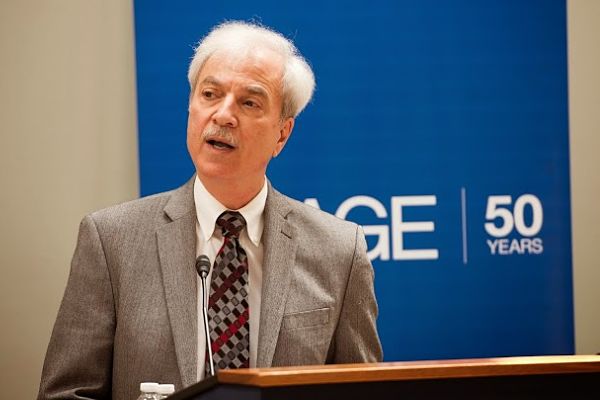
Michael Reisch
In early May SAGE gathered seven social scientists on Capitol Hill to tell stories, stories of their disciplines’ impact on society and the economy, and stories of their own academic journey. The underlying goal of “Stories of Research to Reality: How the Social Sciences Change the World” was both to mark SAGE’s 50th birthday as an independent publisher and to demonstrate the value and impact of social science itself, increasingly under attack as either a waste or a luxury by some legislators.
The entire event, moderated by prominent blogger and George Washington University political scientist John Sides and held at the Hart Senate Office Building, was recorded; the seven individual videos are being published here over the next seven weeks. Each tale presents one facet of the real-world value of actual social and behavioral science research, with the implicit message that this is scholarship we should be encouraging.
The fourth speaker in this series is historian and a social worker Michael Reisch, the Daniel Thursz Distinguished Professor of Social Justice at the University of Maryland and a visiting scholar at the University of California, Berkeley.
Reisch lives in Baltimore, not far from where the Maryland city saw widespread rioting after citizen Freddie Gray died following being taken into custody by police. Reisch’s talk drew from that recent event to inform his historical overview on the causes, characteristics and consequences of chronic poverty. “As the response of some policymakers and some media outlets to these events demonstrate,” he began, “longstanding assumptions about poverty persist. The need for social science research to revise these longstanding attitudes about the poor and about poverty is therefore more important than ever.” So far, he added, social science has had limited success.
In his sweeping yet necessarily abbreviated narrative, Reisch began in the late 19th century with the scientific charity movement and Amos Griswold Warner, who brought professional and statistical rigor to his study of the immigrant poor in New York even as it reflected Victorian morality and social Darwinist thinking. That pioneering effort was then contrasted with the so-called Settlement House movement and the work of Robert Hunter, in which actual scientific and comprehensive observation chipped away at the long-held correlation between (low) morality and (low) income. This, said Reisch, started the first serious discussion — “among the elites, anyway” — about addressing poverty.
He continues his collaborative history and its many players through to the present day, where researchers like William Julius Wilson, Douglas Massey, Kathryn Edin, Mark R. Rank and even Reisch himself often focus their work on specific marginalized populations in the poverty mosaic.
Reisch has played a leadership role in advocacy, professional, and social change organizations that focus on issues of poverty and inequality, and the needs of low-income children and families, welfare recipients, immigrants and refugees, unemployed workers, and homeless persons. He has been honored for his policy advocacy by groups such as the National Association of Social Workers He is a former Woodrow Wilson fellow and Fulbright senior scholar, Reisch has published nearly 30 books and monographs, including 2014’s Social Policy and Social Justice.
The first speakers in this series were:
Deborah Rupp | William C. Byham Chair in Industrial/Organizational Psychology, Department of Psychological Sciences, Purdue University. To see her talk, click HERE.
Bruce Bueno de Mesquita | Julius Silver Professor of Politics, New York University. To see his talk, click HERE.
John W. Creswell | professor of educational psychology, University of Nebraska-Lincoln. To see his talk, click HERE.
Claire M. Renzetti | professor of sociology, University of Kentucky. To see her talk, click HERE.
Upcoming speakers in this series include:
Jim Knight |research associate, University of Kansas Center for Research on Learning, and director of the Kansas Coaching Project
Kerric Harvey | associate professor of media and public affairs, and associate director of the Center for Innovative Media, George Washington University
SAGE is the parent of Social Science Space.