NSF’s Embattled SBE Directorate Shown as Agency’s Policy Heavyweight
Here’s a couple of quick questions for you. What is the smallest of the eight discipline-based directorates at the United States’ National Science Foundation? The answer is the Social, Behavioral and Economic Sciences (SBE) Directorate, with a 2025 budget request of $320 million out of NSF’s total $10.18 billion. For comparison, the next smallest directorate, by budget, is Engineering, at $808 million. The largest is Mathematical and Physical Sciences, at $1.68 billion.

Now which directorates’ funded research output is the most cited by the U.S. government in policy documents? You probably saw this coming, but it’s SBE. At least that’s the answer provided by a one-day analysis exercise conducted by Angel Luis Jaso-Tamame at the recent International Conference on the Science of Science and Innovation 2026 Hackathon in Boulder, Colorado.
“One theme suggested by the organizers was the FY2027 NSF budget proposals,” explained Jaso-Tamame, a senior machine learning engineer at Overton. “I asked an empirical question: across all eight NSF directorates, how does each one’s research actually show up in US policy?SBE — the smallest by publication volume — turned out to have by far the largest policy footprint.” It produces 3.6% of NSF’s published papers, but represents 30% of its policy “footprint.”
Since this was an exercise done on the fly, he offers a couple of caveats, including the obvious one. “The data holds up under checking, but one day isn’t enough to be exhaustive. This is best read as an initial investigation—a clear enough signal to be worth taking further.”
The findings are also timely. The administration of President Donald Trump wants to zero out the budget for the SBE directorate completely, a request made in both the 2026 and 2027 budget requests. The bits and duties of the directorate the administration would want to retain would be farmed out to the other directorates, but the implication that the president sees social and behavioral science as less than equal to the other sciences couldn’t be clearer.
While Congress has pushed back on these requests, mandating in its final spending bills that NSF distribute funds equitably across all basic research areas, SBE lacks “statutory status” and the leadership at NSF has started the process of dismantling the directorate even before Congress weighs in. SBE was established administratively in the 1990s rather than by law, and so it is more vulnerable to such elimination compared to the other pillars.
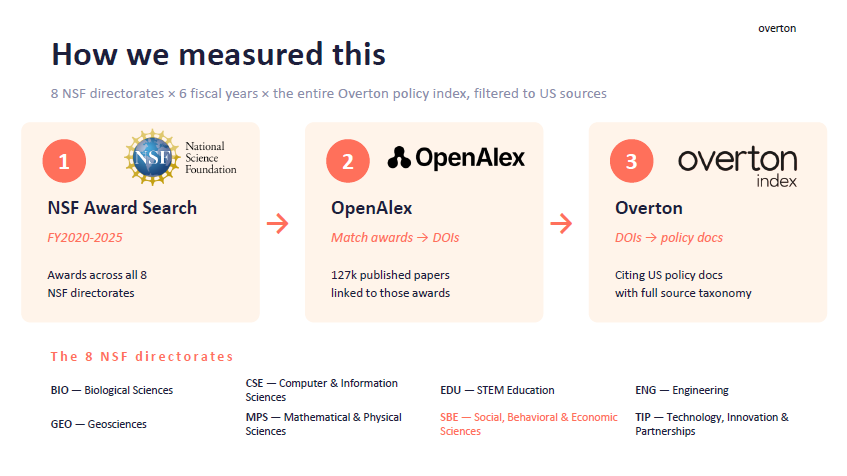
Let’s go back to what Jaso-Tamame found (and also visit his other caveats). This will require a little bit of describing the methodology and a look at the raw numbers, although we’ll include some of the data-rich slides he prepared that present this in greater detail. It will help to know a bit about Overton, too, since its database of policy documents was integral to do this analysis.
Overton, founded by Euan Adie (of Altmetric fame) in 2018, is a platform that tracks how academic research influences policy by indexing policy documents, government reports, parliamentary records, and think tank publications. It’s the engine behind Sage Policy Profiles, our free tool for individual researchers aiming to see how their work is appearing in policy documents.
To arrive at his findings, Jaso-Tamamme gathered all the grants awarded by NSF across all eight directorates from the 2020 to 2025 fiscal years, then matches those awards against the DOIs, or digital object identifiers in the OpenAlex database (“Inspired by the Library of Alexandria, we catalog 323 million scholarly works, linking them to authors, institutions, funders, and more—all fully open.”). The resulting 127,000 papers then were compared to the policy docs from the U.S. government archived by Overton.
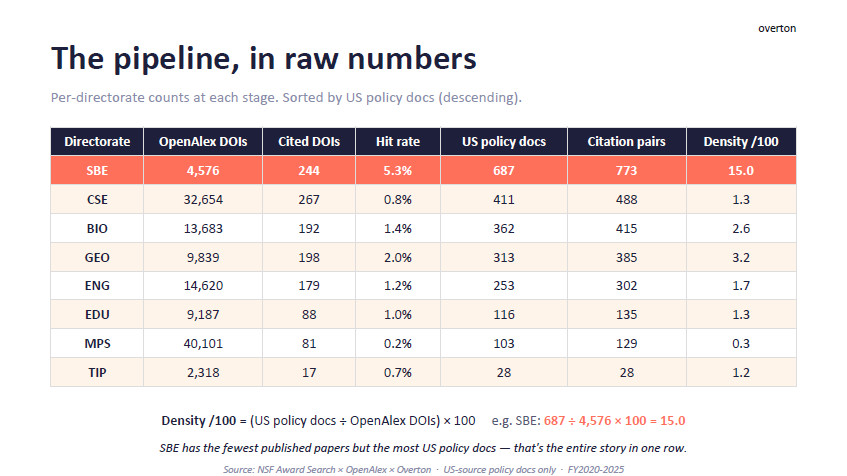
SBE, as noted, had the lowest number of DOIs to start, apart from the newly constituted tech directorate which has fewer years to draw from. The database returned 4,576 DOIs, compared to more than 40,000 for the math and physical sciences directorate. But DOIs in policy documents re-arrange that ordering. SBE had 244 DOIs cited, second only to the computer science directorate at 267. (Looking back at math /physical sciences, it had 81 citations.) Those 244 SBE citations, in turn, appeared in a total of 687 US policy documents.
“SBE has the fewest published papers but the most US policy docs – that’s the entire story in one row,” Jaso-Tamame put at the bottom of a table showing the figures.
The topics of these papers provide insight into why they’re getting cited. At SBE, 13% of the citations are labor economics, 7% cost-of-living, and 6% unemployment. As Jaso-Tamame noted, “Each directorate has a different policy fingerprint. SBE’s distinctive topics … don’t map onto any other directorate’s portfolio.” Still, those other directorate’s top topics are a policy-heavy murderer’s row – artificial intelligence at computer science, climate change at geology and at engineering, COVID-19 at biology and at math/physical sciences.
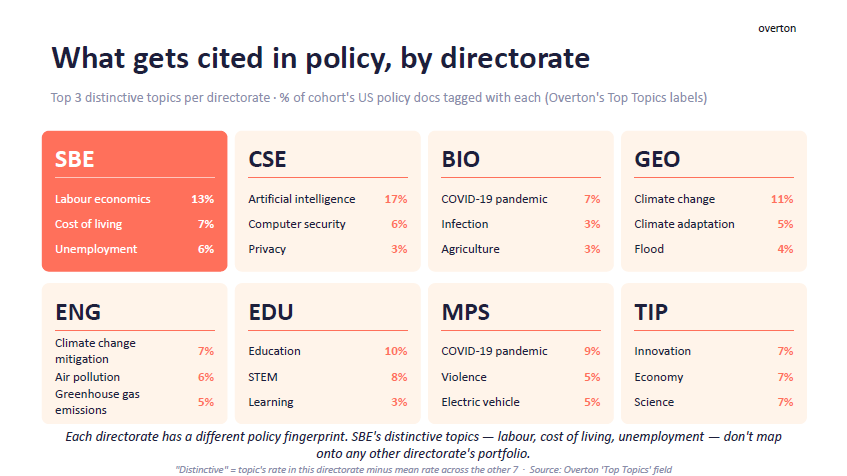
The economic focus of the SBE citations does raise questions about who is using this material, and if – perhaps – some organizations overreliance might skew the results. Or as Jaso-Tamame bluntly summarized one critique: “It’s just NBER and Fed working papers citing each other —not real policy adoption.” The National Bureau of Economic Research is a big user of social science research, but even stripping that out, Jaso-Tamame found, SBE still retains its primacy, leading the next most cited directorate, Geosciences, by 2.7 times. (See the raw numbers graphic to understand how Jaso-Tamame created his “density” measurements. Using that density metric, SBE – including NBER and Fed citations — produces 4.7 times the policy density of Geosciences, and 10 times the NSF median.)
There are some other aspects of the finding that bear mentioning. One, the exercise looked solely at federal policy in the United States, and while many papers are cited internationally, that wasn’t captured. Two, because the OpenAlex date hinges on author-recorded award identifiers, and how that’s done varies across fields, the exact numbers Jaso-Tamame came up with shouldn’t be taken as gospel. That leads to a third point: since the exercise only used paper with an explicit award ID – and thence to a DOI – it’s likely that unrecorded uptake by policymakers would push all numbers higher.
While he never addresses the values-based question about whether the U.S. government should fund SBE. Jaso-Tamame does point out that in examining its oversize footprint, “SBE’s actual distinctive policy topics —labor economics, inflation, inequality, monetary policy, mental health —have no natural home in Computer & Information Sciences, Biological Sciences or Technology, Innovation & Partnerships.”