Renewing the Purpose of Education in an AI World: What is Education For?
Part 1 of 3
Artificial intelligence is transforming society at extraordinary speed. In a remarkably short time, systems that can generate language, analyze information, solve complex problems and create new content have begun to reshape how knowledge is created, accessed and applied. Tasks that only recently seemed to require human intelligence can now be outsourced to machines. These developments offer great opportunities, but their power for good is matched, and in some areas surpassed by their disruptive potential. AI is forcing us to confront not just technical challenges but deep questions about what it means to be human, and how we should protect human flourishing in a world of intelligent machines.
These questions are fundamental to the future shape of education. Schools are the institutions charged with cultivating the knowledge, capacities and values that future generations will need. They are the places where young people learn how to think, judge, create, collaborate and act ethically. The challenge posed by AI is not simply how we teach young people to use it with discernment. It is to ask a much older and more fundamental question: what is education ultimately for?
I write as someone who has spent four decades inside schools, as a history teacher, deputy head and, for sixteen years, head of Kingston Grammar School, City of London School and St Paul’s Girls’ School. Much of that time was spent trying to widen what schools value. I piloted the Extended Project Qualification (EPQ), served on the steering committee of the Pre-U and helped create school-designed alternatives to GCSEs. I am a founding member of Rethinking Assessment and of the Next Generation Assessment Conference, and the author of the HMC report on curriculum reform, Time to Talk. I also contributed to the Times Education Commission and the House of Lords inquiry into 11–16 education, both of which inform this series. I have worked across sectors, founding the West London Partnership of Schools, a collaboration between independent and state schools. The arguments that follow are not abstract. They come from seeing at firsthand what happens when schools are asked to measure the wrong things, and what becomes possible when they are trusted to pursue the right ones.
My own experience is in secondary education, and many of my examples come from that phase. But the purposes and pillars I describe apply from a child’s first years in school, where the foundations of attention, curiosity, language and belonging are laid.
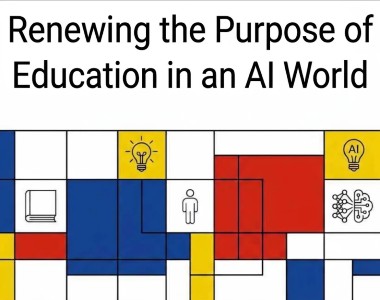
This series proposes that the purpose of education is human flourishing, agency and the common good. It offers a framework built on four pillars – knowledge, agency, character and service – as the foundation for curriculum, pedagogy, assessment, professional learning and school culture. The argument is simple: AI should not lead education systems to abandon their foundations, but to revisit and refine them with renewed clarity and purpose.
Across the three parts of this series, I argue for an education system that:
- Places human flourishing, agency and the common good at the center of educational purpose
- Secures strong disciplinary knowledge, while widening opportunities for judgement, creativity, collaboration and service
- Uses pedagogies and co-curricular experiences that foster active, purposeful engagement with learning
- Ensures AI strengthens rather than substitutes for human thinking, operating under human direction and accountability
- Equips every learner, from five to eighteen, with digital citizenship and AI literacy, and puts wellbeing, belonging and attention at the heart of school life
- Reforms assessment to value what matters, invests in teachers, and takes the risks of AI seriously, so that every learner, whatever their background, can flourish
Why education must change
Artificial intelligence is not the only reason education must change. Rapid technological, social and economic change has exposed long-standing assumptions about curriculum, pedagogy and assessment that were already looking outdated. AI has accelerated these trends, making visible questions that education systems can no longer afford to ignore.
For much of the last century, education was designed for a world in which information was relatively scarce, knowledge changed comparatively slowly and career pathways were more predictable. The National Curriculum, the statutory framework of subjects taught in England’s state schools, continues to provide a valuable framework of disciplinary knowledge, but it was developed in a different technological context (Department for Education, 2014). Today’s learners inhabit a world in which information is abundant, intelligent systems can retrieve and generate knowledge instantly, and the ability to adapt to continual change has become a central attribute.
This does not diminish the importance of knowledge. Knowledge enables us to explore who we are, our cultures and values, and the context in which we live. It is also what makes judgement possible. We cannot evaluate what a machine tells us without secure understanding of our own. But knowledge alone is no longer enough. Educational success depends increasingly on the capacity to apply knowledge wisely, which requires judgement, discernment and ethical reasoning. These are the qualities that enable people to distinguish reliable information from plausible error, and human purpose from technological capability.
The challenge is heightened by uncertainty. Employers expect a substantial proportion of core workplace skills to change within the next five years (World Economic Forum, 2025). Many occupations will change profoundly, and new forms of work will emerge. The most valuable preparation combines secure knowledge, including digital literacy, with curiosity, a commitment to lifelong learning and the ability to adapt understanding to new circumstances.
These changes will not affect all young people equally. Those from disadvantaged backgrounds are already less likely to enjoy breadth of experience, access to technology and support at home. Without deliberate action, AI risks widening those gaps. Any renewal of educational purpose must be a renewal for every learner.
The Times Education Commission (2022) and the House of Lords report Requires improvement: urgent change for 11–16 education (House of Lords Education for 11–16 Year Olds Committee, 2023) both conclude that current educational systems, and assessment in particular, are increasingly misaligned with the demands of a changing world. Our examinations are designed above all for reliability: they reward what can be demonstrated consistently under timed conditions. While there is value in this, much of what matters most for learning, work and citizenship is hard to capture in a timed paper, including sustained inquiry, oral reasoning, collaboration, creativity and practical judgement. What is not assessed is too easily squeezed out of teaching, narrowing opportunity precisely where it is most needed.
The government’s Curriculum and Assessment Review, chaired by Professor Becky Francis, takes some welcome steps, including cutting GCSE examination time by at least 10% and scrapping the English Baccalaureate performance measure, which it found had narrowed students’ choices (Department for Education, 2025). But it is a deliberately cautious document: “a nip here, a tuck there,” as Sir Chris Husbands put it (Husbands, 2025). Its treatment of AI in assessment is confined to concerns about coursework integrity, leaving unanswered the larger question of how assessment must evolve in an AI age. I return to this in Part 2.
Calls for reform sit within a growing international literature urging a return to the fundamental aims of education. The OECD Learning Compass foregrounds learner agency (OECD, 2019); UNESCO emphasizes ethics, inclusion and human rights (UNESCO, 2021); the International Baccalaureate highlights international-mindedness and service (International Baccalaureate, n.d.); and Australia’s Castlereagh Statement insists that human flourishing, not technology, must be at the center of education in an AI age (Castlereagh Statement, 2026). Religious traditions likewise stress dignity, wisdom and moral responsibility (Dicastery for the Doctrine of the Faith and Dicastery for Culture and Education, 2025). Although these frameworks emerge from different contexts, they point towards a common conclusion. Education must prepare young people not simply to succeed in a changing world, but to flourish as individuals and to shape that world responsibly.
Young people are already ahead of the system. The National Literacy Trust’s 2025 survey of more than 60,000 13- to 18-year-olds found that two in three use generative AI, and nearly half do so at least weekly (National Literacy Trust, 2025). Two-thirds agree that it remains important to learn to write even when AI is available, and many check outputs because they “could be wrong”. Yet one in four admits simply copying AI outputs for homework, and only one in six feels more independent when using it. Among university students, use is almost universal. 95% of undergraduates use AI, while fewer than half feel supported by their teaching staff (Higher Education Policy Institute and Kortext, 2026). Young people are not asking schools to ignore AI. What many are asking for is help to use it without losing their own voice.
It is the responsibility of educational leaders to respond. We need to protect learners from systems that can distort attention and judgement, while opening up the undoubted opportunities AI presents. AI is here to stay. The conversation needs to move on from a focus on cheating to embrace the new reality with creativity, vision and clear ethical guardrails.
The purpose of education
Across different traditions and periods, people have described the purpose of education in many ways, yet a clear thread runs through them all. Education has never simply focused on passing on knowledge or preparing someone for a future job. At its core, it is about helping individuals to grow, flourish and use their abilities in ways that strengthen their communities. This series borrows from that tradition and defines the purpose of education as human flourishing, agency and the common good.
Human flourishing
By flourishing I mean something richer than happiness or success. In the tradition that runs from Aristotle, flourishing (eudaimonia) means living well: developing and exercising one’s capacities, pursuing what is worthwhile, forming good relationships and contributing to the life of a community. Modern psychology draws a similar distinction between feeling good and living well, showing that meaning, engagement and relationships are central to the latter (Seligman, 2011).
Flourishing involves challenge and effort as well as fulfilment. It is nourished by joy, wonder and creativity, and sustained by learning to navigate uncertainty, disappointment and loss. It rests on dignity, equity and inclusion, allowing every person to take their full place in society and to feel valued.
Crucially, the qualities that make up a flourishing life are acquired by practicing them. We become thoughtful by thinking, brave by acting bravely and responsible by taking responsibility. This matters in an AI world. When machines can explain, compose and argue, it is tempting to ask which human capacities remain beyond their reach. That is the wrong question, because the answer keeps changing. The better question is what young people become through doing these things themselves.
Intelligent systems may increase efficiency and extend human capabilities, but they cannot determine what constitutes a good life or the values by which societies should live. As technology assumes a greater role in everyday life, education must ensure that human flourishing remains its guiding purpose.
Agency
Agency is the capacity to shape one’s own life rather than be shaped by circumstance: to exercise informed judgement, make responsible decisions and act with intention. It includes the capacity to question intelligent systems and resist undue dependence on them. At its fullest, agency means what I call human sovereignty: remaining the author of one’s own thinking, attention and values.
The common good
Education has never been solely about individual achievement. The common good refers to the social, moral and civic conditions that enable individuals and communities to flourish together. It recognizes that individual wellbeing rests on the wellbeing of others, and that freedom carries responsibilities as well as rights. AI reinforces its importance. Decisions about how intelligent systems are designed, governed and deployed are shaping employment, healthcare, public services and access to information. These decisions cannot be left to commercial organizations or technical specialists alone. Education must equip future citizens to play their part.
From these purposes emerge four educational pillars. Agency appears in both deliberately. It is one of the ends education serves, and also a capacity schools must cultivate day by day.
Four educational pillars
Knowledge
Knowledge remains indispensable. It is the foundation of critical thinking, creativity and sound judgement. It is also what enables us to scrutinize AI outputs. In an AI world, the old “knowledge versus skills” debate is obsolete. Young people need both, taught together, so that they can question, connect, apply and evaluate what they know.
Through knowledge, learners gain access to humanity’s cultural inheritance, scientific understanding and intellectual traditions.
Knowing is also a fundamentally human activity, debated, discovered, experienced and felt. It is shaped by relationships, histories and cultures. AI adds powerfully to the information young people can draw on, but meaning-making – the ability to interpret experience, connect ideas and form coherent understanding – should remain in human hands.
Agency
As a pillar, agency develops when learners are trusted to apply their understanding, work collaboratively, take intellectual risks and accept responsibility for their decisions. It is not a fixed attribute but a capacity that grows through experience.
In an AI-rich world, agency also requires discernment: understanding the capabilities and limitations of intelligent systems and recognizing when AI can enhance thinking and when it risks replacing it.
Character
Character shapes how knowledge and agency are exercised. Knowledge and agency without character can become mere self-interest.
Character is expressed through integrity, compassion, courage, humility, attentiveness and respect for others. It grows through experience, reflection and relationships (Jubilee Centre for Character and Virtues, 2022). In an age when technology increasingly mediates information and influence, these qualities matter all the more. Moral responsibility cannot be delegated to machines.
Service
Service is the outward expression of knowledge, agency and character, directing individual growth towards the flourishing of others. It reminds learners that knowledge carries responsibility and that education should never be solely about personal success.
Service nurtures civic responsibility, environmental stewardship and a commitment to justice and human dignity. It also provides a vital counterbalance to the individualism and isolation that can accompany life in an increasingly digital world.
Taken together, these pillars form a personal and civic resource: the foundation of purposeful action in a world shaped by AI, and a safeguard for human sovereignty in an era of intelligent machines.
What kind of people do we hope our students become?
The success of education is seen most clearly in the kind of people young adults become, in the habits of mind they develop, the values they embody, the relationships they build and the contribution they make to the lives of others. The following describes those qualities.
An educated person possesses secure knowledge and a continuing curiosity about the world. They understand that learning is not something that ends with formal schooling but a lifelong process of discovery, interpretation, growth and enjoyment. They are able to evaluate evidence, recognize complexity, appreciate different perspectives and continue asking thoughtful questions in a world where information is abundant but understanding remains hard won.

They think independently while recognizing that wisdom is rarely developed in isolation. They are capable of making informed decisions, exercising sound judgement and responding thoughtfully to uncertainty and change. Rather than relying uncritically on intelligent technologies or the opinions of others, they retain intellectual independence and the confidence to question, reflect and revise their thinking when presented with new evidence.
They approach the world with imagination as well as reason. They are able to generate ideas, solve problems creatively and collaborate with others in pursuit of shared goals. They recognize that creativity is not simply artistic expression but the capacity to make new connections, see fresh possibilities and respond constructively to challenges that have no straightforward solution.
They also possess strength of character. They seek truth, act with integrity, show compassion and treat others with dignity and respect. They understand that knowledge and capability carry ethical responsibilities and that leadership is expressed through service as much as achievement. They demonstrate resilience in the face of difficulty, humility in recognising the limits of their own understanding and the willingness to continue learning throughout life.
Above all, an educated person understands that individual flourishing and the flourishing of others are inseparable. They recognize that their abilities are gifts to be used not solely for personal advancement but for the benefit of their communities and the wider world. They are prepared to contribute thoughtfully to civic life, care for the natural environment, embrace difference, strengthen democratic society and work towards a more just, compassionate and sustainable future.
Such a vision of the educated person is both timeless and urgently contemporary. Artificial intelligence changes many aspects of how people learn and work, but it does not diminish the human qualities that education exists to cultivate. On the contrary, these become more important, enabling young people not simply to live successfully alongside intelligent machines, but to ensure that those technologies continue to serve genuinely human purposes.
If this is the purpose, the harder question follows: what would schools need to do differently to realize it? That is the focus of the next part of this series. Throughout, one question should guide us: will this help young people flourish?
Next in the series: From Purpose to Practice
Further reading
Cambridge Assessment (2023) Project Qualifications: Students Taking an EPQ Have Better Higher Education Outcomes. Cambridge: Cambridge University Press & Assessment.
Culatta, R. (2021) Digital for Good: Raising Kids to Thrive in an Online World. Boston, MA: Harvard Business Review Press.
Department for Education (2019) Character Education: Framework Guidance. London: Department for Education.
Joint Council for Qualifications (2025) AI Use in Assessments: Your Role in Protecting the Integrity of Qualifications. London: JCQ.
Mollick, E. (2024) Co-Intelligence: Living and Working with AI. London: WH Allen.
Stobart, G. (2008) Testing Times: The Uses and Abuses of Assessment. Abingdon: Routledge.