Philosopher of Psychology: Rom Harré, 1927-2019
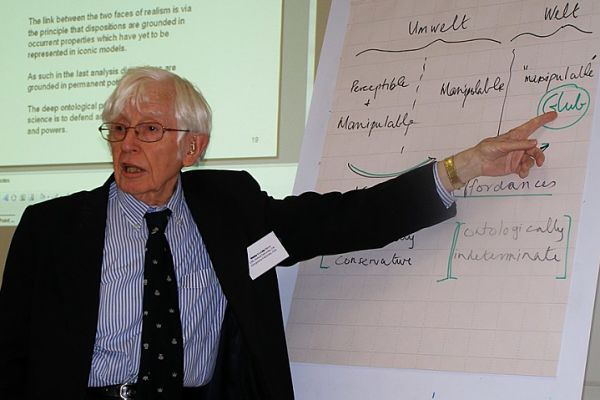
Rom Harré, a philosopher deeply engaged in critically examining the attributes and vulnerabilities of the social sciences, and who was both an early computational researcher and an incredibly prolific academic author, died October 17 at age 91.
While his focus is broadly described as the philosophy of science, Harré’s critique of psychology marked him as an important observer of the field. But as an observer he could be devastatingly skeptical, as he was with interviewers Simone Belli and Juan C. Aceros in 2014.
I became interested in social psychology by accident. I was asked to share in a course on scientific models and one of the talks was given by Michael Argyle, a charming man, about models in social psychology– but it was more or less logical nonsense. That year, Stephen Toulmin visited Oxford and invited me to support him when he gave a talk to social psychologists. They understood nothing and presented the most naïve views. I decided to spend that summer reading up on the literature on social psychology and became more and more appalled.
He wasn’t always so blunt, and in fact, he identified with cultural psychology (“the best camp for me” because of its cultural/historical/instrumental approach). In the second-ever Social Science Bites podcast, in 2012, Harré outlined the disciplines’ shared utility: “I think [cultural psychology] does give you a grasp of the world as it is at this moment, or rather as it was a little while ago. And, of course, that’s not a bad thing: those who know no history are doomed to repeat it. But there’s no guarantee that [social science] is going to function like Newton’s laws of motion.”
Horace Romano Harré was born on December 18, 1927 in Apiti, a rural enclave in New Zealand’s North Island. He started his higher education at what was then the University of New Zealand (later the University of Auckland), studying chemical engineering. He would have stuck with chemical engineering, he later explained, but didn’t have enough money to finish the course. But he had been doing mathematics coursework in parallel, and so graduated UNZ with a bachelor’s in mathematics in 1948 and a master’s in philosophy four years later. Harré’s attraction to math was more than its relative inexpensiveness – he liked math, an affection that expressed itself repeatedly in future years.
He taught mathematics in New Zealand and then Pakistan until he started at University College, Oxford in 1954 as a philosophy student under John L. Austin. Austin fostered Harré’s interest in language, although Harré’s dissertation was on ranking differential equations. He earned his doctorate in 1956.
After stints at the University of Birmingham and the University of Leicester, he was back at Oxford in 1960 as a lecturer on the philosophy of science. While he taught around the globe in subsequent years, he would remain at Oxford (also as a fellow of Linacre College starting in 1965) until he reached the institution’s mandatory retirement age, when he then became emeritus.
As he told Belli and Aceros, “I … appreciate the fact that Oxford is 800 years old and that I am just a very small part of the history of the place. I have done a good deal of work with linguists and anthropologists in my college, enabling me to keep a distance from academic psychology, which has become trapped in a faulty methodology and a primitive metaphysics.”
Harré’s initial contribution to Oxford’s heritage was his work on the philosophy of science, starting with his publication of An Introduction to the Logic of Science in 1960 and continuing throughout his life as he influenced proponents of policy realism and critical realism, such as his student Roy Bhaskar.
Harré’s approach sprang from the social in science, as Luk van Langenhove pointed out in his edited volume, People and Societies: Rom Harre and the Designing of Social Science. Describing Harré’s work as “both prophetic and insightful,” van Langenhove argued that “perhaps the most central theme in his work is his attempt to develop a systematic programme for psychology.”
It was, he said, “by chance” that he met social psychologists as a student at Oxford and quickly realized “took no account of language as a medium of social interaction – in fact, the most important medium.” He incorporated his existing areas of interest, like numbers and words, into his picture of what psychology and sociology ought to be even as he added new interests to the mix. “I differ,” he said, “from my colleagues in that I think there is a proper place for neuroscience as the study of the material tools we use to perform cultural tasks.
“Such sciences as neuroscience and neurochemistry as well as geography and climate change are not just attractive stories promoted by the social influence of their practitioners. They are studies of the ground base which has to be interpreted by people in order to act and which is the source of psychologists’ studies of repertoires of meanings.”
These generated the area of inquiry he called “ethogenics,” based on his idea “that mind is no sort of entity, but a system of beliefs structured by a cluster of grammatical models.”
This maelstrom of ideas – Belli and Aceros said “Harré is a person for whom intellectual adventure is incompatible with prejudice and dogma” – manifested itself in a truly prodigious publishing output, including at least 40 books or edited volumes. This included a periodical, The Journal for the Theory of Social Behaviour, he founded with Paul F. Secord in 1971.
While he remained as a fellow at Oxford after his retirement in 1995, Harre still wanted to lecture, and so took a position as a distinguished research professor at Georgetown University in Washington, D.C. Describing the atmosphere there as “very congenial,” Harre sought to work “on ways to accommodate neuroscience into psychology without leading to the reduction of the latter to the former.”
He also noted he had “kept lines of communication open with my former selves.” He served as president of the International Society for the Philosophy of; taught computational modelling at Georgetown; and conducted comparative linguistics between Spanish and English, and between Japanese and English, as his contributions to social psychology.