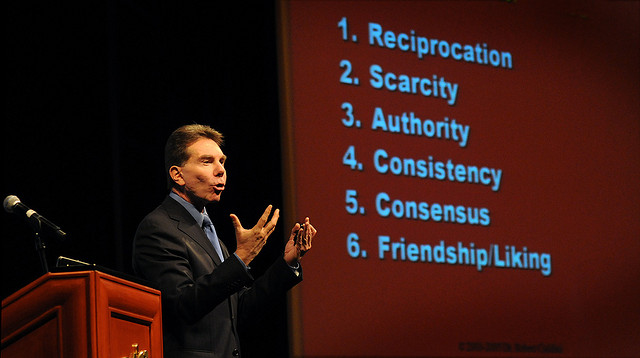
Robert Cialdini Explains: How Can Social Science Inform Policy?
 On November 12, 2013, Dr. Robert Cialdini, Dr. Arthur Lupia, representatives from 16 current congressional offices, two former Members of Congress, and representatives from 21 academic and social and behavioral science organizations met for a lively discussion on Capitol Hill on how psychology can be used to inform government policy. The event was organized by the Division of Behavioral and Social Science and Education, one of the five divisions of the National Research Council, as part of their important initiative “Social and Behavioral Sciences in Action.”
Renowned psychology scholar and bestselling author Robert Cialdini gave a presentation that explained the social factors that lead to behavior change. His six universal principles of social influence – including reciprocation, scarcity, authority, friendship/liking, commitment/consistency, and consensus, can be (and have been) successfully applied to new policy as it is implemented publicly. Dr. Cialdini provided several compelling and even surprising examples (see slides above) such as implementing new health care, energy, and power policy.
Dr. Cialdini’s presentation was followed up by remarks made by former Representatives Brian Baird (D-WA) and Nancy Johnson (R-CT) who acknowledged the invaluable insight offered by social and behavioral scientists for policy and successful persuasion in general. Following these remarks, political scientist Arthur Lupia led a question-and-answer session for the 19 congressional staff in attendance about how they can apply these important findings in their work.
“What does social science tell us about how policy should be improved? It’s not just common sense. Common sense often sends you the opposite direction,” stated Representative Baird. “The surprising findings from the social sciences, by contrast, save time and money.”
To find out more about this SAGE-sponsored event, please click here.





























































































I am looking for other Mental Health settings that have incorporated Cialdini’s Principles.