What Do Academia’s Ubiquitous Rankings Accomplish?
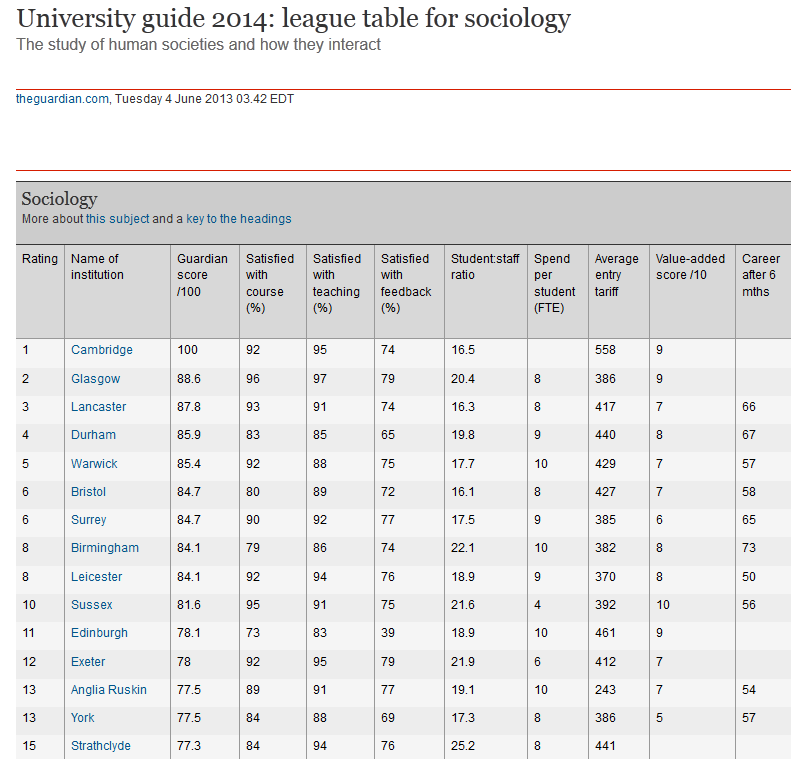
The top 15 universities for sociology this year, according The Guardian, are …
In The Guardian’s university league table for sociology, Cambridge was the best place to study sociology in 2014, and it also was ranked right at the top of the hierarchy for 2015. Manchester rose from 20th to second, Birmingham dropped from 8th to 11th, and Salford improved its ranking from second-last to 57th place. Meanwhile, in The Complete University Guide’s sociology ranking, Birmingham retained 19th place, the London School of Economics dropped from eighth to 18th, Salford rose from 54th to 44th, and Cambridge also came out at the top. The QS ranking for 2014’s global top universities for sociology listed the LSE in fifth place. Cambridge found itself in 12th place, Manchester came 14th, and Essex occupied the 24th rank.
The Social Science Citation Index ranks academic publications. According to its website, it allows its users to “overcome information overload and focus on essential data from the world’s leading journals. Many of my colleagues tell me that they will not publish in journals that are not included in the Social Science Citation Index, as doing so may spell trouble when they are audited by their employers or other professional bodies. Thomson Reuters, the publisher of the SSCI, also published a Journal Citation Report. On its website, the purpose of this report is described as follows:
The recognized authority for evaluating journals, JCR presents quantitative data that supports a systematic, objective review of the world’s leading journals. Using a combination of impact and influence metrics, and millions of cited and citing journal data points that comprise the complete journal citation network of Web of Science™, JCR provides the context to understand a journal’s true place in the world of scholarly literature.
Academic journals also often make it easy for readers to assess their status within a discipline, by advertising their impact factors and position in intra-disciplinary rankings. So, for example, Acta Sociologica reports an impact factor of 0.714, and the journal’s website states that it is ranked 83th among 139 sociology journals. Contributions to Indian Sociology has an impact factor of 0.148 and finds itself in 125th place. Cultural Sociology’s impact factor is 0.391, and the journal is ranked 106th in sociology.
Where Do You Stand?
Academic labor is undergoing fundamental changes. The socio-economic collapse of 2008 has accelerated the pace at which universities are being transformed. In the new academia, how do now seemingly ubiquitous rankings shape the way we work? Why does it matter whether you study or work at the sociology department that comes first, 12th or 89th in a ranking? Why does it matter whether the journal you publish in is included and ranked in a certain index, or not? Is academia becoming more hierarchical? Let us know your thoughts on the role (or rule) of ranking in the academic world by contributing to our open forum, with responses appearing on Social Science Space. Send your written opinion to Daniel Nehring at dfnehring@googlemail.com.
As an individual sociologist, you may also find that you are frequently ranked. Your publications may be indexed and listed according to the frequency with which they are cited or other ways in which they have had an impact on the academic community or other professionals. If you publish a book, it will acquire a sales ranking at online bookshops, such as Amazon, and this will determine how prominent a place it will occupy in those shops’ sales listings. Your teaching is routinely rated by your students on various scales, and your managers will perhaps use your scores to rank you among your colleagues and determine how good a teacher you are.
Many of these ranking systems seem to be fairly new. As far as I know (please do correct me if I am wrong), the impact factor was developed in the 1970s. However, intense attention to bibliometrical rankings appears to be far more recent. Teaching evaluations have become a mainstay of British higher education perhaps within the past decade and a half, and so forth. For most of their history, the work of sociologists and academic labor at large do not seem to have been driven by rankings in the way they are today.
So why are all these rankings important, and what do they accomplish? There has been intense debate about these questions for a long time, of course. Equally, rankings have been criticized on a variety of methodological, conceptual, and political grounds. (For example, take a look here, here, here, here, and here.) Why does it matter whether you study or work at the sociology department that comes first, 12th or 89th in a ranking? Why does it matter whether the journal you publish in is included and ranked in a certain index, or not? What are the consequences of the ubiquity of rankings for the politics of academic labour today? What consequences might it have, in particular, for sociology as an academic discipline?
These are questions which I would like to consider in some detail in my following posts. Academia is undergoing fundamental changes, which have been accelerated by the political responses to the economic collapse of 2008. The place which sociology will occupy within this re-modeled academic world is not at all clear – and perhaps it is not even certain whether sociology will have a place at all! The trend towards ubiquitous rankings offers, in my view, insights into the new shape of academia, and it suggests important questions as to sociology’s standing. This is why I believe that this topic deserves renewed attention.