President Signs Bill on Evidence-Based Policy
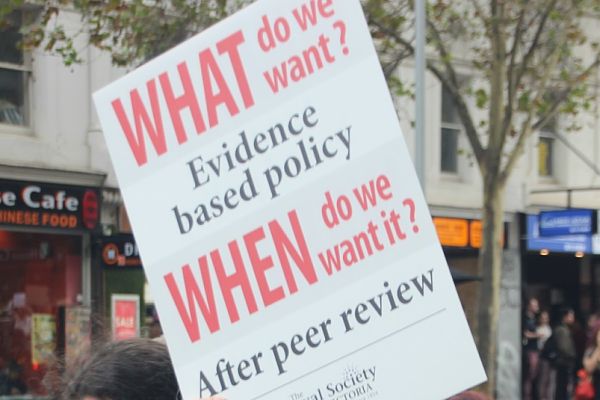
In what’s been billed as “the first step in a longer process of ensuring the government is fully invested in using science to improve the effectiveness of its operations,” on January 14 President Trump signed the Foundations for Evidence-Based Policymaking Act of 2018.
The legislation, according to the White House, “improves evidence-based policy through strengthening Federal agency evaluation capacity; furthering interagency data sharing and open data efforts; and improving access to data for statistical purposes while protecting confidential information.”
The bill was unusual in the current political climate – it was a genuinely bipartisan effort. The original bill was sponsored in 2017 by former Republican Speaker of the House Paul Ryan of Wisconsin and Democratic Senator Patty Murray of Washington state in response to the final report of the Commission on Evidence-Based Policymaking. (Other sponsors included Republicans Trey Gowdy and Blake Farenthold and Democrats Derek Kilmer and Brian Schatz.) Approved by the House on November 15, 2018, and the Senate on December 19, the House cleared the Senate-approved version of the bill on December 21.
The act does not enact all of the report’s recommendations – that’s a bridge too far at the moment – but it does require federal agencies to create an evidence-building plan, designate a ‘chief evaluation officer’ and establish advisory committees on data for evidence building. All of this will be folded into a government-wide plan administered by the Office of Management and Budget.
Of particular interest for researchers, it also mandates that agencies comply with Kilmer and Schatz’s OPEN Government Act, creating a ‘chief data officer’ and inventory their non-confidential data resources and publish the resulting catalog of those datasets in a machine-readable format. The law requires agencies to streamline the application process for outside researchers accessing federal data and to set uniform regulations across the agencies for meeting security needs.
And while some conservative groups argue the intent is to “steal the privacy of ordinary citizens,” the act also calls for ensuring the security of federal data and the privacy of individual information by reauthorizing the Confidential Information Protection and Statistical Efficiency Act. For a full examination of the law’s impact, we recommend this analysis by the Bipartisan Policy Center.
“The overarching message of this bill,” reports the Consortium of Social Science Associations, “is that agencies need to reframe their approach to evaluation and evidence building from an activity that is conducted ad hoc to an ongoing process integrated into the everyday operations of federal programs. COSSA hopes this shift in thinking will provide more opportunities for social scientists from across the disciplines to contribute their expertise to improving the work of government.”