

Could Distributed Peer Review Better Decide Grant Funding?
The landscape of academic grant funding is notoriously competitive and plagued by lengthy, bureaucratic processes, exacerbated by difficulties in finding willing reviewers. Distributed […]
Behavioral economics as a practice is here to stay, suggests a new report. Whether it remains a separate discipline or is absorbed by the other social sciences remains an open question.

Isabel Sawhill and Ron Haskins, says a colleague, ‘have forged a unique and powerful intellectual partnership at Brookings, founding and then elevating the Center on Children and Families and producing world-class work on families, poverty, opportunity, evidence, parenting, work, education, and plenty more besides.’ Watch their Moynihan Lecture here..
Chinese President Xi Jinping stressed the primacy of philosophy and social science in building a strong China, but he also said the disciplines must retain and enhance ‘Chinese characteristics’ like Marxism in the process.
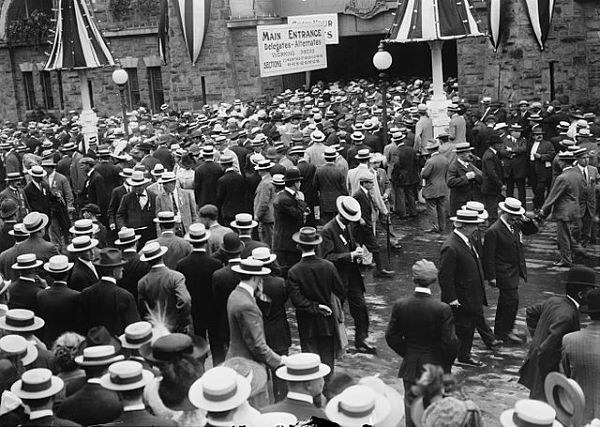
As Amefrcans do every four years after the process ends, we will ask the question whether this is the best way to choose nominees to lead the United States?

Even if you say you don’t mind the government knowing what you do on social media, recent research suggests you tamp down your own opinions when reminded of the possibility of being found out.
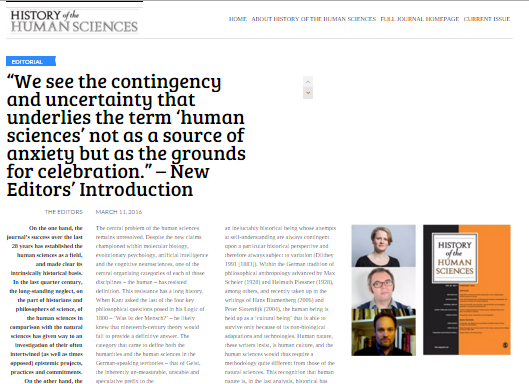
While many academic journal websites are mostly repositories for their digital archives, the interdisciplinary journal History of the Human Sciences has unveiled a […]

Our goal, say the supporters of the #WomenAlsoKnowStuff database of female political scientists, is to amplify the voices of women in the discipline and in the public eye.

Even as it insists it’s not really saying anything new, the American Statistical Association Board of Directors has laid down a marker in the debate over what constitutes “statistical significance.”
Jürgen Habermas, a globally known social theorist whose explorations of democracy, validity and communication have gained new prominence in the current moment, […] People often see science as a world apart: cool, rational and untouched by persuasion or performance. In this view, scientists simply discover […] “Research impact” means different things to different people. Some refer broadly to how science changes behaviors, beliefs, or practices outside academic institutions. […] David Canter considers informal places where people socialize, suggesting they’re an arena ChatGPT and other LLMs can’no’t replicate. As someone who lives […] It’s become cliche since Clive Humbly coined it in 2006, but data is indeed the new oil. It’s a mantra repeated by […] In September 2025, The Guardian reported about a lawyer in Australia having faced sanctions due to false citations. These citations were not […]
EXPLORE
Impact

Jürgen Habermas, 1929-2026: Exponent of the Public Sphere
READ MORE

Scientists Should Keep in Mind It’s Called the ‘Marketplace of Ideas’ for a Reason
READ MORE

Survey Finds Social Scientists Feel Unsupported in Seeking Societal Impact
READ MORE
Innovation

Reaching Parts to Which AI Has No Access
READ MORE

Andrea Medina-Smith on Making Research Data More FAIR
READ MORE

A Status Check on Hallucinated Case Law Incidents
READ MORE