



Could Distributed Peer Review Better Decide Grant Funding?
The landscape of academic grant funding is notoriously competitive and plagued by lengthy, bureaucratic processes, exacerbated by difficulties in finding willing reviewers. Distributed […]
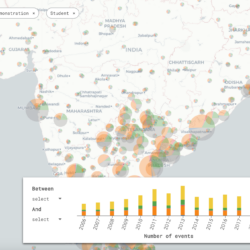
The European Research Center is funding the Global Contentious Politics Dataset, or GLOCON, a state-of-the-art automated database curating information on political events — including confrontations, political turbulence, strikes, rallies, and protests

With research-based evidence increasingly being seen in policy, we should acknowledge that there are risks that the research or ‘evidence’ used isn’t suitable or can be accidentally misused for a variety of reasons.

Overton spoke with Jonathan Breckon to learn about knowledge brokerage, influencing policy and the potential for technology and data to streamline the research-policy interface.
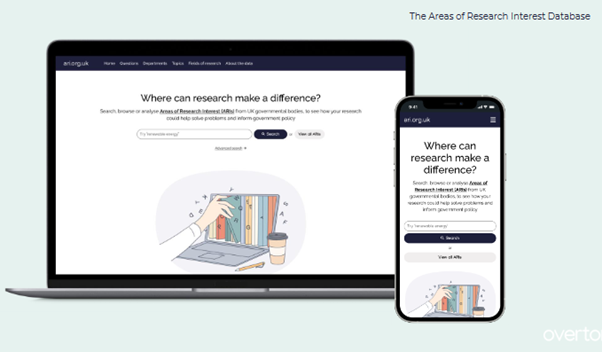
Kathryn Oliver discusses the recent launch of the United Kingdom’s Areas of Research Interest Database. A new tool that promises to provide a mechanism to link researchers, funders and policymakers more effectively collaboratively and transparently.

According to the National Science Foundation, the percentage of American adults with a great deal of trust in the scientific community dropped […]

A new Information Literacy Microsite from sage can be your new home for pressing research on the digital age and the ways to combat mis-, dis-, and misinformation.

Over a 10-year period Carol Tenopir of DataONE and her team conducted a global survey of scientists, managers and government workers involved in broad environmental science activities about their willingness to share data and their opinion of the resources available to do so (Tenopir et al., 2011, 2015, 2018, 2020). Comparing the responses over that time shows a general increase in the willingness to share data (and thus engage in Open Science).

To address racial and ethnic inequalities in the U.S. criminal justice system, the National Academies of Sciences, Engineering and Medicine just released “Reducing Racial Inequality in Crime and Justice: Science, Practice and Policy.”

The Royal Swedish Academy of Sciences has awarded this year’s Nobel Prize in Economic Sciences to the American economists Robert E. Hall […] Four Americans working in the social and behavioral sciences are among the 20 people named MacArthur Fellows this year. Recipients may be […] Euan Adie, the founder of Altmetric and later of Overton, discusses the reasons the led to Overton’s focus on showing researchers how […] The following is an adapted extract from The Cultural Industries, fifth edition, by David Hesmondhalgh. The increasing presence of information technology (IT) […] Developers of AI data centers have a public trust problem. According to multiple surveys, a majority of Americans say they would oppose […] I was adding some final flourishes on the topic of ‘iatrocracy’ to my forthcoming book with Natewindé Sawadogo – Sickness and Social […]
EXPLORE
Impact

Economic Peaks, Troughs and This Year’s Nobelists in Economics
READ MORE

Four From Social Science World Receive 2026 MacArthur Fellowships
READ MORE

Quick Insight: Euan Adie on Getting Academics Credit for Their Impact
READ MORE
Innovation

IT Giants and Their Operations: Should We Be Concerned?
READ MORE

What We Miss When We Study Public Trust with Surveys Alone
READ MORE

AI and ‘Iatrocracy’ – A Cautionary Tale
READ MORE