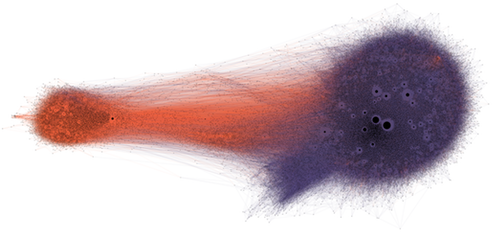

Could Distributed Peer Review Better Decide Grant Funding?
The landscape of academic grant funding is notoriously competitive and plagued by lengthy, bureaucratic processes, exacerbated by difficulties in finding willing reviewers. Distributed […]

A new machine learning tool can detect and classify different strengths of Islamophobic hate speech on Twitter. Bertie Vidgen and Taha Yasseri explain their processes in creating a new tool that detects Islamophobic hate speech on Twitter.

Researchers asked science communicators what they need to know about their audiences. Age, education, gender and economic, educational, cultural and ideological background were typical answers. But to really know your audience, those are just a starting place.

Turnitin and similar programs don’t deal with the causes of plagiarism. Rather, argue Amanda Mphahlele and Sioux McKenna, they allow institutions to claim they’re doing something without really tackling the issues that lead students to plagiarize.
The social science community has a large stake in the accuracy of the U.S. Census for the community’s contued research. Here, law professor Jonathan Entin discusses the legal controversy swirling around the impact a question on citizenship has on the census, something the U.S. Supreme Court is hearing about this week.

The ‘replication crisis’ certainly is uncomfortable for many scientists whose work gets undercut, and the rate of failures may currently be unacceptably high. But psychologist and statistician Eric Loken argues that confronting the replication crisis is good for science as a whole.
Plan S focuses on making all publicly funded research immediately fully and freely available by open access publication. If Australia does not adopt Plan S, the authors argue, it could potentially restrict collaboration, publishing, and funding opportunities with research bodies who subscribe to this ambitious movement.

A text analysis of nine years of grant abstracts submitted to the NSF indicated that what researchers say and how we say it can foretell the amount of funding we are awarded. They also show that the writing funders idealize may not always match up with what they actually prefer.

Isolation and loneliness, as opposed to solitude, seem to the be the lot of many midern researchers. Research shows that 40 percent of academics, and more than half below the age of 35, view isolation at work as the main factor affecting their mental health. And many academics turn to counselling to learn ways to cope with emotional distress.
Jürgen Habermas, a globally known social theorist whose explorations of democracy, validity and communication have gained new prominence in the current moment, […] People often see science as a world apart: cool, rational and untouched by persuasion or performance. In this view, scientists simply discover […] “Research impact” means different things to different people. Some refer broadly to how science changes behaviors, beliefs, or practices outside academic institutions. […] David Canter considers informal places where people socialize, suggesting they’re an arena ChatGPT and other LLMs can’no’t replicate. As someone who lives […] It’s become cliche since Clive Humbly coined it in 2006, but data is indeed the new oil. It’s a mantra repeated by […] In September 2025, The Guardian reported about a lawyer in Australia having faced sanctions due to false citations. These citations were not […]
EXPLORE
Impact

Jürgen Habermas, 1929-2026: Exponent of the Public Sphere
READ MORE

Scientists Should Keep in Mind It’s Called the ‘Marketplace of Ideas’ for a Reason
READ MORE

Survey Finds Social Scientists Feel Unsupported in Seeking Societal Impact
READ MORE
Innovation

Reaching Parts to Which AI Has No Access
READ MORE

Andrea Medina-Smith on Making Research Data More FAIR
READ MORE

A Status Check on Hallucinated Case Law Incidents
READ MORE