
Could Distributed Peer Review Better Decide Grant Funding?
The landscape of academic grant funding is notoriously competitive and plagued by lengthy, bureaucratic processes, exacerbated by difficulties in finding willing reviewers. Distributed […]

As the educational reading landscape shifts to digital, Naomi Baron argues we must find proven strategies to help students become more aware of the best ways to read and study online – especially as regular printed textbooks gradually begin to disappear.
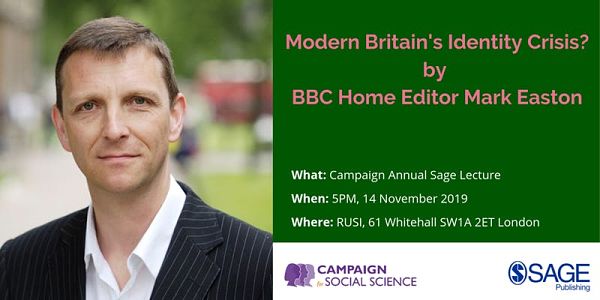
Journalist Mark Easton will address “Britain’s Modern Identity Crisis” as the the Campaign for Social Science hosts the annual SAGE Publishing Lecture. The lecture takes place on November 14 in London. For more information, or to view the prog
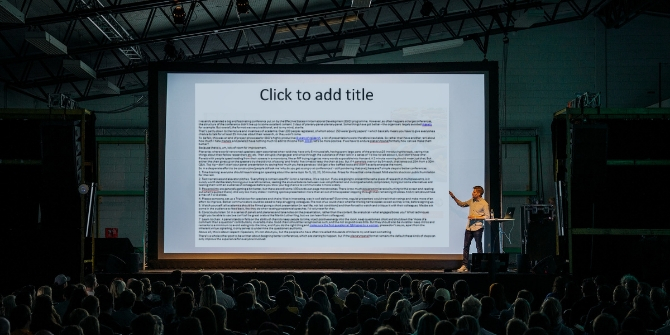
The default format for most academic conferences is a plenary followed by panel presentations. If we can’t revolutionize conference design, we can at least consider Duncan Green’s seven tips for improvement (electric shocks optional).

Twitter, Instagram, Facebook and other social media platforms are sometimes dismissed as distractions for students. But they’re also avenues for scientific communication. Scientists are active on social media, discussing everything from methods to the latest developments in research. They even use social media to raise funds…
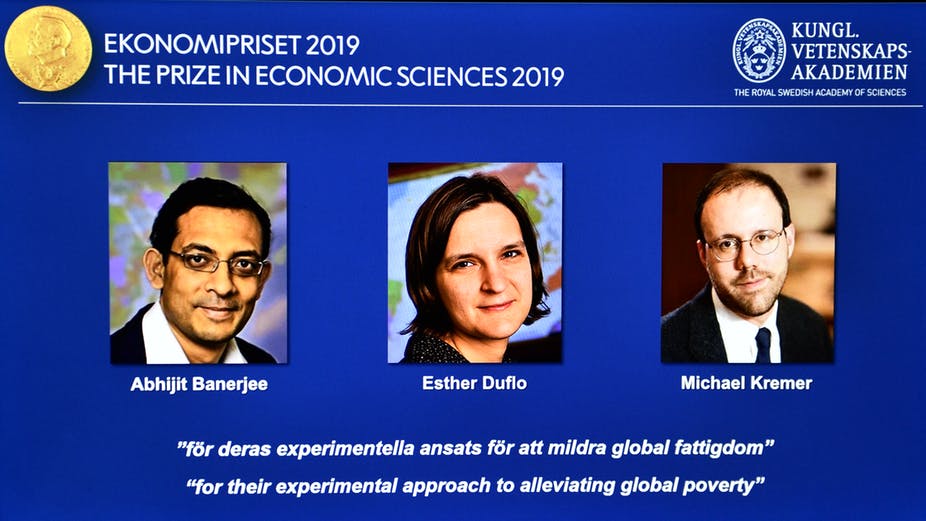
The Sveriges Riksbank Prize in Economic Sciences in Memory of Alfred Nobel 2019 (commonly known as the Nobel Prize for Economics) has been awarded to Abhijit Banerjee, Esther Duflo and Michael Kremer “for their experimental approach to alleviating global poverty.” Through the award, the Nobel committee recognized both the significance of development economics in the world today and the innovative approaches developed by these three economists.

Images tap into attitudes, but not always in the same way for every viewer. An image’s perceived level of influence is based on “believability.” This is the idea that it is true if we agree, fake if we disagree. And it is here that the power of images intersects with the great challenge of the digital age. How do we understand politics, fake news, campaigning, and citizenship in an area dominated by images?
With the advent of the new Research on Research Institute, our Robert Dingwall notes that while research on research fills a gap in the world of knowledge. However, it is important not to confuse it with the research enterprise itself or to assume that this will benefit from being made so planned, rational and evidence-based that the result is to squeeze innovation out of the system.
As part of a SAGE project to demonstrate, measure and promote this impact, we’re looking for short write-ups from members of the social science community that we can share widely to make the case that our disciplines routinely provide knowledge that can be used to improve the human condition.

Euan Adie, the founder of Altmetric and later of Overton, discusses the reasons the led to Overton’s focus on showing researchers how […] Here’s a couple of quick questions for you. What is the smallest of the eight discipline-based directorates at the United States’ National […] Sage’s 10-Year Impact Awards recognize academic papers appearing in Sage-published journals that have achieved lasting impact. The winning papers are the most […] I was adding some final flourishes on the topic of ‘iatrocracy’ to my forthcoming book with Natewindé Sawadogo – Sickness and Social […] How is AI changing the shape and space of higher education? Critical thinking continues to rank highly among key skills and attributes […] My colleagues and I recently spoke with a group of talented, interesting students who just completed their first year of college about […]
EXPLORE
Impact

Quick Insight: Euan Adie on Getting Academics Credit for Their Impact
READ MORE

NSF’s Embattled SBE Directorate Shown as Agency’s Policy Heavyweight
READ MORE

Sage’s 10-Year Impact Awards Capture Longer-Term Significance
READ MORE
Innovation

AI and ‘Iatrocracy’ – A Cautionary Tale
READ MORE

The Critical Student: How GenAI Reshapes Critical Skills and Higher Education’s Role Preparing Students For It
READ MORE

AI Doesn’t Drive Student Cheating. It Just Hitches a Ride
READ MORE