What You See is Not What You Get: Photo-Elicitation’s Missing Arts-based Elements
In this post, co-authors Georgia Stavraki and Ioanna Anninou, both at University of Surrey, reflect on their research article “Arts-based methods in business education: A reflection on a photo-elicitation project,” published in Management Learning.
The value of arts-based methods in business schools is well established and relates to the experiential learning nature of such methods, such as for instance cultivating and generating soft skills and mindsets required for effectively dealing with complex business contexts. Arts-based methods also relate to distinctive learning benefits, such as reflexive and critical thinking that effectively engage students and create inclusive and meaningful learning opportunities. Such evidence alongside the centrality of experiential learning methods in higher education motivated us to employ an arts-based method, i.e. photo-elicitation, in an undergraduate Consumer Behaviour module. Photo-elicitation is a qualitative methodology that uses photographs (which are produced by students in the discussed context) to elicit implicit meanings, feelings, and abstract thoughts, and then explores such insights in interviews.
Even though photo-elicitation has been widely employed and investigated in business and marketing education, current discussions about photo-elicitation as a learning and teaching tool downplay the underlying value of photo-elicitation’s arts-based origins in (experiential) learning processes. In other words, current approaches of the photo-elicitation method focus primarily on the method’s learning processes and outcomes without questioning or explaining how such processes and outcomes arise. Moreover, our encounters with students during their progression with the photo-elicitation project that took place in the aforementioned module and the submitted final assignment made us feel that the arts-based origins of the photo-elicitation method are disclosed in students’ encounters with the method.

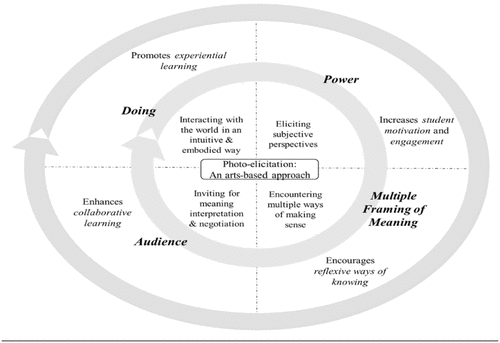
In this context, in our paper ‘Arts-based methods in business education: A reflection on a photo-elicitation project” in Management Learning, we bring to the fore under-theorized arts-based elements, i.e. doing, power, multiple framing of meaning, audience, of the photo-elicitation method. Specifically, we provide a conceptualization of photo-elicitation as an (experiential) learning and teaching tool which shows the interaction between photo-elicitation’s arts-based elements and relevant learning processes and outcomes.
For instance, doing refers to experiential aspects of taking a photograph, through which a student discloses moments of awareness about an experience. This active engagement also manifests the element of power, which allows for discovering idiosyncratic encounters with an experience. Multiple framing of meaning refers to a reflexive exploration of such subjective meanings and feelings evoked in photographs. Finally, audience refers to viewers’ encounters with photographs and the collaboration with their group members for exploring the meanings shown in photographs. We also offer insights into students’ encounters with the photo-elicitation method, namely performances through which students experience the photo-elicitation method and learn through it.
Our paper summarizes overlapping stages of an arts-based research process, as they have been identified in various studies, yet they have not been synthesized and explored within a learning and teaching context. Thus, we offer a) novel insights into the pedagogy of the photo-elicitation method (e.g. insights into the implementation of photo-elicitation as an arts-based method), and b) implications that enrich the teaching practices of business educators by illustrating photo-elicitation’s arts-based capacity to allow for various learning opportunities that develop competencies essential for a business curriculum.